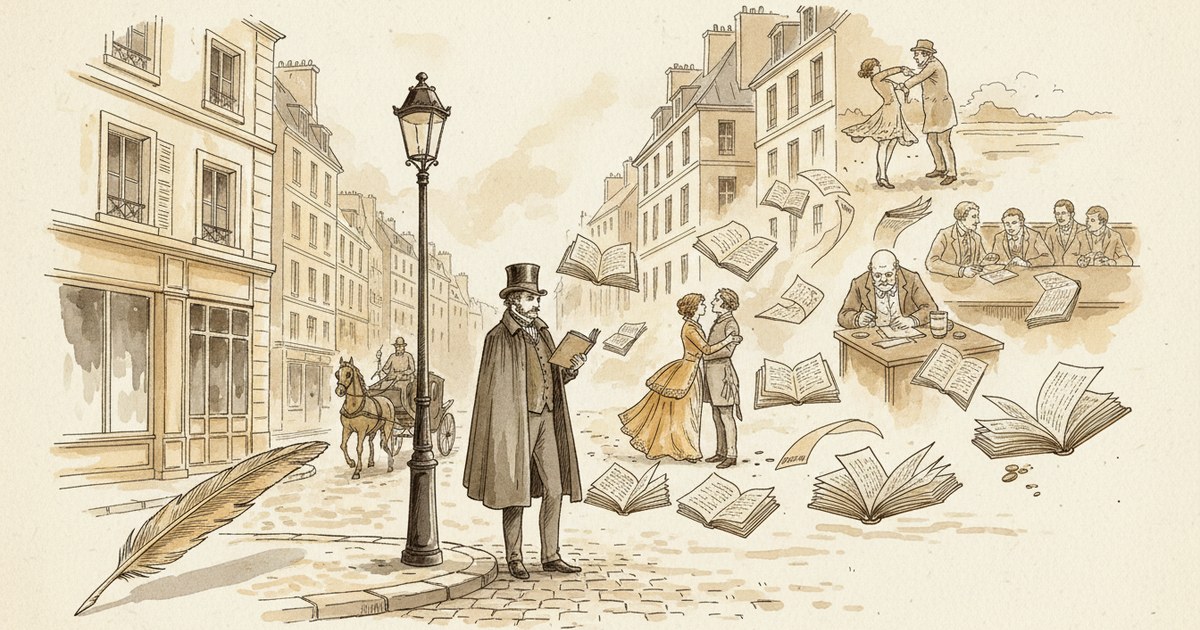
The story opens mid-heist. Arsène Lupin, locked in a first-class compartment somewhere between Paris and Le Havre, has just introduced himself to a woman who doesn’t yet know she’s travelling with the most wanted man in France. He’s charming. He’s precise. He steals her jewellery, returns it, and walks off the train into legend. Maurice Leblanc wrote that scene in 1905 for Je Sais Tout magazine, and French readers understood immediately that they were dealing with something new — not a villain, not quite a hero, but a category of one.
For English-language readers coming to Lupin fresh, the first question is always the same: where do I start? The canon runs to dozens of novels and story collections, translated across more than a century by hands of wildly varying skill and intention. Some editions drop chapters. Some flatten Leblanc’s comic timing into prim Edwardian prose. Some modernise so aggressively that the Belle Époque atmosphere — which is half the point — evaporates entirely. The answer, if you want the real Lupin, is The Extraordinary Adventures of Arsène Lupin, Gentleman Burglar. It’s where Leblanc invented him, and it’s where this translation delivers him most faithfully.
This isn’t arbitrary. Gentleman Burglar is a short-story collection, which means it functions as a perfect pressure test: each story is self-contained, the register stays consistent, and you can feel Leblanc discovering the character’s possibilities in real time. By the final story, where Lupin goes head-to-head with a thinly disguised Sherlock Holmes — renamed “Herlock Sholmes” after Conan Doyle lodged a formal complaint — the character has fully crystallised. The thesis Leblanc was working toward since that train compartment is complete: the criminal is the most interesting man in the room, and the detective is always one step behind.
The Journalist Who Built a Myth
Maurice Leblanc was forty years old when he wrote “The Arrest of Arsène Lupin,” and he had spent two decades failing at the thing he actually wanted to do. He’d published novels. He’d written naturalist fiction in the manner of Zola. None of it caught. He was a working journalist in Paris when the editor of Je Sais Tout commissioned him to write a gentleman-thief story — the kind of summer entertainment the magazine needed. Leblanc said yes and produced something that changed his life entirely.
The journalism background matters for how the book reads. Leblanc had spent years writing to deadline for a general audience, learning to hook readers fast, cut anything that didn’t advance the story, make every line of dialogue do double work. You feel this in the pacing of the Lupin stories, which are ruthlessly economical. The opening of “The Queen’s Necklace” drops you into a drawing room with a mystery already unsolved — no stage-setting, no atmospheric throat-clearing. The journalist’s discipline shaped the prose before Leblanc even knew he had a character worth protecting.
Leblanc grew up in Rouen in a bourgeois family that had seen better days — a detail that explains Lupin’s particular class consciousness. Lupin steals from the aristocracy with a precision that reads less like crime and more like redistribution. He’s not a romantic outlaw; he’s a man who understands exactly how inherited wealth works and finds the whole apparatus slightly absurd. Writing him, Leblanc was drawing on a France that had just lived through the Dreyfus Affair, that still organised itself around the polite fictions of class. Lupin punctures those fictions with a lockpick and a calling card.
By the time Conan Doyle protested the use of Sherlock Holmes in the final story of this collection, Leblanc had already understood the size of what he’d built. He spent the next three decades writing nothing but Lupin — more than a dozen novels, several story collections, a character who outlasted everything else he ever made. What started as a summer commission became the frame around an entire life’s work. The character stole its author, and Leblanc never seemed to mind.
Nine Cases That Invented the Gentleman Thief
The nine stories in Gentleman Burglar aren’t arranged chronologically in Lupin’s life — they’re arranged by escalation. Leblanc is testing what his character can do, story by story, raising the stakes each time. In “Arsène Lupin in Prison,” Lupin orchestrates a jewel theft from inside his own cell, communicating through the personal columns of a newspaper. It’s a locked-room problem inverted: the criminal is the one who’s locked in, and he still wins. The story works because Leblanc withholds the mechanism until the last possible moment — and when he reveals it, the explanation is so simple you feel briefly embarrassed for the police.
The range of the collection makes the argument. Leblanc moves from the intimate (the train compartment, a single stolen necklace) to the operatic (Lupin manipulating an entire investigation from his cell). What stays constant is the voice: dry, precise, amused by its own cleverness. In “The Seven of Hearts,” a man discovers his apartment has been used as the staging ground for a crime he didn’t commit. The story turns on a detail so small — a playing card left on a mantelpiece — that a less confident writer would have signalled it three paragraphs earlier. Leblanc leaves it until it detonates.
The Herlock Sholmes story deserves special attention because it’s doing something beyond entertainment. Leblanc sets up the most famous detective in European fiction and then has Lupin beat him — not through violence or luck, but through superior attention. Lupin has read the situation more completely. This is Leblanc making a claim about what his character represents: not anti-social disorder, but a different and sharper way of seeing. The detective restores the status quo. The thief reveals that the status quo was always a construction.
The collection is also an argument about complicity. Leblanc gives Lupin a moral code — he doesn’t hurt people, he doesn’t steal from those who can’t afford the loss, he has something like honour — and this is precisely the mechanism by which the reader is recruited. You’re not watching a villain. You’re watching a man you quietly want to win. Leblanc discovered in 1905 what crime fiction has been trading on ever since: the reader’s desire to be on the wrong side of the law, safely.
The Translation Landscape
The original public-domain translation by Alexander Teixeira de Mattos, published in 1907, is the version most readers have encountered without knowing it — it’s the text that circulates on Project Gutenberg and populates most cheap print-on-demand editions. Teixeira de Mattos was a competent translator working fast for a commercial market, and his version has real virtues: it preserves the period register, and some of his rendering of Lupin’s dialogue captures the drawling self-confidence that makes the character work. But it was produced in a hurry, and it shows. The comic timing occasionally misfires. Certain passages read as if the translator had the dictionary in one hand and the manuscript in the other, and the seams are visible.
Penguin Classics has published Lupin material in various configurations, generally with more editorial care and useful introductions that situate Leblanc in the French popular tradition. The limitation is tonal inconsistency across volumes — different translators handle the same character differently, and what reads as wry elegance in one story can drift into stiffness in another. For a short-story collection where register is everything, that drift is a real problem. Other recent translations from independent presses have tried to modernise the prose, sometimes successfully, more often at the cost of the Belle Époque specificity that makes Leblanc’s world a place rather than a backdrop.
The central challenge for any Lupin translator is Leblanc’s comic rhythm. His sentences build and release in a particular way — information is withheld, then delivered with a timing that depends on sentence length and syntactic weight. In the arrest scene on the train, Lupin’s self-introduction moves as a series of short declarative clauses that accelerate. A translation that smooths those clauses into flowing English loses the staccato confidence that defines the man. This translation preserves that rhythm — the sentences carry weight where they need it and move fast where they don’t, and Lupin sounds like himself throughout.
Why This Translation?
What this edition gets right is the balance between period authenticity and readability. This translation doesn’t modernise Lupin — it doesn’t sand down the Belle Époque edges to make him feel more contemporary — but it also doesn’t produce a museum piece. The prose breathes. When Lupin speaks, he sounds like a man who has thought faster than everyone else in the room and found the gap quietly amusing. That quality is Leblanc’s central achievement, and it’s the first thing to go when a translation gets either too cautious or too free. This one holds the line.
The Classics Retold edition includes all nine original stories, unabridged, in a clean format designed for the kind of reading Leblanc intended: fast, pleasurable, slightly conspiratorial. If you want to understand why Arsène Lupin produced imitators across a century — why his DNA runs through everything from the caper film to the prestige heist series — start here. The paperback is available on Amazon. The man who invented the gentleman criminal deserves to be read in a translation that takes him seriously.
Is Arsène Lupin suitable for younger readers?
The stories are appropriate for confident teenage readers and up. Lupin’s crimes are elegant rather than violent — no one gets hurt, and the moral stakes are more about wit than menace. The stories were originally published in a general-interest magazine designed for a broad French readership, and they read that way: accessible, fast-moving, and more interested in cleverness than darkness. The class commentary runs underneath everything, but it’s light enough that a younger reader can enjoy the surface and a more experienced reader can engage the argument.
Do I need to read the Lupin stories in order?
No. Each story in Gentleman Burglar is self-contained — they were published as standalone magazine pieces, and the internal chronology is deliberately loose. You can read them in any sequence. That said, reading them in the order presented in this edition gives you the specific pleasure of watching Leblanc test and extend his character story by story, which is its own kind of experience. The progression from the train compartment to the Herlock Sholmes confrontation has a shape to it, even if Leblanc wasn’t planning it that way from the start.
How does Arsène Lupin compare to Sherlock Holmes?
They share a creator’s logic: both are defined by superior attention, by the capacity to read a room more completely than anyone else present. But where Holmes restores order, Lupin subverts it, and the Leblanc stories are built on that distinction. The final story in this collection, where the two characters meet directly, is the sharpest expression of what separates them — Lupin wins not because he’s more powerful, but because he’s playing a different game. Holmes represents the rule of law. Lupin represents the argument that the rules were written by people with something to protect.
Is this a complete translation of the original French collection?
Yes. This translation covers all nine stories from the original 1907 French collection, Arsène Lupin, gentleman-cambrioleur, unabridged. Some earlier English editions omitted stories, condensed chapters, or combined volumes in ways that distorted Leblanc’s original structure and pacing. This edition presents the collection as Leblanc assembled it — the order, the escalation, and the progression from the opening train story to the Herlock Sholmes confrontation are all intact, as he left them.
Recommended Edition
ARSÈNE LUPIN – Gentleman Burglar — Maurice Leblanc
The title of the most famous crossover in detective fiction is, technically, a lie. Arsène Lupin contre Herlock Sholmès does not feature Sherlock Holmes. Conan Doyle’s lawyers made sure of that. But Maurice Leblanc’s barely-disguised stand-in — same deductive genius, same Baker Street address, same pipe — loses. Comprehensively. The English detective, transplanted to French soil, is outmaneuvered, outcharmed, and ultimately made to look slightly ridiculous by a man who picks pockets the way other people shake hands. That reversal is the whole point. And whether an English translation captures it determines whether you are reading one of the cleverest acts of literary larceny ever committed — or just another adventure story in a frock coat.
The problem with translating Leblanc is that Lupin is not primarily a plot. He is a register. He speaks the way someone performs rather than converses — every sentence slightly too polished, every confession slightly too candid, every apology a small act of aggression. He is not witty the way drawing-room comedy is witty. He is witty the way a card sharp is witty: the smile is real, but you are already losing. A translation that flattens that tone into ordinary swashbuckling has missed the character entirely.
What Leblanc Was Actually Doing
Leblanc came to Lupin sideways. In 1905 he was forty-one, two decades into a literary career that had produced carefully crafted psychological novels in the vein of Maupassant — and almost no readers. The commission that produced Arsène Lupin, gentleman-cambrioleur was, by his own account, purely mercenary. The character was supposed to be a quick magazine piece. Instead it became a thirty-six-year obligation he could never discharge. “Lupin has pursued me for thirty years,” he said late in his life. “I would very much like to have been able to devote myself to other things.”
That reluctance left a mark on the writing. Leblanc is doing several things simultaneously in the Lupin stories, and translation that misses the layers reduces them to entertainment in the most impoverished sense. There is obvious adventure, yes. But there is also sustained literary parody — of Conan Doyle, of the gentleman-rogue tradition, of French bourgeois respectability — and a particular kind of anarchic joy in watching a man systematically dismantle systems designed to contain him. Lupin is not admirable in the conventional sense. He is more interesting than that: he is the reader’s guilty pleasure made flesh, the id in a top hat. The prose must hold that tension without collapsing it into simple roguishness.
The Translation Landscape
The early English translations of Leblanc — many dating from the 1910s — are public domain, freely available, and uneven in ways that matter enormously. The most widely circulated versions, often attributed to translators like Alexander Teixeira de Mattos, were produced in an era when French popular fiction was routinely domesticated for English audiences: simplified, occasionally bowdlerized, and sometimes edited to tighten plots that Leblanc (a meticulous plotter who occasionally overbuilt his mechanisms) had constructed for a French magazine-reading rhythm. These versions are not useless, but they often sound like Victorian adventure fiction translated from the French, which creates a tonal problem — Lupin’s Frenchness is part of what he is, and an English that erases it erases the joke.
The specific challenge in the Holmes crossover book is tonal balance. When Lupin and Herlock Sholmès share scenes, the prose has to carry two incompatible registers simultaneously: the English detective’s cool forensic certainty and the French thief’s theatrical improvisation. In French, this contrast is built into the syntax — Leblanc writes Sholmès in a style that is subtly more rigid, more methodical, than the fluid ironies he gives Lupin. Translations that miss this and render both characters in the same English register lose the central comedy. The whole book is about a clash of national sensibilities as much as a clash of characters, and the English must render that visible.
More recent translations, produced by translators working with greater linguistic self-consciousness, handle this better. The best current versions understand that Lupin’s dialogue requires a lightness that is difficult to achieve: too formal and he sounds pompous; too colloquial and he sounds common. The register that works is something like extremely well-mannered insolence — the politeness of someone who doesn’t need to be rude because they’ve already won. The Classics Retold edition of Arsène Lupin Against Herlock Sholmes goes after that register specifically, preserving the syntactic playfulness of Leblanc’s French without making the English feel imported.
What to Look for in Any Edition You Choose
The opening chapters are your test. In the French, Leblanc establishes Lupin’s voice within three paragraphs: a combination of apparent confession, theatrical self-awareness, and absolute confidence that the reader is already on his side. A translation that gets this right will have you smiling by the end of page one — not at a joke, exactly, but at a tone, a posture, a way of holding the world at arm’s length while pretending to embrace it. A translation that gets it wrong will have you reading competent adventure fiction that doesn’t explain why anyone bothered with this character for a century.
Also watch the interrogation scenes. When the police question Lupin — which happens more often than you might expect, since he occasionally allows himself to be caught for reasons of his own — the dialogue carries enormous weight. His answers must be simultaneously truthful and deceptive, self-incriminating and exculpatory, earnest and mocking. These scenes are where Leblanc’s structural intelligence shows most clearly, and where translation failures are most damaging. If the dialogue sounds merely clever, the translation is underperforming. It should sound dangerous.
For the Holmes crossover specifically: attend to how the English detective is rendered. Leblanc is not simply mocking Conan Doyle. He is engaging with the Holmes tradition seriously enough to understand what makes the character compelling — and then showing why that mode of intelligence is insufficient for dealing with Lupin. A translation that renders Sholmès as a buffoon misses the point. A translation that renders him as a proper threat, only to have Lupin outmaneuver him through means that are genuinely surprising, gets it right. The English detective must be formidable. Otherwise Lupin’s victory is meaningless.
Recommended Edition
Arsène Lupin Against Herlock Sholmes — Maurice Leblanc
If you haven’t met Lupin yet, start with Arsène Lupin, Gentleman Burglar rather than the Holmes crossover. The short story format suits Lupin’s mode of operation — each story is a complete heist, elegantly set up and executed, with a reversal in the final pages that earns its place precisely because Leblanc has been pointing at something else the entire time. The stories build a character through accumulation rather than backstory: by the end of the collection you understand who Lupin is not because he has explained himself but because you have watched him operate across a dozen different registers. That is how good popular fiction works, and Leblanc does it with the efficiency of someone who has no intention of being caught wasting your time.
The Classics Retold edition of the first collection preserves the story structure and the tonal range, including the shifts between Lupin’s chapters and the chapters narrated by characters who are trying, and failing, to understand what just happened to them. That narrative doubling — seeing the heist from inside Lupin’s world and then from outside it — is where much of the comedy lives, and it requires a translation that can modulate between Lupin’s self-regarding certainty and the bewildered competence of his observers. Both are present in the Classics Retold edition.
This post contains affiliate links. As an Amazon Associate, we earn from qualifying purchases.
What is the best English translation of Arsène Lupin?
There is no single canonical “best” translation — the field is divided between older public-domain versions (readable but often tonally domesticated) and newer translations that work harder to preserve Leblanc’s register. The key test is Lupin’s dialogue: it should sound simultaneously polished and dangerous, not merely charming. The Classics Retold edition of the first collection and the Holmes crossover handles this balance well for contemporary readers.
Did Sherlock Holmes actually appear in a Maurice Leblanc novel?
Not under that name. The character in Arsène Lupin contre Herlock Sholmès (1908) is named “Herlock Sholmès” — Conan Doyle’s estate objected to the use of the real name, so Leblanc made the rename official. The character is otherwise transparently Holmes: same Baker Street address, same deductive method, same pipe. He loses, which was rather the point of the exercise.
Is the Lupin Netflix series based on these books?
Loosely. The Netflix series Lupin (2021) features a protagonist inspired by the Leblanc character but does not directly adapt the novels — it is a contemporary thriller built around the mythology of Lupin rather than a straight adaptation. If you come to the books via the series, expect something more playful and formally structured than the show’s thriller mode.
Where should I start with Arsène Lupin?
Start with Arsène Lupin, Gentleman Burglar, the first short story collection. It introduces the character across eight distinct heists, each structurally different, and establishes the voice and the rules of Lupin’s world. The Holmes crossover, while the most famous entry, assumes some familiarity with Lupin and benefits from being read second.
D’Artagnan is forty years old, still wearing the same sword, and going nowhere fast. Twenty years after he rode into Paris desperate and penniless and helped save a queen’s honor, he holds a modest rank in the king’s musketeers and no real prospect of advancement. Cardinal Mazarin, the new power in France, barely acknowledges him. Athos has retreated to a country estate. Porthos married a rich widow and is getting fat. Aramis is plotting something ecclesiastical that nobody fully understands. The band that swore “all for one, and one for all” has scattered into middle age, and Dumas opens this sequel by showing us exactly how ordinary heroism looks with the shine worn off.
The thesis of Twenty Years After is not a comfortable one: loyalty is not enough. The France of 1648 is fracturing along the fault lines of the Fronde — a civil war pitting the parliament and the old nobility against Cardinal Mazarin’s government — and when d’Artagnan and Porthos are recruited by Mazarin to suppress it, they discover that Athos and Aramis are fighting on the other side. Four men who swore a blood oath are now, quite literally, pointing weapons at each other. Dumas doesn’t flinch from the arithmetic. He doesn’t rescue the motto. He asks what it costs when everything your younger self believed turns out to be context-dependent.
This is also why the book surprises readers who come expecting a swashbuckling encore. The action is here — duels, prison breaks, a desperate crossing to England where the four attempt and fail to save Charles I from the executioner’s block — but the engine running underneath is not adventure. It’s the question of what four men owe each other when their loyalties have diverged and two decades have made strangers of them. That tension doesn’t resolve cleanly, and Dumas is honest enough not to pretend it does.
The Novelist Who Raided History and Called It Research
Alexandre Dumas was born in 1802 in Villers-Cotterêts, the son of a Napoleonic general and the grandson of an enslaved Haitian woman and a French marquis. He grew up in a household that had known genuine military glory and then watched it evaporate — his father died young, the family money followed, and Dumas was left with a name that opened some doors and a racial heritage that closed others. He spent his early adulthood copying manuscripts in Paris for the Duc d’Orléans, reading voraciously, writing plays that started to succeed. By his thirties he was one of the most famous writers in France. By his forties, one of the most famous in Europe. He never stopped writing long enough to be careful with money, which meant he never stopped needing to write.
That biographical fact — the constant financial pressure, the factory-pace output — matters more than it sounds when you’re reading the Musketeer novels. Dumas didn’t write Twenty Years After as a considered return to beloved characters. He wrote it because the first book had created a demand and he had the material, the collaborator (his research partner Auguste Maquet handled the historical architecture), and the creative energy to go deeper into people he already knew. What looks like a sequel is actually a reckoning. A writer who understood what it meant to have been young and ambitious and to have ended up somewhere more complicated was precisely the right person to put d’Artagnan at forty and ask him what the oath is worth now.
His outsider relationship to French aristocratic culture shapes the novel’s politics in ways that are easy to miss. Dumas understood the Fronde — the revolt of the nobles and the Paris parliament against royal authority — not as a history lesson but as a drama about who gets to claim legitimacy. He was sympathetic to all sides and fully loyal to none, which is precisely how the novel handles its factions. Athos and Aramis fight for the Fronde’s ideals of aristocratic independence. D’Artagnan and Porthos serve the crown out of pragmatism and personal loyalty to a young king. Nobody is simply right. That moral ambiguity didn’t come from academic study; it came from a man who had spent his life reading the room in rooms where he was not quite supposed to be.
The sheer scale of Dumas’s output — enough text in a lifetime to fill a hundred volumes, produced partly through collaboration — has given literary history an excuse to underrate him. The factory model, the serial publication, the hired research: critics used all of it to suggest he wasn’t quite serious. What they missed is that the serial form didn’t dilute his instincts; it sharpened them. His ear for the chapter-ending hook, for the scene that arrives at precisely the right moment to reset the emotional stakes, for the beat of comedy that makes the next beat of consequence land harder — all of that is craft. Twenty Years After is a long novel that never feels long. That’s not an accident of plot mechanics. It’s a writer who knew exactly what he was doing.
What the Motto Costs When You’re Forty
The structural gamble of Twenty Years After is that Dumas gives you two hundred pages to watch d’Artagnan try to reassemble something that doesn’t want to be reassembled. Athos, now the Comte de la Fère, has turned quieter and more principled with age — no longer the elegant drunk of the first novel but something closer to a moral philosopher, and he has decided that Mazarin’s France is not worth his sword. Porthos is cheerfully uncomplicated; he wants a title and will fight whoever Athos tells him to fight. But even Porthos has a dignity now, a settled bourgeois comfort that makes his eventual return to violence feel genuinely costly. Aramis is the most transformed of all, and Dumas handles him with deliberate opacity. You never quite know what Aramis wants. That’s the point. The man who was always plotting something has become entirely plot.
The English section of the novel — where the four travel to London in a last-ditch attempt to prevent the execution of Charles I — is the emotional core and the moral hinge. They fail. They watch the king die. And in the aftermath, Dumas pulls off something genuinely strange: he makes that failure feel like the truest thing in the book. Four men at the height of their powers, fully reunited, working together with the old fluency — and it isn’t enough. History doesn’t care about competence. It doesn’t reward loyalty. It proceeds on its own logic, and the best you can manage is to have been there, to have tried, to survive the attempt. D’Artagnan walks away from the scaffold carrying knowledge he can’t unfeel. The motto still exists. It just means something different now.
The comedy — which is everywhere in the first novel — is still present here. Porthos’s vanity, Aramis’s ecclesiastical maneuvering, d’Artagnan’s constant calculation of every room he enters: Dumas doesn’t abandon the tonal register that made the original beloved. But the jokes now sit against darker material, and he doesn’t flag the transition. You laugh, and then three pages later someone is making a decision about which side of a civil war they’re on, and the novel treats both moments with equal seriousness. That tonal management — the refusal to signal when to feel what — is what separates Twenty Years After from the pulp adventure novel it superficially resembles. Dumas understood that life doesn’t come with emotional stage directions. Neither does the book.
The Translation Landscape
The available English translations of Twenty Years After sort into two distinct categories: Victorian and modern, and the gap between them is wide. The Victorian translations — most of which have circulated since the 1840s and form the basis of most free ebook versions — are readable in the way that all Victorian prose is readable: steadily, with patience, and with the understanding that characters “exclaim” things every four pages. The dialogue has the cadence of stage melodrama. The humor, which in Dumas depends on precise timing and the dry aside, reads as broad farce. Characters who should feel caustic come across as merely fussy. These translations aren’t wrong, exactly. They’re translations of a different era’s idea of what a French novel should sound like in English.
Lawrence Ellsworth’s modern translation, published by Pegasus Books in 2021, is a significant step forward. Ellsworth is a committed Dumas scholar — he also translated The Red Sphinx — and his prose has the rhythm of contemporary English without losing period flavor. The dialogue breathes. D’Artagnan’s sardonic edge comes through. If you want a single modern translation with scholarly notes and a reliable introduction to the historical context of the Fronde, Ellsworth is the serious choice. The trade-off is apparatus: the notes and supplementary material can interrupt the reading experience for someone who wants the novel and nothing else, and the physical volume is substantial.
The Classics Retold edition prioritizes pace over philology. Where Ellsworth is attentive to the texture of the French and to the specific weight of a word Dumas chose, this translation keeps its eye on momentum. The scene in which d’Artagnan first visits Athos at his country estate — finding him transformed, quieter, at a remove from everything they once shared — lands here as a revelation compressed into a single paragraph rather than a gradual accumulation of detail. That’s a translation choice. It’s the right one for a reader who wants to feel what the novel is doing before analyzing how it does it.
Why Read This Translation?
Twenty Years After is not a short book, and the version you read shapes the experience considerably. The Victorian translations that dominate free ebook platforms preserve the story but muffle its timing. The Ellsworth translation is authoritative and thorough. The Classics Retold edition is the one to reach for if you want the novel at full speed — the chapter-ending hooks working as designed, the tonal whiplash between comedy and consequence landing cleanly, and the precise moment when d’Artagnan realizes that the oath is not what he thought it was arriving without prose getting in the way. It makes the argument for Dumas that Dumas always deserved.
This translation is available in paperback on Amazon, and it’s the edition worth keeping on the shelf. Not because it’s the only serious modern translation, but because it reads the way Dumas wrote: fast, committed, and with the understanding that the real subject of the novel is not adventure but what happens to men who were built for crisis once the crisis is over. You can find it here. The chapter where the four men stand at the scaffold in London — reunited at last, and helpless — is alone worth the price of admission.
Is Twenty Years After as good as The Three Musketeers?
Different, and in some ways more interesting. The first novel is a masterpiece of momentum — it almost never slows. Twenty Years After is more deliberate, more interested in what middle age does to men who were built for crisis. It asks harder questions and doesn’t answer them cleanly. Readers who want the pure kinetic energy of the original may find it more demanding; readers who want to understand what Dumas was actually arguing about loyalty, time, and political reality will find the sequel indispensable to the first.
Do I need to read The Three Musketeers before starting this one?
Yes, and it’s not a hardship. Dumas assumes familiarity with the characters, the shape of their original adventure, and the relationships that make the eventual fracture feel costly. Coming to Twenty Years After cold means missing the weight behind every reunion scene. Read the first novel, then read this one immediately after. The gap between them — what happened in those twenty years, what it did to four people — is the subject of the book.
What is the Fronde, and how much historical background do I need?
The Fronde was a series of civil conflicts in France between 1648 and 1653, pitting the parliament and the nobility against Cardinal Mazarin and the regency government of Anne of Austria. Dumas explains enough in the novel that a reader with no prior knowledge can follow the political stakes. A brief skim of the basics before you start will sharpen the reading — knowing that the Fronde actually happened, and roughly how it ended, makes Dumas’s moral ambiguity feel pointed rather than vague. He’s not inventing complexity. He’s finding it in the record.
Is this a faithful translation of the original French?
The Classics Retold edition is a modern English translation that prioritizes readability and pace. It renders Dumas’s French accurately while making choices — favoring an English idiom that carries the right weight over a more literal equivalent — that serve the reading experience. Readers who want a translation with extensive scholarly apparatus and closer philological attention should consider the Ellsworth edition alongside this one. Readers who want to be inside the novel, carried by it, will find this translation does exactly that.
In Père Goriot, there is a moment near the end when the old man is dying in a rented room and his two daughters — both wealthy, both dressed for a ball — do not come. He has given them everything, divided his fortune between them over decades, melted down his wife’s silverware to fund their social climbing, and now he is calling for them from a filthy cot in the Maison Vauquer while his fellow boarders listen through the wall. Balzac does not editorialize. He simply records it. That restraint is the whole point: the scene is so precisely observed that no commentary could improve it.
Balzac spent his entire career arguing one thesis, and he spent it with the obsessive patience of a scientist: money is not a backdrop to human life in modern society — it is the structure of it. Every relationship, every marriage, every act of generosity or cruelty, runs on an economic logic that most people pretend isn’t there. His great cycle, La Comédie Humaine, built from nearly a hundred novels and stories over three decades, is the most sustained attempt in literary history to map exactly how capital shapes character. To read him is to have that argument made on you — not explained, but demonstrated, scene by scene, until you cannot stop seeing it.
The Balzac Collection, Volume 1 brings together key works from across that cycle in a modern English translation that renders his prose with the speed and clarity it deserves. This is not a difficult author made accessible — Balzac was always a popular novelist, read on train journeys and in drawing rooms, and the best translations honor that velocity. What this edition gives you is a Balzac who moves.
The Man Who Owed Everyone and Understood Everything
Honoré de Balzac was born in Tours in 1799, the son of a civil servant who’d reinvented himself after the Revolution, and he spent most of his adult life in a state of catastrophic debt. This is not incidental. By his mid-twenties he had launched a printing business that collapsed, leaving him with obligations that would take the rest of his life to service. He wrote to pay them down. He wrote at night, by candlelight, sustained by coffee, sometimes eighteen hours at a stretch, producing at a pace that still seems physically impossible. Between 1829 and 1850 he published roughly ninety novels and novellas. The debt was the engine.
What that situation gave him — besides the obvious urgency — was an encyclopedic, visceral, firsthand knowledge of how money moves. He knew creditors, bailiffs, moneylenders, notaries, speculators. He understood the specific humiliation of owing a small sum and the specific freedom of owing a large one. When he writes a character calculating whether an inheritance can be leveraged against a debt to fund a marriage that will unlock a better inheritance still, he is not imagining that calculation. He is writing it from memory. The moral architecture of La Comédie Humaine rests on a foundation of personal embarrassment that he converted, methodically, into social theory.
He was also a compulsive observer of surfaces. The cut of a coat, the quality of a carpet, the precise age at which a Parisian woman’s face begins to show the cost of her ambitions — Balzac catalogued these things the way a naturalist catalogues specimens. He had read his Geoffroy Saint-Hilaire and took seriously the idea that the social world obeyed laws as deterministic as those governing animal species. The title La Comédie Humaine was a deliberate echo of Dante, but the project was more Linnaean than theological: a complete taxonomy of the human types produced by post-revolutionary French society, organized by milieu, class, and appetite.
He died in 1850, a few months after finally marrying the Polish countess he had courted for nearly two decades. He was fifty-one. Victor Hugo, who visited him in his final hours, wrote that he died “at the moment when he was beginning to see the infinite.” The remark is characteristically Romantic and characteristically beside the point. Balzac had been seeing the infinite — the infinite calculation behind every social gesture — since his first debt came due.
What a Hundred Characters Chasing the Same Thing Looks Like
The novels collected in Volume 1 operate as Balzac’s clearest demonstration of his thesis. Père Goriot is the keystone: a Lear transposed to a boarding house, organized around the question of what a father’s love costs when it is expressed entirely in money. Eugène de Rastignac arrives in Paris from the provinces, naive and ambitious, and watches Goriot — a former pasta merchant who made his fortune during the revolutionary grain shortages — unmake himself in real time for daughters who have learned to see him only as a source. The novel ends with Rastignac standing over Goriot’s pauper’s grave, looking down at the lights of Paris. “Now it’s just the two of us,” he says to the city. He has understood the lesson.
That lesson is not cynical, exactly — or rather, it is not only cynical. What makes Balzac so difficult to dismiss is that he renders the characters who are destroyed by the economic logic of his world with the same precision he uses for the ones who master it. Goriot is not a fool. He is a man whose love took the only form available to him, and that form had a price. The novel doesn’t argue that he should have loved differently. It argues that a society organized around inheritance and social position will extract exactly this price from exactly this kind of love, reliably, every time.
Eugénie Grandet, also in this volume, turns the same lens on provincial wealth. Grandet is a miser — but again, not a cartoon. He is a man in whom the logic of capital has replaced every other instinct so completely that the reader watches it happen with something closer to horror than contempt. When Eugénie’s cousin arrives from Paris and she gives him her gold — her entire hoard, her only inheritance — the gesture is simultaneously the most generous act in the novel and a sentence she will spend decades serving. Balzac does not editorialize here either. The trap closes on her slowly enough that you can see every individual mechanism.
The shorter pieces in the collection extend the argument into new registers — satire, grotesque, near-farce. Balzac understood that the same economic logic that produces tragedy in a boarding house produces comedy in a notary’s office, and he moved between modes without losing the analytical thread. The cumulative effect of reading these works together, as this edition allows, is not exhaustion but accumulation: you begin to see the architecture he was building, the recurring characters who drift between novels, the social world that coheres across hundreds of pages into something with the density of lived experience.
The Translation Landscape
Balzac has been translated into English continuously since the 1830s, and the range in quality is enormous. The Victorian and Edwardian versions — Ellen Marriage’s translations for Dent, many of which circulate freely on Project Gutenberg — have a certain period charm but impose a rhetorical heaviness that muffles Balzac’s pace. His sentences move fast and hit hard; the older translations tend to drape them in subordinate clauses and careful qualification, producing a Balzac who reads like a man speaking very slowly in a crowded room. These versions have their place as historical documents. They are not the versions to read.
The Penguin Classics edition of Eugénie Grandet, translated by M.A. Crawford, is more serviceable — accurate, competent, the kind of translation that does its job without calling attention to itself. The Oxford World’s Classics Père Goriot, translated by Olivia McCannon, is genuinely strong: she handles the novel’s tonal shifts well and resists the temptation to soften Balzac’s blunter passages. Burton Raffel’s Modern Library translations have their advocates — he’s a skilled literary translator and the prose reads cleanly — though some critics find that his choices occasionally smooth away the roughness that gives Balzac his sociological texture, the sense of a narrator who is also, always, a witness.
The Classics Retold edition approaches the problem differently. Where older translations treated Balzac’s density as something to be managed — parceled out carefully, with footnotes — this translation treats it as velocity. The prose in the Goriot boarding house scenes reads with the compression of a short story; the longer descriptive passages move without the feeling of obligation that can make Victorian-era Balzac translations feel like inventory lists. A key test passage is the introduction of the Maison Vauquer at the opening of Père Goriot — a sustained catalog of décor and smell that establishes the moral atmosphere of the entire novel. In older translations it tends to read as scene-setting. Here, it reads as evidence: every detail placed like an exhibit in a prosecution.
Why This Translation?
The practical answer is that this edition gives you the most important works in a single volume, in prose that doesn’t ask you to fight it. Balzac should feel urgent. He should feel, at moments, like someone explaining something important that everyone around you has agreed not to say. The Classics Retold edition of The Balzac Collection, Volume 1 produces that experience. You can find it on Amazon — the paperback is here — and for a reader coming to Balzac for the first time, it is the right starting point: enough of the cycle to understand what he was building, in a translation that moves at his actual speed.
The deeper reason is that Balzac is one of the few nineteenth-century novelists whose central argument gets more accurate as time passes. The society he was mapping — built on inherited capital, on the marriage market as a financial instrument, on the way that money determines not just what you do but who you are permitted to become — did not end in 1850. It reconfigured. Rastignac’s challenge to Paris from the edge of a pauper’s grave still lands because the city he was addressing is still standing, still lit, still making the same demands. A translation that lets you feel the urgency of that challenge is not a luxury. It is the minimum requirement.
What books are included in The Balzac Collection, Volume 1?
Volume 1 centers on the foundational novels of La Comédie Humaine, including Père Goriot and Eugénie Grandet, along with shorter works from the cycle. Together they represent Balzac’s core argument about money, ambition, and social structure in post-revolutionary France.
Do I need to have read Balzac before to enjoy this collection?
No. Père Goriot is the standard entry point to La Comédie Humaine for good reason: it introduces the recurring character of Rastignac and states Balzac’s thesis as clearly as he ever states it. Starting here, with this collection, is the standard approach.
How does Balzac compare to other 19th-century French novelists like Flaubert or Zola?
Flaubert is more controlled and more self-consciously literary; Zola more systematically naturalistic. Balzac is faster and messier than either — more interested in the mechanics of money than in style, more willing to let a scene run past elegance in order to land its point. The three are often read together as a sequence, but Balzac comes first chronologically and argumentatively.
Is this a good edition for book clubs?
Yes, particularly for groups interested in the relationship between literature and economics, or in how social class operates. Père Goriot and Eugénie Grandet both turn on decisions that are easy to identify and hard to judge cleanly, which generates better discussion than novels with cleaner moral lines.
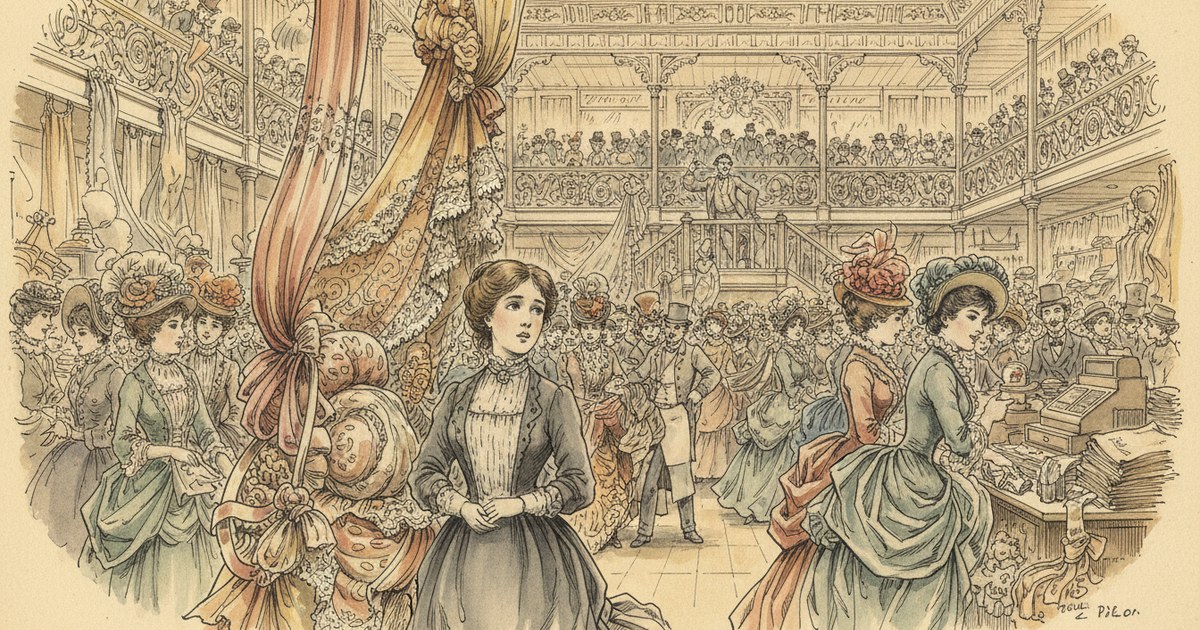
The department store at the center of Émile Zola’s novel keeps expanding. It absorbs the shops around it one by one — the old linen draper, the umbrella seller, the glover — not through violence but through the simple logic of scale. Lower prices. More variety. Better light. The neighbors don’t lose in a fight. They just become irrelevant. By the time Denise Baudu understands what she’s watching, the old Paris she arrived in is already gone.
Au Bonheur des Dames, published in 1883, is the eleventh novel in Zola’s twenty-volume Rougon-Macquart cycle — and the one that cuts deepest precisely because the monster at its center isn’t monstrous. The Ladies’ Paradise is beautiful. It smells like silk and new wood. Women lose hours inside it the way gamblers lose hours at tables, pulled forward by the next counter, the next display, the arrangement of goods designed to make leaving feel like an act of will. Zola’s thesis is stark and he never blinks from it: modern capitalism doesn’t conquer through force. It seduces. And seduction is harder to resist than force, because part of you wants to be conquered.
That’s not a metaphor Zola decorates the novel with. It’s the novel’s skeleton. Every scene — the silk hall, the white sale, the ruined competitors dying by inches across the street — builds the same argument: that the old intimate economy of Paris, where a shop owner knew your name and your mother’s name, could not survive contact with a system that replaced knowing with spectacle. Denise’s uncle Baudu watches from across the street as his customers vanish. He understands exactly what’s happening. Understanding changes nothing.
The Writer Who Took Notes Before He Took Sides
Zola spent months inside Le Bon Marché before he wrote a scene. He took notes on the floor plans, the staff hierarchies, the exact choreography of a seasonal sale — who stood where, how goods were arranged to create movement, what the light looked like through the new plate-glass windows. He interviewed shop girls and department heads and recorded the store’s revenue figures. When Mouret orchestrates his famous white sale in the novel, flooding every floor with white goods until the building itself seems to exhale fabric, the scene works because Zola had watched the real thing happen. The Naturalist novel, as he conceived it, was supposed to function like a scientific experiment: set your conditions, observe without flinching, record what you find. What he found at Le Bon Marché disturbed and fascinated him in equal measure.
He was born in Paris in 1840 but grew up in Aix-en-Provence after his father — a civil engineer who had come to build a dam — died when Zola was seven, leaving the family in debt. Economic precarity was not abstract to him. When he returned to Paris as a young man and took a series of low-paying jobs before landing work in publishing, he was one bad month away from being the people he would later write about: the shop girls sleeping four to a room on the upper floors, the small merchants watching their margins compress year by year until there was nothing left to compress. That proximity shows in every page of this novel. Its most unflinching passages are not the ones that condemn the store — they are the ones that show why the store’s logic is irresistible even to people it is in the process of destroying.
By the time Zola reached Au Bonheur des Dames, he had published ten novels in the Rougon-Macquart cycle and had the confidence to let his antagonist be genuinely attractive. Earlier installments had more legible villains — drunkenness in L’Assommoir, mining capitalism as open predation in Germinal. Here the antagonist is an idea, and Zola’s achievement is making you understand the people who embody it without excusing them. Mouret, the founder of the Ladies’ Paradise, is brilliant, charming, and not entirely wrong about the world he’s building. He provides economic footing to hundreds of women who would otherwise have none. He also weaponizes their desire and discards them when they age out of usefulness. Zola holds both facts simultaneously and refuses to resolve the tension, which is why the novel reads as urgent rather than dated.
Three years before the Dreyfus Affair would make him the most famous writer in France — before the open letter that would land him in London rather than a prison cell — Zola was already practicing the art of confronting a structure larger than any individual. The interesting question, he understood, was never whether the department store was good or bad. It was whether anything could stop it, and whether stopping it was something a reasonable person would actually want.
The Architecture of Desire
The Ladies’ Paradise opens when Denise Baudu arrives in Paris from the provinces to work for her uncle, a linen draper whose small shop sits directly across the street from the expanding store. She is poor, she is capable, and she is the only character in the novel who manages to look at the Ladies’ Paradise with clear eyes — which means she sees both what it costs and what it offers. When she applies for work there, the novel’s central tension arrives without fanfare: she knows what the store is doing to her uncle, and she takes the job anyway, because the alternative is worse. Zola doesn’t belabor this. He lets the logic speak for itself.
The novel moves through the store’s seasonal events, each bigger than the last. The white sale — a February promotion that floods every department with white goods, linens, lace, curtains, wedding dresses — is the centerpiece, and Zola’s account of it is one of the most precise renderings of spectacle-as-manipulation in nineteenth-century fiction. The goods aren’t simply displayed; they’re arranged to generate movement, to steer customers forward while letting them believe they’re choosing their own path. “The selling machine,” Mouret explains to a visitor with genuine pride, “is a machine for making women spend.” He says it without embarrassment. He means it as a technical observation. The chill of the passage comes from the fact that he’s correct.
What saves the novel from becoming a polemic is Denise. She rises through the store’s hierarchy not by becoming compliant but by being genuinely good at her job and genuinely resistant to the logic that demands her availability. Mouret becomes fixated on her — and this is the novel’s sharpest irony — partly because she won’t yield. He has built a machine for generating desire and the one person who refuses to operate by its rules is the one he cannot stop thinking about. The personal story and the economic argument converge without feeling schematic: the thesis about seduction applies equally to commerce and to love, and Zola lets them illuminate each other without collapsing the distinction.
The small merchants across the street die slowly and without drama. Baudu, Denise’s uncle, is the novel’s most heartbreaking figure — not because he is heroic, but because he is entirely correct in his analysis and entirely powerless in his response. He knows what the store is doing. He watches from his window as his customers stop crossing the threshold. He stays — not out of delusion but out of a loyalty that Zola treats as grief rather than stubbornness. There is no catharsis for Baudu. The novel doesn’t offer him one.
The Translation Landscape
The two English translations most readers are likely to encounter are Brian Nelson’s for Oxford World’s Classics (1995) and Robin Buss’s for Penguin Classics. Nelson brings genuine scholarly apparatus — careful notes, a considered introduction that frames the novel within the Rougon-Macquart project — and his prose is clean and accurate. His caution becomes a liability in the store’s great set-piece descriptions. The white sale sequence in the original French has a headlong, accumulative quality that edges into overwhelm; Nelson renders it faithfully but with enough restraint to deflate the excess Zola needs you to feel. The store should make you dizzy. In Nelson’s version, it is vivid and informative.
Buss’s Penguin version moves faster and takes more risks with idiom. He had a genuine feel for nineteenth-century French realism — his Balzac is consistently strong — and the character scenes are livelier for it. Where Buss is less sure-footed is in the passages where Zola’s prose leans into something close to dream logic: the moments when the store stops being a setting and becomes a force of nature. The modern English translation in this edition is built around exactly those moments. The opening sequence — Denise’s first sight of the Ladies’ Paradise from the street — holds the dazzle and the menace in the same breath. The white sale overwhelms. The scenes in Mouret’s office carry the weight of what is actually at stake. Where the older translations treat the store as background, this translation treats it as pressure.
Why This Translation?
Any translation of Au Bonheur des Dames has to decide how much to implicate the reader in the store’s seductions. This is the novel’s central formal problem: Zola wants you to feel the pull before you understand what’s pulling you, because that’s how the thing actually works. A translation that keeps its scholarly distance is telling you about the store rather than putting you inside it. This edition makes the choice to go inside — the silk halls feel like silk halls, the seasonal sales feel like events you could lose an afternoon to — without sacrificing the precision of the passages where Zola is most openly analyzing what he’s built. Readers who want comprehensive scholarly apparatus should reach for Nelson. Readers who want to understand why this novel was a sensation in 1883 and still reads as urgent should start here.
The paperback edition is available on Amazon. For readers new to Zola, this is the entry point that makes the Rougon-Macquart cycle feel like a living project rather than a monument to be admired from a distance. For readers who’ve spent time with the older translations and found them dutiful rather than propulsive, the difference is apparent within the first chapter. The novel that mapped modern capitalism before the word “consumer” existed deserves a translation that can still catch you off guard.
Is The Ladies’ Paradise part of a series?
Yes. It is the eleventh of twenty novels in Zola’s Rougon-Macquart cycle, which traces one family across the Second French Empire. Each novel stands alone — The Ladies’ Paradise requires no prior knowledge of the cycle — but readers who enjoy it often move to Germinal, Nana, or L’Assommoir, which apply the same relentless sociological attention to different corners of French society.
Do I need to read the other Rougon-Macquart novels before this one?
No. Zola designed each novel to function independently. Characters from other volumes occasionally appear, but The Ladies’ Paradise introduces everyone you need. It is, if anything, one of the more accessible entries in the cycle — Zola is at his most novelistic here, letting character and setting carry the argument rather than front-loading the naturalist apparatus.
How does The Ladies’ Paradise compare to Germinal?
Germinal is more violent and more explicitly political — Zola at his most operatic. The Ladies’ Paradise is subtler and in some ways more unsettling, because the enemy is not a mine owner with an armed guard but a system that feels like progress. Both novels are essential. Most readers find The Ladies’ Paradise the easier starting point, and it makes Germinal hit harder when you get there.
Is this novel still relevant today?
The department store Zola described was the Amazon of its era — a platform that aggregated everything, undercut everyone, and made its own convenience feel like a natural condition rather than a design decision. The mechanisms Mouret uses to manufacture desire are still in use, refined over 140 years into something more precise and less visible. The novel is not an allegory. It is a description of a system that never stopped running.
The bottle came out of a shark’s stomach. That is where the story starts — not in a parlor, not at a dockside farewell, but in the gut of a predator pulled aboard a Scottish yacht in 1867. Inside: a fragment of paper in three languages, seawater-blurred, carrying the last known coordinates of a ship called the Britannia and the name of its captain, Harry Grant. The latitude survives. The longitude does not. Two children are waiting somewhere in Scotland, and their father has been missing for two years.
What follows is a chase around the 37th parallel — through the drought-cracked pampas of Patagonia, the convict roads of colonial Australia, the trembling volcanic coastline of New Zealand — conducted on the logic that one intact number might be enough to find a man alive. It shouldn’t be enough. The children, Mary and Robert Grant, believe it will. Jules Verne, who was writing this novel while his own son was being committed to a reform school against the boy’s desperate protests, understood something about the particular anguish of hope that refuses to become reasonable.
Jules Verne published Les Enfants du capitaine Grant between 1867 and 1868. The Victorian-era English translations that followed were cut, condensed, and stripped — the scientific digressions gutted, the children reduced to props, the expedition’s emotional logic traded for forward momentum. What remained was adventure without interiority. This modern English translation restores what those editions discarded: a novel that moves between expedition thriller and a precise, unsentimental study of what children are capable of believing about the people they love.
The Man Who Sent His Characters Everywhere He Couldn’t Go
Verne was born in 1828 in Nantes, a port city that put ships in his eyeline from childhood and geography in his bones. His father, a successful lawyer, expected him to follow into the profession. Verne followed as far as Paris, enrolled in law school, and immediately started writing plays. He spent his twenties as a moderately unsuccessful dramatist and a stockbroker who was bad at the job, watching the great age of exploration through newspapers and the publications of the Paris Geographical Society.
This matters because Verne never traveled much. The journeys in the Voyages Extraordinaires — to the moon, to the ocean floor, to the poles, to the center of the earth — were built from library research, scientific reports, and a methodical imagination. When the Glenarvan expedition in this novel moves through Patagonia, the detail is thick and confident: tidal patterns, geological formations, the behavior of the pampas wind. Verne got it from books. The authority in the prose is not the authority of experience — it is the authority of a man who has read everything and believes the world can be understood if you read enough of it.
His son Michel was born in 1861 and almost immediately became evidence that the world does not always cooperate with understanding. By his early teens Michel was volatile, reckless, and impossible to manage — a boy who had inherited his father’s restlessness without inheriting his discipline. Verne signed the commitment papers for a reform school when Michel was around fifteen. He was then at the height of his fame and his productivity, writing a novel per year for Hetzel, and he was doing the hardest thing a parent can do: making a decision about a child he could no longer reach. The Grant children spend the entirety of this novel refusing to accept that their father is beyond reach. Verne put the wish he could not act on into the children who could.
The Voyages Extraordinaires were written under contract for Pierre-Jules Hetzel, Verne’s publisher and, in a real sense, his collaborator. Hetzel pushed toward optimism, scientific education, and a vision of progress that would sell to French bourgeois families. Les Enfants du capitaine Grant is dedicated to this mission — the expedition’s geographer, Paganel, delivers geography lessons along the route. But what Hetzel could not entirely suppress was the emotional undercurrent: a father who cannot be found, children who insist on finding him anyway, and a world that keeps producing new obstacles without producing any mercy.
What the 37th Parallel Actually Teaches You
The conceit of the novel is geographical and also philosophical. The 37th parallel circles the globe, and the Glenarvan expedition decides to follow it through every landmass it crosses, searching for any trace of the Britannia’s survivors. The method is both rigorous and absurd — the survivors could be anywhere within a vast corridor — and this tension is the engine of the book. Verne wants you to feel the gap between the confidence of the scientific method and the chaos of the actual world.
What makes the novel work is the children. Robert Grant is twelve years old, impulsive, and physically brave in the way twelve-year-old boys sometimes are when they have nothing left to lose. His sister Mary is older and steadier — and in the Victorian translations, largely decorative. In the restored text, she is the one who holds the expedition’s emotional logic together: the one who, when the evidence turns against their father’s survival, argues not from evidence but from the kind of certainty that has no name in scientific literature. Verne is not mocking this. He is arguing that it is a form of knowledge.
The expedition’s comic relief, Monsieur Paganel, is the geographer who has accidentally boarded the wrong ship and has nowhere else to be. In lesser hands he would be pure function. In Verne’s, he is also a figure of genuine intellectual generosity — a man whose love of geography is infectious because it is real. When Paganel explains the tectonic logic of the Andes or the migration patterns of the condor, the explanation is not a textbook intrusion. It is Verne’s argument that the world is worth knowing, that the effort of understanding is itself a form of love. The digression is the thesis.
The novel’s final act moves to New Zealand, and there Verne does something the Victorian translators consistently softened. He does not make the Maori people background. They are actors in the plot with their own logic and their own interests, and the expedition’s survival depends on correctly reading a situation they did not create. The restored text puts this dynamic back at full weight. The world the Glenarvan expedition moves through is not a map — it is a set of cultures, ecologies, and power structures, each with its own rules, and ignoring any of them has consequences.
The Translation Landscape
Verne has the unfortunate distinction of being one of the most badly served authors in the history of English translation. The original Victorian editions — published primarily by Sampson Low, Marston and Company through the 1870s and 1880s — were condensed and rewritten for a British market that publishers assumed wanted action and not science. Verne’s actual sentences, his digressions, his tonal range, were treated as editorial problems to be solved. The result was that English readers spent over a century believing Verne was a competent but thin adventure writer, when French readers knew him as something considerably more complex. Retroactive scholarship has confirmed the scale of the damage: researchers comparing the French originals to the canonical English versions found cuts, inserted passages, and shifts in register that amounted to different books.
For Les Enfants du capitaine Grant specifically, the English translation situation is thin. There is no Penguin Classics edition, no Oxford World’s Classics rescue, no Pevear/Volokhonsky-style scholarly intervention for this title. I.O. Evans produced a series of Verne translations for Arco Publications in the 1960s that were more faithful than the Victorian originals but still operated under the assumption that English readers wanted brevity — the scientific sequences remain abbreviated. What circulates today is largely reprints of those earlier versions, some lightly modernized in vocabulary, most not. Readers who know the story through adaptations — the 1962 film, the Disney production — have encountered a further simplified shape. The modern English translation in the Classics Retold edition works from the complete French text, restoring the scientific sequences, the full register of Paganel’s characterization, and the emotional architecture that Victorian editors decided was surplus to requirements.
Why This Translation Belongs on Your Shelf
The test of a Verne translation is not the adventure sequences — any competent translator can handle those. The test is Paganel. His lectures on geography need to feel like the speech of a man genuinely in love with a subject, not like an encyclopedia being read aloud. In the Victorian translations, Paganel’s digressions are either cut or delivered in prose so flat that the joke of his enthusiasm — a man who cannot stop explaining things, even when everyone around him is in immediate danger — disappears entirely. In this translation, the rhythm of his speech is preserved: he accelerates when excited, qualifies when cautious, and his observations are specific enough to feel like knowledge rather than color. That specificity is the difference between a character and a function.
For readers who came to Verne through abridged school editions and want to know what they missed, the Classics Retold edition — available in paperback and ebook on Amazon — answers that question without fuss. The novel is long but not difficult, propulsive but not thin. What it offers, in a faithful translation for the first time in modern English, is the specific and uncommon pleasure of watching two children refuse to accept what the world has decided about their father — and of watching the world, reluctantly, yield.
Is In Search of the Castaways the same book as The Children of Captain Grant?
Yes. Les Enfants du capitaine Grant has been published in English under both titles. “In Search of the Castaways” foregrounds the expedition structure; “The Children of Captain Grant” foregrounds the emotional engine. They are the same novel. The Classics Retold edition uses the former title but the French original is noted for clarity.
Is this book appropriate for younger readers?
Verne wrote for a broad audience that included children, and the novel’s protagonists are themselves children. The adventure content — shipwreck, capture, earthquake, peril of several kinds — is intense but not graphic. Most readers twelve and up who are comfortable with 19th-century pacing will find it accessible. The restored scientific digressions may slow younger readers in places, but they are also the passages that reward rereading most.
Do I need to read other Jules Verne novels before this one?
No. Les Enfants du capitaine Grant stands entirely alone. It shares its fictional world with the broader Voyages Extraordinaires series, and a character from this novel reappears in a later book, but the story has its own beginning and its own end. No prior knowledge of Verne is required.
What makes this edition different from other English versions currently available?
Most English editions in print are reprints or light revisions of 19th-century translations that condensed the novel significantly. This modern English translation works from the complete French text, restoring the scientific sequences, the full characterization of figures like Paganel, and the tonal range that Victorian editors consistently removed. It is not a scholarly edition with apparatus, but it is a faithful one — which, for this title, is rarer than it should be.
Four French musicians are kidnapped in California. Not violently — there’s a car waiting at the train station, courteous men in good suits, and before the string quartet fully understands what has happened, they are on board a moving island the size of a small city, hired to play concerts for millionaires who have purchased their way off the earth entirely. This is the opening of Propeller Island, Jules Verne’s 1895 novel, and it takes about twelve pages before you realize Verne isn’t writing adventure fiction. He’s writing a warning.
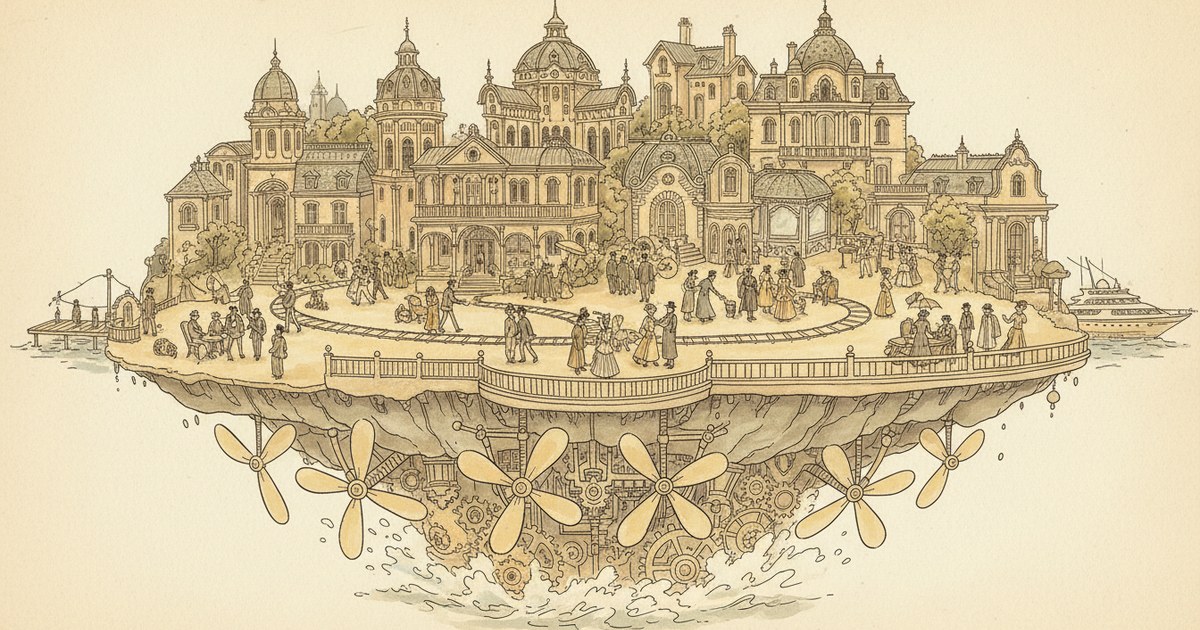
Standard Island — that’s the island’s name, precise and corporate — is an engineering marvel: a steel platform roughly a kilometer across, driven through the Pacific by giant propellers, populated by the ultra-wealthy who pay rent to a private company for the privilege of living there, free of any nation’s laws or obligations. Verne fills the first third of the book with technical specifications delivered in deadpan detail: the electrical grids, the freshwater systems, the artificial harbor. He makes you believe in it completely, and then he makes you watch it come apart.
The thesis is this: wealth concentrated past a certain point cannot govern itself. The island’s two dominant families — the Tankerdons on the left, the Coverleys on the right — agree on nothing and need nothing from each other, which means they have no reason to compromise and every reason to compete. The musicians, professional outsiders paid to provide culture to people who have opted out of the world, watch this deterioration with the specific horror of people who understand exactly what they’re seeing and cannot leave. Verne doesn’t frame this as tragedy. He frames it as engineering — a system running correctly toward its inevitable failure mode.
The Man Who Stopped Believing in Progress
Verne wrote Propeller Island at sixty-seven, near the end of a career that had made him, depending on your country, either the father of science fiction or a writer of children’s adventure stories. By 1895 he had buried his publisher and long-time collaborator Pierre-Jules Hetzel, whose optimistic editorial hand had shaped Twenty Thousand Leagues Under the Sea and Around the World in Eighty Days into the buoyant entertainments they became. Without Hetzel, the cheerful ambivalence about technology that runs through the early Verne had nowhere to hide. What emerged was something colder.
The biographical facts that matter here are not the famous ones. It is not useful to know that Verne wrote facing the sea, or that he owned yachts. What matters is that he was writing at the precise moment when the American robber baron became a global phenomenon — when men like Carnegie and Vanderbilt were demonstrating, publicly and in real time, that vast private fortunes had no natural limit and generated no natural obligation. Verne, who had spent his entire career inside capitalist publishing structures and understood what it meant to produce on contract, recognized the mechanism intimately. He had been living a version of it.
His late novels share a quality that Propeller Island makes explicit: a conviction that the engineering solutions humans celebrate most loudly are the ones most precisely calibrated to produce disaster. Paris in the Twentieth Century, suppressed by Hetzel himself and not published until 1994, describes a technologically advanced society that has crushed the arts entirely. The Eternal Adam ends civilizations. This is not pessimism as mood. It is pessimism as method. Verne builds Standard Island the way an investigator reconstructs a crime scene — backward from the collapse, so that every detail of the construction is also evidence of how it fails.
That method gives Propeller Island its particular texture. The novel reads like a technical manual that knows it is also a eulogy. Verne describes the island’s power systems in loving detail not because he admires them but because he needs you to understand exactly which component will fail first and why. The biographical fact that matters is not whether Verne was optimistic or pessimistic by temperament — it is that he was a systematic thinker whose system had, by 1895, reached its conclusions.
A Floating City Running Its Failure Scenario
The quartet — Yvernes, Pinchinat, Frascolin, and Zorn — function as the novel’s conscience by accident. They are not moral heroes. They are professionals who need to be paid and want to go home, and their increasingly desperate observations of Standard Island’s political deterioration have the quality of expert witnesses testifying to something they wish they hadn’t seen. When the Tankerdon and Coverley factions begin positioning for control of the island’s governance, it is Frascolin — the most analytical of the four — who first identifies the structural problem. The island has no constitution. It has a company charter, and company charters do not contemplate stalemate.
Verne is extraordinarily specific about the shape of this deadlock. The two factions do not fight over ideology. They fight over the island’s heading — literally, which direction the propellers point. Standard Island’s governor-general can order any destination, but the two families each control enough votes to paralyze any decision they oppose. The island drifts. Verne doesn’t lean on this as metaphor; he lets the technical reality carry the weight. When the council deadlocks over whether to steer toward Hawaii or toward the Fiji archipelago, the island goes nowhere, burning fuel, accumulating risk, while the musicians practice scales in a concert hall built for an audience that is busy destroying itself.
The novel’s final act involves a cascade of consequences that Verne has prepared with the precision of a demolitions expert placing charges. Every element introduced in the first hundred pages returns. The musicians’ contract, the island’s route, the rival families’ finances, the mechanical specifications of the propellers themselves — everything that seemed like scene-setting turns out to be load-bearing. When the collapse comes, it does not feel like plot. It feels like a proof.
What makes Propeller Island worth reading now is not that it predicted anything in particular. It is that Verne got the mechanism right. The failure mode he describes — private sovereignty, concentrated wealth, no external obligation, no natural limiting force — is not a historical curiosity. It is a design currently in active use, refined and scaled. The string quartet is still there too, somewhere, watching from a stage they can’t leave.
The Translation Landscape
Propeller Island has had a thin life in English. The first translation, by W.J. Gordon, appeared in 1896 — one year after the French original — and was produced at the pace Victorian publishing demanded of Verne: quickly, for a reading public that wanted the plot and didn’t particularly require fidelity. Gordon’s version is competent in a period sense. It conveys the story without embarrassing itself, and handles the technical passages adequately. But it makes consistent choices that flatten Verne’s irony. Where Verne’s French is deliberately corporate and bureaucratic — dry in a way that signals critique — Gordon tends toward the warmly journalistic. The deadpan disappears. You are left with a peculiar adventure novel that seems almost to like the island it is describing.
For most of the twentieth century, Gordon’s 1896 text was effectively the only text: reprinted, repackaged, excerpted in Verne anthologies, and occasionally re-titled. Readers who encountered Propeller Island in English were encountering a book that had been de-ironized at the point of translation. The satire was present in outline but absent in tone. This matters more for Propeller Island than for Verne’s earlier novels because the satire is the novel. Twenty Thousand Leagues can survive a clumsy translation — the ocean is still there, the Nautilus still moves. Propeller Island, where the mode is the meaning, cannot absorb that loss without becoming a different book entirely.
Oxford World’s Classics has not produced an edition of this title, and the Penguin Classics catalog — comprehensive on Verne’s best-known work — passes over Propeller Island entirely. A small number of academic translations have appeared in journal excerpts and university press anthologies over the intervening decades, but none established a clear standard for general English readers. The book remained, in practical terms, available only in Gordon’s Victorian paraphrase or not at all. That gap is precisely what this translation was built to close.
Why This Translation?
The Classics Retold edition was prepared with a specific intent: to restore the bureaucratic register that Gordon’s version lost. Verne’s satire operates through diction — through the precise, affectless vocabulary of corporate governance applied to human catastrophe. Where Gordon writes “the island’s council resolved to proceed,” this translation preserves the full administrative syntax Verne used, because the syntax is doing satirical work that paraphrase erases. The result is a novel that reads the way Verne intended: not as an adventure slightly shadowed by pessimism, but as a satire that happens to contain an adventure. The quartet’s professional detachment — their careful, musicians’ attention to what they observe — comes through in a voice that is clinical without being cold.
This translation is available now in paperback. If you’ve read Twenty Thousand Leagues or The Mysterious Island and assumed you’d exhausted what Verne had to offer, Propeller Island is the corrective — the book where the optimism breaks down and what’s underneath it turns out to be worth reading far more carefully. Pick up the Classics Retold edition here. It is the sharpest English version of this novel in print, and it is the version that lets the satire do what Verne built it to do.
What is Propeller Island about?
Propeller Island (originally L’Île à hélice) is an 1895 novel by Jules Verne about four French musicians who are effectively kidnapped and brought to Standard Island — a vast, motorized steel platform populated by the ultra-wealthy, traveling the Pacific free of any national government or law. The novel follows the musicians as they observe the island’s two dominant factions drive it toward political and physical collapse. It is simultaneously an adventure novel, a technical marvel, and a sustained satire on private sovereignty and concentrated wealth.
How does Propeller Island compare to Verne’s better-known novels?
It is darker and more pointed than Twenty Thousand Leagues Under the Sea or Around the World in Eighty Days, both of which retain a fundamental optimism about human ingenuity. Propeller Island belongs to Verne’s late period, after his longtime publisher Hetzel died and the editorial pressure toward upbeat conclusions was removed. Readers who know only Verne’s celebrated work will find this novel startling — more satirical in intent, more precise in its pessimism, and in several ways more interesting as a result.
Is Propeller Island suitable for younger readers?
The novel contains no graphic violence and was published, like most of Verne’s work, as family-appropriate fiction. That said, its pleasures are primarily ironic rather than action-driven, and younger readers expecting the pacing of Journey to the Center of the Earth may find the political machinery slow to engage. It is best appreciated by readers who can hold the technical scaffolding in mind long enough to watch Verne dismantle it — roughly, readers from mid-secondary school onward who are comfortable with satire.
Why has Propeller Island been so overlooked compared to Verne’s other novels?
Several reasons compound each other. The novel was never absorbed into the popular Verne canon established in English translation during the late Victorian period. Its satire — which requires tonal fidelity to land — was blunted in the 1896 Gordon translation that became the default text. And unlike Twenty Thousand Leagues or The Mysterious Island, it lacks a charismatic central figure on the order of Captain Nemo. What it has instead is a mechanism: a political system failing in slow motion, observed by four musicians who cannot stop playing while it falls. That is a harder thing to market, and a richer thing to read.
On August 20, 1672, a mob in The Hague tore the De Witt brothers apart. Johan, the Grand Pensionary of Holland, and his brother Cornelis were stripped, beaten, stabbed, and shot — then pieces of them were sold as souvenirs. It was one of the ugliest political murders of the century, carried out by a crowd convinced they were serving order. Dumas opens The Black Tulip with this scene, and he does not look away. He makes you stand in the crowd and watch a civilization eating its own.
Then — in the very next chapter — he pivots to a man tending his garden.
That pivot is the argument of the entire novel. While history tears itself apart in the streets, Cornelius Van Baerle, a prosperous young tulip-grower in Dordrecht, is attempting something the world has never seen: a truly black tulip. Not dark purple, not near-black — jet black, without flaw. The city of Haarlem has offered 100,000 florins to whoever achieves it. Cornelius doesn’t want the money. He wants the flower. Dumas understood something about that kind of obsession — that it’s not escapism but its own form of courage. To insist on beauty while the mob howls outside your gate is a political act.
The Son of a General the Empire Preferred to Forget
Alexandre Dumas was born in 1802 in Villers-Cotterêts, a market town an hour northeast of Paris. His father, Thomas-Alexandre Dumas, had been — briefly, improbably — one of the most feared cavalry commanders in the French Revolutionary Army. Born in Saint-Domingue to a French nobleman and an enslaved Haitian woman, Thomas-Alexandre had risen through sheer ferocity of talent to become a general of division. Napoleon then spent the rest of his career making sure that achievement went unrewarded. By the time Alexandre was four, his father was dead, broken by years of neglect and a imprisonment in Naples. The family was left nearly penniless, the pension denied.
This is not a biographical footnote. It is the marrow of everything Dumas wrote. He grew up knowing exactly what it looked like when powerful men decided that a person of exceptional ability was nonetheless inconvenient — and what it looked like when institutions closed ranks to protect that decision. He was largely self-educated, working as a notary’s clerk while reading everything he could find, and when he finally broke through in Paris, first with history plays and then with the novels that made him famous, he kept returning to the same situation: the man of genuine worth at the mercy of a system with no interest in his worth.
The Black Tulip, published in 1850, was written late in that career, when Dumas had already given the world The Three Musketeers and The Count of Monte Cristo. He was fifty, famous, financially chaotic, and apparently still thinking about what it meant to be destroyed by forces that had nothing to do with your actual guilt. Cornelius Van Baerle is arrested not for anything he did but for papers he was holding for his godfather — the same Johan de Witt whose murder opens the novel — without even knowing what they contained. The system that kills the De Witts also swallows Cornelius. Dumas isn’t making a metaphor. He’s describing a mechanism he recognized.
The collaboration with Auguste Maquet, who contributed research and structural scaffolding to many of Dumas’s novels, is worth noting precisely because The Black Tulip doesn’t read like a collaboration. It reads like a man with a specific grievance working it out at speed. The obsessive detail about tulip cultivation — the soil preparation, the grafting, the naming conventions — has the texture of someone who found in horticulture a language for the kind of patience and precision that history keeps punishing.
The Flower That Grows in the Dark
The plot mechanism Dumas uses is almost sadistically elegant. Cornelius’s neighbor, Jacob Boxtel, was himself a serious tulip-grower — until Cornelius, without meaning to, built a greenhouse that cast a shadow over Boxtel’s garden. That shadow killed Boxtel’s prize collection and turned a reasonable man into something monstrous. He spends the rest of the novel trying to steal Cornelius’s achievement. The black tulip becomes the site where envy, ambition, beauty, and justice all converge.
In prison in the Loevestein fortress, Cornelius meets Rosa, the jailer’s daughter. Their courtship is conducted through the bars of his cell, and Dumas gives it a quality that his swashbuckling adventures often don’t stop for: slowness. Cornelius teaches Rosa to read by writing lessons on scraps of paper passed through the grating. She grows his tulip bulb in a plot of earth outside the prison walls, reporting its progress back to him. The novel’s most quietly devastating passage is the one where Cornelius, unable to see the tulip himself, listens to Rosa describe it as it opens. He is a man who has spent his adult life tending flowers with his own hands, and now the only plant he cares about exists entirely in someone else’s description of it. Dumas doesn’t underline this. He trusts you to feel it.
The theft and the confrontation before the Haarlem committee are staged with the timing of a playwright — which Dumas was, before he was a novelist, and it shows. But the novel’s actual climax is quieter: the moment when the black tulip is officially registered under the name Rosa Barlaensis, combining Cornelius’s surname with Rosa’s given name. The flower is named for both of them. The obsession and the love turn out to have been the same thing.
What makes The Black Tulip worth reading alongside the more famous Dumas titles is its compression. At roughly 250 pages, it doesn’t have room for the plot surplus that occasionally buries Monte Cristo. Every chapter advances something. The pace of the opening — massacre, garden, arrest — gives you the whole novel’s logic in forty pages, and then Dumas spends the remaining two hundred earning it.
The Translation Landscape
The existing English translations divide roughly into two camps. The Victorian-era versions, most of them anonymous or semi-anonymous, are available free in various digital archives and are largely unreadable — not because the French is difficult, but because nineteenth-century English translators of French popular fiction had a habit of flattening theatrical dialogue into something resembling legal correspondence. Boxtel’s jealous ranting, which in French has the cadence of a man talking himself into monstrousness, tends to emerge as a series of grave declarative sentences. The texture that makes Dumas feel alive gets ironed out. Robin Buss’s Penguin Classics translation, the most widely cited modern version, is a genuine improvement: accurate, clean, and particularly good at the prison scenes where the register needs to stay intimate without becoming sentimental. Where it occasionally loses ground is in the set pieces — the mob scene, the Haarlem committee — where Dumas is writing at full theatrical volume and a more literal approach produces something slightly muffled.
The Classics Retold edition positions itself in the space those set pieces leave open. The translation keeps the rhythmic aggression of the opening crowd scene — short declarative sentences that hit like a drumbeat — while letting the tulip-cultivation passages breathe at their own slower pace. A single passage makes the difference legible: the moment Boxtel first sees Cornelius’s greenhouse shadow falling across his garden. In the Buss, it’s a competent rendering of a plot point. In this translation, it reads like what it is: the exact moment a man’s life divides into before and after. That distinction is not decorative. It’s what the next two hundred and fifty pages depend on.
Why This Translation?
The Black Tulip is not a difficult book, but it is a precise one — and precision in translation means something different here than it does with, say, Flaubert, where you’re trying to preserve a surface. With Dumas, you’re trying to preserve momentum, and momentum is the hardest thing to carry across languages because it lives in sentence rhythm, not vocabulary. The Classics Retold edition was made with that problem front and center: the goal was an English text that moves at the speed Dumas intended, where the twenty pages of mob violence and the twenty pages of horticultural patience feel like they belong to the same novel because they do.
The paperback edition is available on Amazon and includes a translator’s note on the historical context of the rampjaar — the Dutch “year of disaster” — that situates the De Witt murders without turning the opening into a history lecture. If you’ve read Dumas before, this is the novel that shows you a different gear. If you haven’t, it’s a better starting point than most people expect: tight, fast, and structurally honest about what it’s trying to do. The Classics Retold edition is here.
Is The Black Tulip based on a true story?
Partially. The De Witt brothers’ murder on August 20, 1672 — which opens the novel — is historical fact, one of the most notorious political killings of the Dutch Golden Age. The tulip-growing competition and the character of Cornelius Van Baerle are Dumas’s invention, but they’re set against scrupulously accurate historical backdrop: the Dutch tulip mania of the seventeenth century was real, as was the intense culture of competitive breeding among wealthy growers.
What does the black tulip symbolize in the novel?
The tulip functions as the novel’s argument made visible: that the pursuit of something genuinely beautiful, when conducted with total commitment, is itself a form of resistance against the ugliness of political life. Dumas is careful not to make it allegorical in any simple sense — Cornelius genuinely wants the flower, not what it represents — but the structural contrast between the mob violence of the opening and the obsessive patience of the tulip-growing is unmistakably deliberate.
How does The Black Tulip compare to Dumas’s other novels?
It’s shorter and tighter than either The Three Musketeers or The Count of Monte Cristo, with less of the digressive subplot energy those novels rely on. It shares with Monte Cristo a core interest in wrongful imprisonment and the question of what patience costs a person, but it resolves that interest through love rather than revenge — which makes it a quieter novel, and in some ways a more honest one.
Is The Black Tulip a romance?
It has a central love story, but calling it a romance undersells it. The relationship between Cornelius and Rosa develops entirely in conditions of constraint — prison bars, smuggled letters, secondhand descriptions of a flower he can’t see — and Dumas treats that constraint as the substance of the love, not an obstacle to it. What they build together is a tulip and a shared language of literacy and patience. The romance is real, but it grows in the dark, which is the point.
In the summer of 1863, Jules Verne handed his manuscript to the publisher Pierre-Jules Hetzel with a note explaining that he had, to his knowledge, invented a new kind of literature. Hetzel sent it back with corrections. The argument that followed—over tone, over credibility, over whether the volcano at the end was too much—lasted three months. Verne won on the volcano. What emerged from that quarrel was Journey to the Center of the Earth, a book that sent its readers somewhere no one had been and made the descent feel inevitable, as if the path had always been there, waiting under the basalt.
The thesis of this novel is not that the earth has a hollow interior. Verne knew the science was speculative; he used it as a premise, not a claim. The real argument the book makes is subtler and more durable: that the universe rewards the obsessive. Every figure who drives the plot forward—the professor, the nephew, the taciturn Icelander Hans—is defined by a single overriding competence brought to bear on an impossible situation. Verne is not writing about exploration. He is writing about what it costs to follow an idea all the way down.
The Man Who Mapped From an Armchair
Verne was born in Nantes in 1828, close enough to the Loire’s mouth that ships were a fact of childhood. The story goes that at eleven he stowed away on a vessel bound for the Indies, intending to bring back a coral necklace for a girl he liked. His father intercepted him at the first port. Verne reportedly said he would travel only in his imagination from then on—which is either apocryphal or the most perfectly Vernian origin story ever constructed. Either way, it landed.
What matters biographically is that Verne became a compulsive reader of scientific journals, geographic surveys, and expedition accounts. He filed index cards on coal seam depths, volcanic formations, Icelandic topography, the tensile strength of rope. By the time he wrote Journey, he had never seen Iceland, never descended a mine shaft, never stood on a glacier. The novel’s Iceland is assembled from texts—and it reads more convincingly than most travel writing of the era because Verne understood that the function of detail is not atmosphere but authority. Every measurement in this book is there to make the impossible feel earned.
He was also, crucially, broke and ambitious in roughly equal measure. The Extraordinary Voyages series he would build with Hetzel was as much commercial calculation as artistic vision. Verne needed books that would sell to families, to boys, to the educated middle class that wanted science wrapped in story. That constraint sharpened him. He could not be obscure. He could not afford to lose the reader on page forty. The result is a novel that pulls with genuine narrative pressure—not the pressure of suspense exactly, but of logical necessity. Each step underground makes retreat a little more unthinkable.
What Happens When the Staircase Goes Only One Way
The book’s engine is Professor Otto Lidenbrock, a German geologist whose relationship to other people runs entirely through the medium of their usefulness to his research. He deciphers a runic manuscript pointing to a passage through Iceland’s Snæfellsjökull volcano, informs his nephew Axel that they are leaving Thursday, and dismisses all counterarguments—including Axel’s correct observations about heat and pressure—with the confidence of a man who has simply decided the data will cooperate. He is insufferable and completely compelling, because Verne is smart enough to make him right. Not about everything. But enough. The moment you realize the professor’s recklessness is load-bearing—that without his refusal to consider failure the expedition would have turned back in the first cavern—is the moment the novel clicks into focus.
What Verne builds underground is not a horror story and not a fantasy. It is something stranger: a world that operates by geology’s actual rules, extrapolated past the point where anyone can check. The underground sea, the stone forest of fossilized trees, the sight of prehistoric creatures surfacing in black water—these land because Verne has done enough real science beforehand to make the extrapolation feel like discovery rather than invention. The reader follows Axel’s terror and the professor’s exhilaration at the same time, and the book is large enough to hold both without resolving the tension into a lesson. When the party is finally ejected from the earth’s interior by volcanic pressure—shot upward through a lava tube like a cork—it reads not as rescue but as the mountain deciding it is done with them.
Why This Translation
Most English-language readers have encountered Verne through Victorian translations that were not merely dated but actively mangled—sentences flattened, scientific passages cut for length, the professor’s voice stripped of its particular combination of tyranny and grandeur. This modern English translation restores what those editions lost: the pacing Verne actually wrote, the precision of Axel’s narration, and the full weight of the argument the novel is making. It reads with the directness the original demands. The Classics Retold edition is available in paperback here—the version worth reading is this one.
Did Jules Verne ever travel to the places he wrote about in his early novels?
For most of his major works, no. Verne constructed his fictional geographies from maps, scientific journals, and accounts in the Bibliothèque nationale rather than firsthand experience. His desk in Amiens was, in many ways, his only real voyage.
What was Hetzel’s main objection to Verne’s original manuscript in 1863?
Hetzel pushed back on tone and credibility, worried that readers wouldn’t accept the premise without a more measured, scientific framing. The dispute over the volcano ending was particularly contentious and dragged the revision process into a three-month standoff.
How did Verne claim his work was different from the adventure fiction that already existed?
Verne told Hetzel he had invented a new kind of literature—one grounded in verifiable science and geographic fact rather than pure fantasy or moral allegory. He wanted readers to feel that the journeys in his books could, in principle, actually be made.
Why does it matter that Verne mapped places he never visited?
It reveals how thoroughly he constructed authenticity through research rather than experience, which made his errors and inventions equally deliberate. When he got details wrong—or right—it was the library speaking, not the traveler.
On November 4, 1838, a fifty-five-year-old French diplomat checked into a Paris apartment, ordered his secretary to take dictation, and told everyone else to leave him alone. Fifty-two days later — on December 26, the day after Christmas — he stopped talking. The manuscript of The Charterhouse of Parma was finished. Henri Beyle, who had published novels before without causing much stir, handed the world one of the most admired books in the French language, then went back to being a minor consul in a dusty Italian port town.
The speed is not a curiosity. It is the whole argument of the book made flesh. The Charterhouse of Parma is a novel about what happens when energy, desire, and intelligence are forced to live inside the suffocating machinery of politics and power — and the fifty-two-day composition was Stendhal doing exactly what his hero Fabrice del Dongo never quite manages: moving before the world can stop him. Balzac, who had no shortage of his own genius to protect, read it and declared it “the most significant novel of his time.” Tolstoy read the Waterloo chapters and rewrote his own understanding of war. Hemingway acknowledged the debt. Henry James called it one of the dozen best novels ever written. None of them were being polite.
The thesis is simple and devastating: passion is real; the world is not — or not in the way that romantics need it to be. Fabrice del Dongo spends the entire novel trying to live as though Napoleonic glory is still available, as though love is cleanly accessible to those who want it badly enough. Italy disagrees. The petty court of Parma, the ministerial intrigues, the prison tower above the plain — these are Stendhal’s argument that the machinery of society grinds hardest against precisely those who refuse to become machines themselves.
The Man Who Loved Italy More Than France
Henri Beyle was born in Grenoble in 1783 and spent the rest of his life in flight from it. As a teenager he joined Napoleon’s Italian campaigns and rode into Milan with the army — experiencing, he later said, the happiest weeks of his existence. The Charterhouse of Parma opens with exactly this moment, in what may be the most exhilarated first chapter in nineteenth-century fiction: French soldiers arriving in a city that embraces them, a population drunk on liberation, music in the streets. That Stendhal lived this scene before he wrote it is not incidental. The joy in those pages is the joy of a real twenty-year-old’s memory, and it sets the novel’s whole register — pleasure is possible, the world can open — before the machinery of Restoration politics closes back in.
He used over 170 pen names across his life, settling on “Stendhal” — borrowed from a German provincial town, for reasons he never explained — for the work that lasted. The disguise was constitutional. He was a Bonapartist and republican surviving in the Restoration, a man of appetite and intelligence employed as a minor bureaucrat, in love serially and unrequitedly. In 1822 he published a theoretical study of romantic passion called De l’Amour, which introduced his concept of crystallization: the process by which a lover coats the beloved in imagined perfection until the real person disappears. It is the operating system of his fiction. Fabrice doesn’t fall in love with Clélia Conti so much as crystallize her — and the novel knows this, and finds it both beautiful and doomed.
By 1838, Beyle was serving as consul in Civitavecchia, a minor Roman port he hated, grinding through customs paperwork while the Italy he loved sat just out of reach. Paris was leave. The Charterhouse was written on leave. That it poured out in fifty-two days says something about what happens when a man finally gets to the page he has been carrying for decades. The novel is not sloppy — it is fluent in the way that only happens when a writer already knows the territory. Stendhal had been living among courts, informers, ministers, and romantic obsessives his entire adult life. He was not inventing a world. He was reporting on it.
He died in 1842, on a Paris street, of a stroke. He had written in his diary: “I am fifty years old. Could it be true? And I am not fifty yet in the life I have lived.” This is the novel’s complaint too. Life keeps happening at the wrong speed, in the wrong register, inside institutions built to exhaust energy rather than honor it.
The Battle Nobody Sees, the Prison Nobody Wants to Leave
Stendhal’s Waterloo sequence is probably the most influential battle description in all of fiction, and it works precisely because it refuses to be a battle description. Fabrice del Dongo, seventeen years old, rides toward Waterloo expecting the epic confrontation of his imagination — the Napoleon of legend, the charge, the moment of historical clarity. What he finds is mud, confusion, a woman selling brandy from a cart, soldiers stealing his horse, an accusation of spying. He hears cannons. He sees men fall. He returns afterward not knowing whether he was actually present at the battle. “Was this a real battle?” he asks. “Was this Waterloo?” Stendhal’s answer is that history happens in fog, that heroism is mostly a story told after the fact, and that the gap between experience and narrative is where the novel lives. Tolstoy read those chapters and drew directly on their technique for War and Peace.
The second great set piece inverts everything. Fabrice, imprisoned in the Farnese Tower on a trumped-up charge, has every reason to despair. Instead he discovers from his cell window a view of Clélia Conti tending her birds in the aviary below. He falls in love across distance and height. The prison becomes, absurdly, the most alive he has ever been — because in the tower there is no court intrigue, no ministerial calculation, no role to play. Only the window, the birds, and Clélia. Stendhal has the nerve to insist that this is not an irony but the truth: constraint can produce freedom if the thing you love is inside the constraint with you. That Fabrice eventually escapes and finds the world outside smaller than his cell is the novel’s most devastating joke.
Around Fabrice, the book builds an entire political ecosystem described with the affectionate contempt of someone who spent years navigating one. Count Mosca — brilliant, pragmatic, self-aware enough to know exactly how compromised he is — loves the Duchess Gina Sanseverina with the helplessness of a man who understands everything except how to stop. Gina, Fabrice’s aunt, loves Fabrice with an intensity the novel declines to fully name. The court of Parma is a miniature of every European government of the period: petty, paranoid, capable of genuine cruelty over nothing. Stendhal doesn’t satirize it. He describes it with precision, and the precision is enough.
The Translation Landscape
English readers have had options since C.K. Scott Moncrieff’s 1925 translation — the same Scott Moncrieff who gave us the standard Proust. His Charterhouse is readable, and for its era admirably direct, but it carries the weight of Edwardian prose habits that slow Stendhal’s characteristic velocity. Passages that should cut land softly. The comedy, which in French has a dry, almost offhand quality, tips toward elaborateness in Moncrieff’s hands. It remains historically significant; it no longer reads as the best option available.
Richard Howard’s 1999 version for the Modern Library is widely considered the gold standard, and for good reason. Howard keeps Stendhal’s ironic detachment intact without academicizing it. The sentences move. The Waterloo chapter, in Howard, reads at exactly the right speed — fast enough to feel like chaos, controlled enough to feel designed. John Sturrock’s 2006 Penguin Classics version is clean and accurate and slightly bloodless: more useful for close reading than for the sustained pleasure this novel demands. Sylvia Raphael’s Oxford World’s Classics edition is scholarly and reliable, with useful notes, but the prose sometimes sacrifices momentum for literalness, which works against a novelist whose style is essentially the delivery mechanism of the joke.
Why This Translation?
The Classics Retold edition of The Charterhouse of Parma brings the novel into contemporary English without flattening Stendhal’s ironic distance or domesticating his French idiom into something merely smooth. Where earlier translations sometimes chose safety — a reliable word, a conventional syntax — this edition makes choices that honor the novel’s speed. Stendhal wrote in fifty-two days because he was following something; a translation that feels labored defeats that. The Classics Retold edition moves the way the novel was written: fast, precise, and committed to the irony rather than hedging against it.
For readers coming to The Charterhouse of Parma for the first time, this translation offers what matters most: entry into the novel’s actual world, not a scholarly mediation of it. The Waterloo sequence lands. The prison tower lands. The Duchess Gina’s grief in the final pages lands. This edition is available in paperback for readers ready to meet one of the great novels of the French language on its own terms. Stendhal’s argument — that passion is the realest thing in a world engineered to make passion impractical — comes through with the clarity those fifty-two days of dictation were reaching for. Read it at the speed it was written.
Is The Charterhouse of Parma difficult to read?
It is long — around 500 pages in most editions — and Stendhal’s narrative assumes you can track a large cast navigating Italian court politics. But the prose itself is not difficult. Stendhal writes with unusual clarity and pace for a nineteenth-century novelist, and a good modern translation makes the novel accessible without simplifying it. Most readers find it absorbing rather than demanding.
Does this novel need to be read alongside Stendhal’s other work?
The Charterhouse of Parma stands completely alone. It shares a sensibility with The Red and the Black — romantic ambition in collision with social machinery — but different characters, a different setting, and a different emotional register. Read either one first. Most readers who begin with The Charterhouse find it the more immediately pleasurable of the two.
What makes the Waterloo sequence so celebrated?
Stendhal depicts the Battle of Waterloo entirely from inside the confusion of a participant who has no commanding view of what is happening. There are no heroic charges, no clarifying moments of decision — only noise, mud, and a woman selling brandy from a cart. Tolstoy read it and drew directly on its technique for the battle sequences in War and Peace. It is the first modern war narrative: war as it is experienced, not as it is narrated.
Where does The Charterhouse of Parma fit in the French literature canon?
It sits at the foundation of the French realist novel, alongside Balzac and ahead of Flaubert, though Stendhal’s tone is more ironic and less exhaustive than either. His influence runs through Tolstoy and James and into the twentieth century — Proust, who admired Stendhal’s psychological precision, is difficult to imagine without it. For a first encounter with French literary fiction, it is one of the most rewarding entry points: serious without being solemn, long without feeling slow.
You must be logged in to post a comment.