
The bottle came out of a shark’s stomach. That is where the story starts — not in a parlor, not at a dockside farewell, but in the gut of a predator pulled aboard a Scottish yacht in 1867. Inside: a fragment of paper in three languages, seawater-blurred, carrying the last known coordinates of a ship called the Britannia and the name of its captain, Harry Grant. The latitude survives. The longitude does not. Two children are waiting somewhere in Scotland, and their father has been missing for two years.
What follows is a chase around the 37th parallel — through the drought-cracked pampas of Patagonia, the convict roads of colonial Australia, the trembling volcanic coastline of New Zealand — conducted on the logic that one intact number might be enough to find a man alive. It shouldn’t be enough. The children, Mary and Robert Grant, believe it will. Jules Verne, who was writing this novel while his own son was being committed to a reform school against the boy’s desperate protests, understood something about the particular anguish of hope that refuses to become reasonable.
Jules Verne published Les Enfants du capitaine Grant between 1867 and 1868. The Victorian-era English translations that followed were cut, condensed, and stripped — the scientific digressions gutted, the children reduced to props, the expedition’s emotional logic traded for forward momentum. What remained was adventure without interiority. This modern English translation restores what those editions discarded: a novel that moves between expedition thriller and a precise, unsentimental study of what children are capable of believing about the people they love.
The Man Who Sent His Characters Everywhere He Couldn’t Go
Verne was born in 1828 in Nantes, a port city that put ships in his eyeline from childhood and geography in his bones. His father, a successful lawyer, expected him to follow into the profession. Verne followed as far as Paris, enrolled in law school, and immediately started writing plays. He spent his twenties as a moderately unsuccessful dramatist and a stockbroker who was bad at the job, watching the great age of exploration through newspapers and the publications of the Paris Geographical Society.
This matters because Verne never traveled much. The journeys in the Voyages Extraordinaires — to the moon, to the ocean floor, to the poles, to the center of the earth — were built from library research, scientific reports, and a methodical imagination. When the Glenarvan expedition in this novel moves through Patagonia, the detail is thick and confident: tidal patterns, geological formations, the behavior of the pampas wind. Verne got it from books. The authority in the prose is not the authority of experience — it is the authority of a man who has read everything and believes the world can be understood if you read enough of it.
His son Michel was born in 1861 and almost immediately became evidence that the world does not always cooperate with understanding. By his early teens Michel was volatile, reckless, and impossible to manage — a boy who had inherited his father’s restlessness without inheriting his discipline. Verne signed the commitment papers for a reform school when Michel was around fifteen. He was then at the height of his fame and his productivity, writing a novel per year for Hetzel, and he was doing the hardest thing a parent can do: making a decision about a child he could no longer reach. The Grant children spend the entirety of this novel refusing to accept that their father is beyond reach. Verne put the wish he could not act on into the children who could.
The Voyages Extraordinaires were written under contract for Pierre-Jules Hetzel, Verne’s publisher and, in a real sense, his collaborator. Hetzel pushed toward optimism, scientific education, and a vision of progress that would sell to French bourgeois families. Les Enfants du capitaine Grant is dedicated to this mission — the expedition’s geographer, Paganel, delivers geography lessons along the route. But what Hetzel could not entirely suppress was the emotional undercurrent: a father who cannot be found, children who insist on finding him anyway, and a world that keeps producing new obstacles without producing any mercy.
What the 37th Parallel Actually Teaches You
The conceit of the novel is geographical and also philosophical. The 37th parallel circles the globe, and the Glenarvan expedition decides to follow it through every landmass it crosses, searching for any trace of the Britannia’s survivors. The method is both rigorous and absurd — the survivors could be anywhere within a vast corridor — and this tension is the engine of the book. Verne wants you to feel the gap between the confidence of the scientific method and the chaos of the actual world.
What makes the novel work is the children. Robert Grant is twelve years old, impulsive, and physically brave in the way twelve-year-old boys sometimes are when they have nothing left to lose. His sister Mary is older and steadier — and in the Victorian translations, largely decorative. In the restored text, she is the one who holds the expedition’s emotional logic together: the one who, when the evidence turns against their father’s survival, argues not from evidence but from the kind of certainty that has no name in scientific literature. Verne is not mocking this. He is arguing that it is a form of knowledge.
The expedition’s comic relief, Monsieur Paganel, is the geographer who has accidentally boarded the wrong ship and has nowhere else to be. In lesser hands he would be pure function. In Verne’s, he is also a figure of genuine intellectual generosity — a man whose love of geography is infectious because it is real. When Paganel explains the tectonic logic of the Andes or the migration patterns of the condor, the explanation is not a textbook intrusion. It is Verne’s argument that the world is worth knowing, that the effort of understanding is itself a form of love. The digression is the thesis.
The novel’s final act moves to New Zealand, and there Verne does something the Victorian translators consistently softened. He does not make the Maori people background. They are actors in the plot with their own logic and their own interests, and the expedition’s survival depends on correctly reading a situation they did not create. The restored text puts this dynamic back at full weight. The world the Glenarvan expedition moves through is not a map — it is a set of cultures, ecologies, and power structures, each with its own rules, and ignoring any of them has consequences.
The Translation Landscape
Verne has the unfortunate distinction of being one of the most badly served authors in the history of English translation. The original Victorian editions — published primarily by Sampson Low, Marston and Company through the 1870s and 1880s — were condensed and rewritten for a British market that publishers assumed wanted action and not science. Verne’s actual sentences, his digressions, his tonal range, were treated as editorial problems to be solved. The result was that English readers spent over a century believing Verne was a competent but thin adventure writer, when French readers knew him as something considerably more complex. Retroactive scholarship has confirmed the scale of the damage: researchers comparing the French originals to the canonical English versions found cuts, inserted passages, and shifts in register that amounted to different books.
For Les Enfants du capitaine Grant specifically, the English translation situation is thin. There is no Penguin Classics edition, no Oxford World’s Classics rescue, no Pevear/Volokhonsky-style scholarly intervention for this title. I.O. Evans produced a series of Verne translations for Arco Publications in the 1960s that were more faithful than the Victorian originals but still operated under the assumption that English readers wanted brevity — the scientific sequences remain abbreviated. What circulates today is largely reprints of those earlier versions, some lightly modernized in vocabulary, most not. Readers who know the story through adaptations — the 1962 film, the Disney production — have encountered a further simplified shape. The modern English translation in the edition linked below works from the complete French text, restoring the scientific sequences, the full register of Paganel’s characterization, and the emotional architecture that Victorian editors decided was surplus to requirements.
Why This Translation Belongs on Your Shelf
The test of a Verne translation is not the adventure sequences — any competent translator can handle those. The test is Paganel. His lectures on geography need to feel like the speech of a man genuinely in love with a subject, not like an encyclopedia being read aloud. In the Victorian translations, Paganel’s digressions are either cut or delivered in prose so flat that the joke of his enthusiasm — a man who cannot stop explaining things, even when everyone around him is in immediate danger — disappears entirely. In this translation, the rhythm of his speech is preserved: he accelerates when excited, qualifies when cautious, and his observations are specific enough to feel like knowledge rather than color. That specificity is the difference between a character and a function.
For readers who came to Verne through abridged school editions and want to know what they missed, the edition linked below — available in paperback and ebook on Amazon — answers that question without fuss. The novel is long but not difficult, propulsive but not thin. What it offers, in a faithful translation for the first time in modern English, is the specific and uncommon pleasure of watching two children refuse to accept what the world has decided about their father — and of watching the world, reluctantly, yield.
Is In Search of the Castaways the same book as The Children of Captain Grant?
Yes. Les Enfants du capitaine Grant has been published in English under both titles. “In Search of the Castaways” foregrounds the expedition structure; “The Children of Captain Grant” foregrounds the emotional engine. They are the same novel. the edition linked below uses the former title but the French original is noted for clarity.
Is this book appropriate for younger readers?
Verne wrote for a broad audience that included children, and the novel’s protagonists are themselves children. The adventure content — shipwreck, capture, earthquake, peril of several kinds — is intense but not graphic. Most readers twelve and up who are comfortable with 19th-century pacing will find it accessible. The restored scientific digressions may slow younger readers in places, but they are also the passages that reward rereading most.
Do I need to read other Jules Verne novels before this one?
No. Les Enfants du capitaine Grant stands entirely alone. It shares its fictional world with the broader Voyages Extraordinaires series, and a character from this novel reappears in a later book, but the story has its own beginning and its own end. No prior knowledge of Verne is required.
What makes this edition different from other English versions currently available?
Most English editions in print are reprints or light revisions of 19th-century translations that condensed the novel significantly. This modern English translation works from the complete French text, restoring the scientific sequences, the full characterization of figures like Paganel, and the tonal range that Victorian editors consistently removed. It is not a scholarly edition with apparatus, but it is a faithful one — which, for this title, is rarer than it should be.
Also worth reading
More from Jules Verne

Verne Built an Island. We Finally Caught Up.
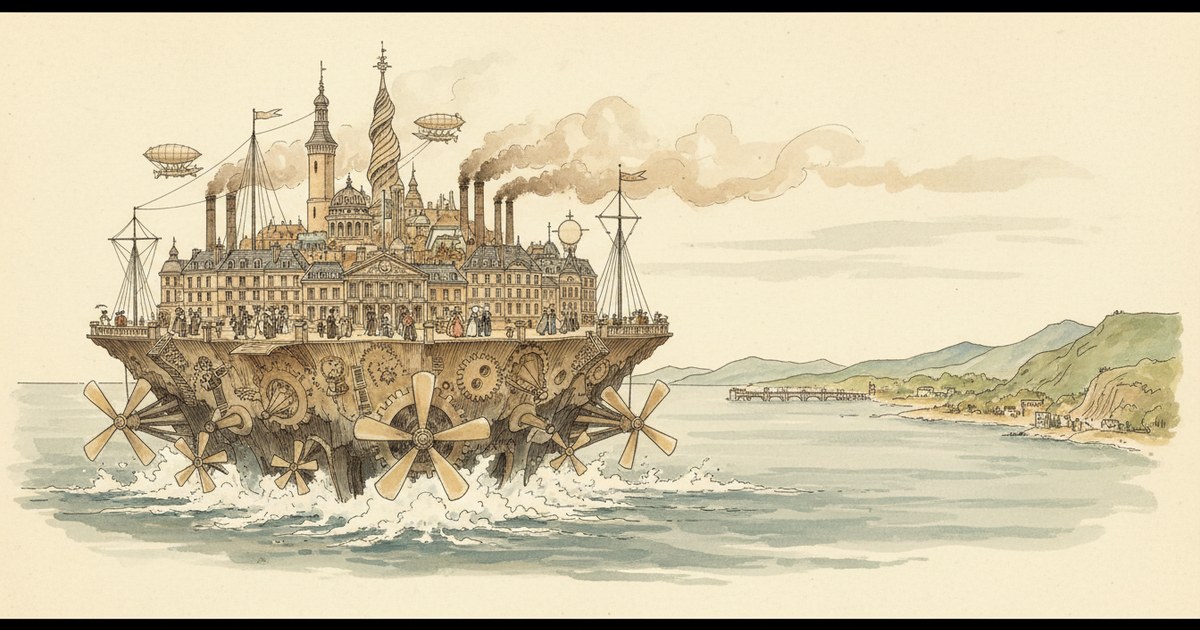
Four French musicians are kidnapped in California. Not violently — there’s a car waiting at the train station, courteous men in good suits, and before the string quartet fully understands what has happened, they are on board a moving island the size of a small city, hired to play concerts for millionaires who have purchased their way off the earth entirely. This is the opening of Propeller Island, Jules Verne’s 1895 novel, and it takes about twelve pages before you realize Verne isn’t writing adventure fiction. He’s writing a warning.
Standard Island — that’s the island’s name, precise and corporate — is an engineering marvel: a steel platform roughly a kilometer across, driven through the Pacific by giant propellers, populated by the ultra-wealthy who pay rent to a private company for the privilege of living there, free of any nation’s laws or obligations. Verne fills the first third of the book with technical specifications delivered in deadpan detail: the electrical grids, the freshwater systems, the artificial harbor. He makes you believe in it completely, and then he makes you watch it come apart.
The thesis is this: wealth concentrated past a certain point cannot govern itself. The island’s two dominant families — the Tankerdons on the left, the Coverleys on the right — agree on nothing and need nothing from each other, which means they have no reason to compromise and every reason to compete. The musicians, professional outsiders paid to provide culture to people who have opted out of the world, watch this deterioration with the specific horror of people who understand exactly what they’re seeing and cannot leave. Verne doesn’t frame this as tragedy. He frames it as engineering — a system running correctly toward its inevitable failure mode.
The Man Who Stopped Believing in Progress
Verne wrote Propeller Island at sixty-seven, near the end of a career that had made him, depending on your country, either the father of science fiction or a writer of children’s adventure stories. By 1895 he had buried his publisher and long-time collaborator Pierre-Jules Hetzel, whose optimistic editorial hand had shaped Twenty Thousand Leagues Under the Sea and Around the World in Eighty Days into the buoyant entertainments they became. Without Hetzel, the cheerful ambivalence about technology that runs through the early Verne had nowhere to hide. What emerged was something colder.
The biographical facts that matter here are not the famous ones. It is not useful to know that Verne wrote facing the sea, or that he owned yachts. What matters is that he was writing at the precise moment when the American robber baron became a global phenomenon — when men like Carnegie and Vanderbilt were demonstrating, publicly and in real time, that vast private fortunes had no natural limit and generated no natural obligation. Verne, who had spent his entire career inside capitalist publishing structures and understood what it meant to produce on contract, recognized the mechanism intimately. He had been living a version of it.
His late novels share a quality that Propeller Island makes explicit: a conviction that the engineering solutions humans celebrate most loudly are the ones most precisely calibrated to produce disaster. Paris in the Twentieth Century, suppressed by Hetzel himself and not published until 1994, describes a technologically advanced society that has crushed the arts entirely. The Eternal Adam ends civilizations. This is not pessimism as mood. It is pessimism as method. Verne builds Standard Island the way an investigator reconstructs a crime scene — backward from the collapse, so that every detail of the construction is also evidence of how it fails.
That method gives Propeller Island its particular texture. The novel reads like a technical manual that knows it is also a eulogy. Verne describes the island’s power systems in loving detail not because he admires them but because he needs you to understand exactly which component will fail first and why. The biographical fact that matters is not whether Verne was optimistic or pessimistic by temperament — it is that he was a systematic thinker whose system had, by 1895, reached its conclusions.
A Floating City Running Its Failure Scenario
The quartet — Yvernes, Pinchinat, Frascolin, and Zorn — function as the novel’s conscience by accident. They are not moral heroes. They are professionals who need to be paid and want to go home, and their increasingly desperate observations of Standard Island’s political deterioration have the quality of expert witnesses testifying to something they wish they hadn’t seen. When the Tankerdon and Coverley factions begin positioning for control of the island’s governance, it is Frascolin — the most analytical of the four — who first identifies the structural problem. The island has no constitution. It has a company charter, and company charters do not contemplate stalemate.
Verne is extraordinarily specific about the shape of this deadlock. The two factions do not fight over ideology. They fight over the island’s heading — literally, which direction the propellers point. Standard Island’s governor-general can order any destination, but the two families each control enough votes to paralyze any decision they oppose. The island drifts. Verne doesn’t lean on this as metaphor; he lets the technical reality carry the weight. When the council deadlocks over whether to steer toward Hawaii or toward the Fiji archipelago, the island goes nowhere, burning fuel, accumulating risk, while the musicians practice scales in a concert hall built for an audience that is busy destroying itself.
The novel’s final act involves a cascade of consequences that Verne has prepared with the precision of a demolitions expert placing charges. Every element introduced in the first hundred pages returns. The musicians’ contract, the island’s route, the rival families’ finances, the mechanical specifications of the propellers themselves — everything that seemed like scene-setting turns out to be load-bearing. When the collapse comes, it does not feel like plot. It feels like a proof.
What makes Propeller Island worth reading now is not that it predicted anything in particular. It is that Verne got the mechanism right. The failure mode he describes — private sovereignty, concentrated wealth, no external obligation, no natural limiting force — is not a historical curiosity. It is a design currently in active use, refined and scaled. The string quartet is still there too, somewhere, watching from a stage they can’t leave.
The Translation Landscape
Propeller Island has had a thin life in English. The first translation, by W.J. Gordon, appeared in 1896 — one year after the French original — and was produced at the pace Victorian publishing demanded of Verne: quickly, for a reading public that wanted the plot and didn’t particularly require fidelity. Gordon’s version is competent in a period sense. It conveys the story without embarrassing itself, and handles the technical passages adequately. But it makes consistent choices that flatten Verne’s irony. Where Verne’s French is deliberately corporate and bureaucratic — dry in a way that signals critique — Gordon tends toward the warmly journalistic. The deadpan disappears. You are left with a peculiar adventure novel that seems almost to like the island it is describing.
For most of the twentieth century, Gordon’s 1896 text was effectively the only text: reprinted, repackaged, excerpted in Verne anthologies, and occasionally re-titled. Readers who encountered Propeller Island in English were encountering a book that had been de-ironized at the point of translation. The satire was present in outline but absent in tone. This matters more for Propeller Island than for Verne’s earlier novels because the satire is the novel. Twenty Thousand Leagues can survive a clumsy translation — the ocean is still there, the Nautilus still moves. Propeller Island, where the mode is the meaning, cannot absorb that loss without becoming a different book entirely.
Oxford World’s Classics has not produced an edition of this title, and the Penguin Classics catalog — comprehensive on Verne’s best-known work — passes over Propeller Island entirely. A small number of academic translations have appeared in journal excerpts and university press anthologies over the intervening decades, but none established a clear standard for general English readers. The book remained, in practical terms, available only in Gordon’s Victorian paraphrase or not at all. That gap is precisely what this translation was built to close.
Why This Translation?
The Classics Retold edition was prepared with a specific intent: to restore the bureaucratic register that Gordon’s version lost. Verne’s satire operates through diction — through the precise, affectless vocabulary of corporate governance applied to human catastrophe. Where Gordon writes “the island’s council resolved to proceed,” this translation preserves the full administrative syntax Verne used, because the syntax is doing satirical work that paraphrase erases. The result is a novel that reads the way Verne intended: not as an adventure slightly shadowed by pessimism, but as a satire that happens to contain an adventure. The quartet’s professional detachment — their careful, musicians’ attention to what they observe — comes through in a voice that is clinical without being cold.
This translation is available now in paperback. If you’ve read Twenty Thousand Leagues or The Mysterious Island and assumed you’d exhausted what Verne had to offer, Propeller Island is the corrective — the book where the optimism breaks down and what’s underneath it turns out to be worth reading far more carefully. Pick up the Classics Retold edition here. It is the sharpest English version of this novel in print, and it is the version that lets the satire do what Verne built it to do.
What is Propeller Island about?
Propeller Island (originally L’Île à hélice) is an 1895 novel by Jules Verne about four French musicians who are effectively kidnapped and brought to Standard Island — a vast, motorized steel platform populated by the ultra-wealthy, traveling the Pacific free of any national government or law. The novel follows the musicians as they observe the island’s two dominant factions drive it toward political and physical collapse. It is simultaneously an adventure novel, a technical marvel, and a sustained satire on private sovereignty and concentrated wealth.
How does Propeller Island compare to Verne’s better-known novels?
It is darker and more pointed than Twenty Thousand Leagues Under the Sea or Around the World in Eighty Days, both of which retain a fundamental optimism about human ingenuity. Propeller Island belongs to Verne’s late period, after his longtime publisher Hetzel died and the editorial pressure toward upbeat conclusions was removed. Readers who know only Verne’s celebrated work will find this novel startling — more satirical in intent, more precise in its pessimism, and in several ways more interesting as a result.
Is Propeller Island suitable for younger readers?
The novel contains no graphic violence and was published, like most of Verne’s work, as family-appropriate fiction. That said, its pleasures are primarily ironic rather than action-driven, and younger readers expecting the pacing of Journey to the Center of the Earth may find the political machinery slow to engage. It is best appreciated by readers who can hold the technical scaffolding in mind long enough to watch Verne dismantle it — roughly, readers from mid-secondary school onward who are comfortable with satire.
Why has Propeller Island been so overlooked compared to Verne’s other novels?
Several reasons compound each other. The novel was never absorbed into the popular Verne canon established in English translation during the late Victorian period. Its satire — which requires tonal fidelity to land — was blunted in the 1896 Gordon translation that became the default text. And unlike Twenty Thousand Leagues or The Mysterious Island, it lacks a charismatic central figure on the order of Captain Nemo. What it has instead is a mechanism: a political system failing in slow motion, observed by four musicians who cannot stop playing while it falls. That is a harder thing to market, and a richer thing to read.
Also worth reading
More from Jules Verne
Dumas Hid His Heart in a Flower
On August 20, 1672, a mob in The Hague tore the De Witt brothers apart. Johan, the Grand Pensionary of Holland, and his brother Cornelis were stripped, beaten, stabbed, and shot — then pieces of them were sold as souvenirs. It was one of the ugliest political murders of the century, carried out by a crowd convinced they were serving order. Dumas opens The Black Tulip with this scene, and he does not look away. He makes you stand in the crowd and watch a civilization eating its own.
Then — in the very next chapter — he pivots to a man tending his garden.
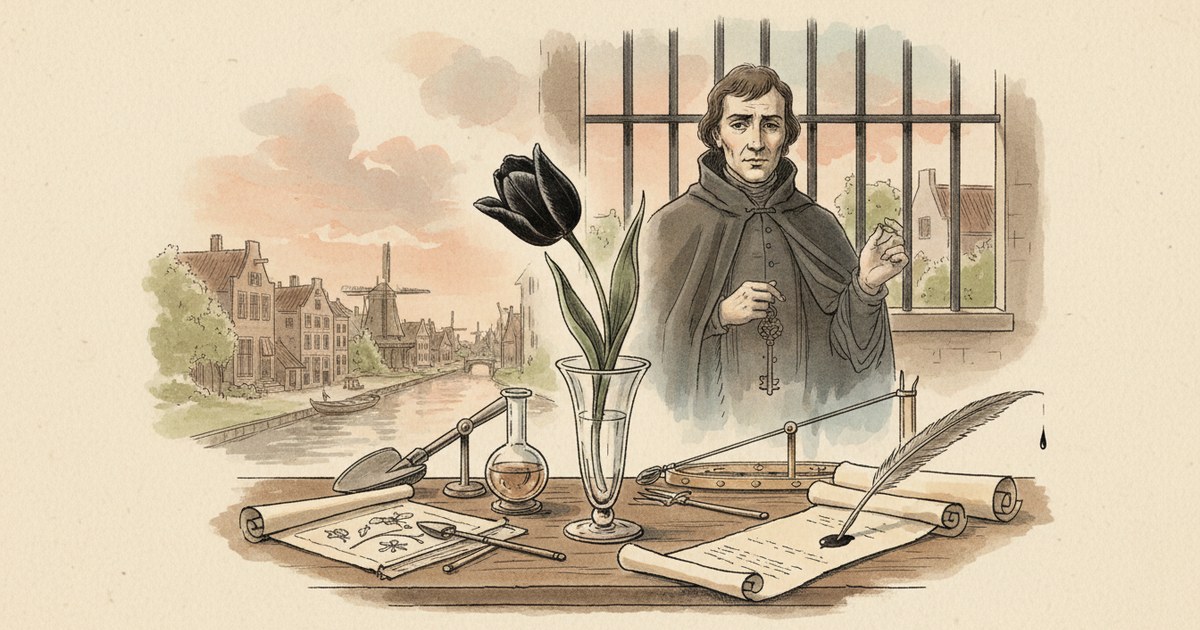
That pivot is the argument of the entire novel. While history tears itself apart in the streets, Cornelius Van Baerle, a prosperous young tulip-grower in Dordrecht, is attempting something the world has never seen: a truly black tulip. Not dark purple, not near-black — jet black, without flaw. The city of Haarlem has offered 100,000 florins to whoever achieves it. Cornelius doesn’t want the money. He wants the flower. Dumas understood something about that kind of obsession — that it’s not escapism but its own form of courage. To insist on beauty while the mob howls outside your gate is a political act.
The Son of a General the Empire Preferred to Forget
Alexandre Dumas was born in 1802 in Villers-Cotterêts, a market town an hour northeast of Paris. His father, Thomas-Alexandre Dumas, had been — briefly, improbably — one of the most feared cavalry commanders in the French Revolutionary Army. Born in Saint-Domingue to a French nobleman and an enslaved Haitian woman, Thomas-Alexandre had risen through sheer ferocity of talent to become a general of division. Napoleon then spent the rest of his career making sure that achievement went unrewarded. By the time Alexandre was four, his father was dead, broken by years of neglect and a imprisonment in Naples. The family was left nearly penniless, the pension denied.
This is not a biographical footnote. It is the marrow of everything Dumas wrote. He grew up knowing exactly what it looked like when powerful men decided that a person of exceptional ability was nonetheless inconvenient — and what it looked like when institutions closed ranks to protect that decision. He was largely self-educated, working as a notary’s clerk while reading everything he could find, and when he finally broke through in Paris, first with history plays and then with the novels that made him famous, he kept returning to the same situation: the man of genuine worth at the mercy of a system with no interest in his worth.
The Black Tulip, published in 1850, was written late in that career, when Dumas had already given the world The Three Musketeers and The Count of Monte Cristo. He was fifty, famous, financially chaotic, and apparently still thinking about what it meant to be destroyed by forces that had nothing to do with your actual guilt. Cornelius Van Baerle is arrested not for anything he did but for papers he was holding for his godfather — the same Johan de Witt whose murder opens the novel — without even knowing what they contained. The system that kills the De Witts also swallows Cornelius. Dumas isn’t making a metaphor. He’s describing a mechanism he recognized.
The collaboration with Auguste Maquet, who contributed research and structural scaffolding to many of Dumas’s novels, is worth noting precisely because The Black Tulip doesn’t read like a collaboration. It reads like a man with a specific grievance working it out at speed. The obsessive detail about tulip cultivation — the soil preparation, the grafting, the naming conventions — has the texture of someone who found in horticulture a language for the kind of patience and precision that history keeps punishing.
The Flower That Grows in the Dark
The plot mechanism Dumas uses is almost sadistically elegant. Cornelius’s neighbor, Jacob Boxtel, was himself a serious tulip-grower — until Cornelius, without meaning to, built a greenhouse that cast a shadow over Boxtel’s garden. That shadow killed Boxtel’s prize collection and turned a reasonable man into something monstrous. He spends the rest of the novel trying to steal Cornelius’s achievement. The black tulip becomes the site where envy, ambition, beauty, and justice all converge.
In prison in the Loevestein fortress, Cornelius meets Rosa, the jailer’s daughter. Their courtship is conducted through the bars of his cell, and Dumas gives it a quality that his swashbuckling adventures often don’t stop for: slowness. Cornelius teaches Rosa to read by writing lessons on scraps of paper passed through the grating. She grows his tulip bulb in a plot of earth outside the prison walls, reporting its progress back to him. The novel’s most quietly devastating passage is the one where Cornelius, unable to see the tulip himself, listens to Rosa describe it as it opens. He is a man who has spent his adult life tending flowers with his own hands, and now the only plant he cares about exists entirely in someone else’s description of it. Dumas doesn’t underline this. He trusts you to feel it.
The theft and the confrontation before the Haarlem committee are staged with the timing of a playwright — which Dumas was, before he was a novelist, and it shows. But the novel’s actual climax is quieter: the moment when the black tulip is officially registered under the name Rosa Barlaensis, combining Cornelius’s surname with Rosa’s given name. The flower is named for both of them. The obsession and the love turn out to have been the same thing.
What makes The Black Tulip worth reading alongside the more famous Dumas titles is its compression. At roughly 250 pages, it doesn’t have room for the plot surplus that occasionally buries Monte Cristo. Every chapter advances something. The pace of the opening — massacre, garden, arrest — gives you the whole novel’s logic in forty pages, and then Dumas spends the remaining two hundred earning it.
The Translation Landscape
The existing English translations divide roughly into two camps. The Victorian-era versions, most of them anonymous or semi-anonymous, are available free in various digital archives and are largely unreadable — not because the French is difficult, but because nineteenth-century English translators of French popular fiction had a habit of flattening theatrical dialogue into something resembling legal correspondence. Boxtel’s jealous ranting, which in French has the cadence of a man talking himself into monstrousness, tends to emerge as a series of grave declarative sentences. The texture that makes Dumas feel alive gets ironed out. Robin Buss’s Penguin Classics translation, the most widely cited modern version, is a genuine improvement: accurate, clean, and particularly good at the prison scenes where the register needs to stay intimate without becoming sentimental. Where it occasionally loses ground is in the set pieces — the mob scene, the Haarlem committee — where Dumas is writing at full theatrical volume and a more literal approach produces something slightly muffled.
the edition linked below positions itself in the space those set pieces leave open. The translation keeps the rhythmic aggression of the opening crowd scene — short declarative sentences that hit like a drumbeat — while letting the tulip-cultivation passages breathe at their own slower pace. A single passage makes the difference legible: the moment Boxtel first sees Cornelius’s greenhouse shadow falling across his garden. In the Buss, it’s a competent rendering of a plot point. In this translation, it reads like what it is: the exact moment a man’s life divides into before and after. That distinction is not decorative. It’s what the next two hundred and fifty pages depend on.
Why This Translation?
The Black Tulip is not a difficult book, but it is a precise one — and precision in translation means something different here than it does with, say, Flaubert, where you’re trying to preserve a surface. With Dumas, you’re trying to preserve momentum, and momentum is the hardest thing to carry across languages because it lives in sentence rhythm, not vocabulary. the edition linked below was made with that problem front and center: the goal was an English text that moves at the speed Dumas intended, where the twenty pages of mob violence and the twenty pages of horticultural patience feel like they belong to the same novel because they do.
The paperback edition is available on Amazon and includes a translator’s note on the historical context of the rampjaar — the Dutch “year of disaster” — that situates the De Witt murders without turning the opening into a history lecture. If you’ve read Dumas before, this is the novel that shows you a different gear. If you haven’t, it’s a better starting point than most people expect: tight, fast, and structurally honest about what it’s trying to do. the edition linked below is here.
Is The Black Tulip based on a true story?
Partially. The De Witt brothers’ murder on August 20, 1672 — which opens the novel — is historical fact, one of the most notorious political killings of the Dutch Golden Age. The tulip-growing competition and the character of Cornelius Van Baerle are Dumas’s invention, but they’re set against scrupulously accurate historical backdrop: the Dutch tulip mania of the seventeenth century was real, as was the intense culture of competitive breeding among wealthy growers.
What does the black tulip symbolize in the novel?
The tulip functions as the novel’s argument made visible: that the pursuit of something genuinely beautiful, when conducted with total commitment, is itself a form of resistance against the ugliness of political life. Dumas is careful not to make it allegorical in any simple sense — Cornelius genuinely wants the flower, not what it represents — but the structural contrast between the mob violence of the opening and the obsessive patience of the tulip-growing is unmistakably deliberate.
How does The Black Tulip compare to Dumas’s other novels?
It’s shorter and tighter than either The Three Musketeers or The Count of Monte Cristo, with less of the digressive subplot energy those novels rely on. It shares with Monte Cristo a core interest in wrongful imprisonment and the question of what patience costs a person, but it resolves that interest through love rather than revenge — which makes it a quieter novel, and in some ways a more honest one.
Is The Black Tulip a romance?
It has a central love story, but calling it a romance undersells it. The relationship between Cornelius and Rosa develops entirely in conditions of constraint — prison bars, smuggled letters, secondhand descriptions of a flower he can’t see — and Dumas treats that constraint as the substance of the love, not an obstacle to it. What they build together is a tulip and a shared language of literacy and patience. The romance is real, but it grows in the dark, which is the point.
Also worth reading


Verne Mapped a World He Never Visited
“`html
In the summer of 1863, Jules Verne handed his manuscript to the publisher Pierre-Jules Hetzel with a note explaining that he had, to his knowledge, invented a new kind of literature. Hetzel sent it back with corrections. The argument that followed—over tone, over credibility, over whether the volcano at the end was too much—lasted three months. Verne won on the volcano. What emerged from that quarrel was Journey to the Center of the Earth, a book that sent its readers somewhere no one had been and made the descent feel inevitable, as if the path had always been there, waiting under the basalt.
The thesis of this novel is not that the earth has a hollow interior. Verne knew the science was speculative; he used it as a premise, not a claim. The real argument the book makes is subtler and more durable: that the universe rewards the obsessive. Every figure who drives the plot forward—the professor, the nephew, the taciturn Icelander Hans—is defined by a single overriding competence brought to bear on an impossible situation. Verne is not writing about exploration. He is writing about what it costs to follow an idea all the way down.
The Man Who Mapped From an Armchair
Verne was born in Nantes in 1828, close enough to the Loire’s mouth that ships were a fact of childhood. The story goes that at eleven he stowed away on a vessel bound for the Indies, intending to bring back a coral necklace for a girl he liked. His father intercepted him at the first port. Verne reportedly said he would travel only in his imagination from then on—which is either apocryphal or the most perfectly Vernian origin story ever constructed. Either way, it landed.
What matters biographically is that Verne became a compulsive reader of scientific journals, geographic surveys, and expedition accounts. He filed index cards on coal seam depths, volcanic formations, Icelandic topography, the tensile strength of rope. By the time he wrote Journey, he had never seen Iceland, never descended a mine shaft, never stood on a glacier. The novel’s Iceland is assembled from texts—and it reads more convincingly than most travel writing of the era because Verne understood that the function of detail is not atmosphere but authority. Every measurement in this book is there to make the impossible feel earned.
He was also, crucially, broke and ambitious in roughly equal measure. The Extraordinary Voyages series he would build with Hetzel was as much commercial calculation as artistic vision. Verne needed books that would sell to families, to boys, to the educated middle class that wanted science wrapped in story. That constraint sharpened him. He could not be obscure. He could not afford to lose the reader on page forty. The result is a novel that pulls with genuine narrative pressure—not the pressure of suspense exactly, but of logical necessity. Each step underground makes retreat a little more unthinkable.
What Happens When the Staircase Goes Only One Way
The book’s engine is Professor Otto Lidenbrock, a German geologist whose relationship to other people runs entirely through the medium of their usefulness to his research. He deciphers a runic manuscript pointing to a passage through Iceland’s Snæfellsjökull volcano, informs his nephew Axel that they are leaving Thursday, and dismisses all counterarguments—including Axel’s correct observations about heat and pressure—with the confidence of a man who has simply decided the data will cooperate. He is insufferable and completely compelling, because Verne is smart enough to make him right. Not about everything. But enough. The moment you realize the professor’s recklessness is load-bearing—that without his refusal to consider failure the expedition would have turned back in the first cavern—is the moment the novel clicks into focus.
What Verne builds underground is not a horror story and not a fantasy. It is something stranger: a world that operates by geology’s actual rules, extrapolated past the point where anyone can check. The underground sea, the stone forest of fossilized trees, the sight of prehistoric creatures surfacing in black water—these land because Verne has done enough real science beforehand to make the extrapolation feel like discovery rather than invention. The reader follows Axel’s terror and the professor’s exhilaration at the same time, and the book is large enough to hold both without resolving the tension into a lesson. When the party is finally ejected from the earth’s interior by volcanic pressure—shot upward through a lava tube like a cork—it reads not as rescue but as the mountain deciding it is done with them.
Why This Translation
Most English-language readers have encountered Verne through Victorian translations that were not merely dated but actively mangled—sentences flattened, scientific passages cut for length, the professor’s voice stripped of its particular combination of tyranny and grandeur. This modern English translation restores what those editions lost: the pacing Verne actually wrote, the precision of Axel’s narration, and the full weight of the argument the novel is making. It reads with the directness the original demands. the edition linked below is available in paperback here—the version worth reading is this one.
“`
Also worth reading

Frequently Asked Questions
Did Jules Verne ever travel to the places he wrote about in his early novels?
For most of his major works, no. Verne constructed his fictional geographies from maps, scientific journals, and accounts in the Bibliothèque nationale rather than firsthand experience. His desk in Amiens was, in many ways, his only real voyage.
What was Hetzel’s main objection to Verne’s original manuscript in 1863?
Hetzel pushed back on tone and credibility, worried that readers wouldn’t accept the premise without a more measured, scientific framing. The dispute over the volcano ending was particularly contentious and dragged the revision process into a three-month standoff.
How did Verne claim his work was different from the adventure fiction that already existed?
Verne told Hetzel he had invented a new kind of literature—one grounded in verifiable science and geographic fact rather than pure fantasy or moral allegory. He wanted readers to feel that the journeys in his books could, in principle, actually be made.
Why does it matter that Verne mapped places he never visited?
It reveals how thoroughly he constructed authenticity through research rather than experience, which made his errors and inventions equally deliberate. When he got details wrong—or right—it was the library speaking, not the traveler.
Stendhal Finished This Novel in 52 Days.
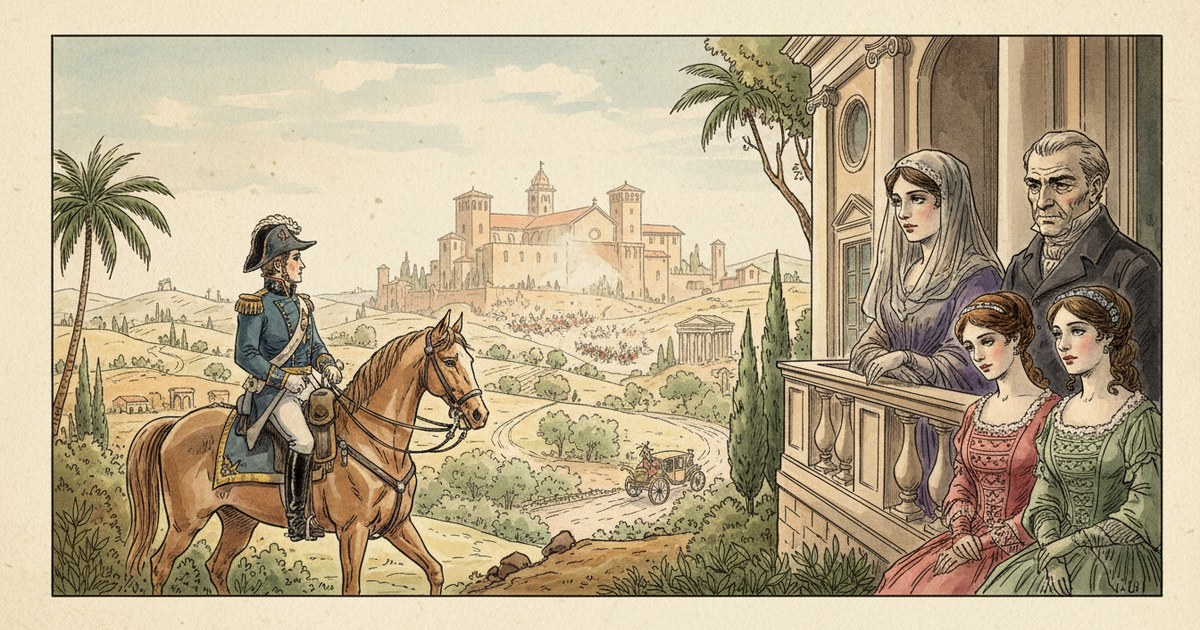
On November 4, 1838, a fifty-five-year-old French diplomat checked into a Paris apartment, ordered his secretary to take dictation, and told everyone else to leave him alone. Fifty-two days later — on December 26, the day after Christmas — he stopped talking. The manuscript of The Charterhouse of Parma was finished. Henri Beyle, who had published novels before without causing much stir, handed the world one of the most admired books in the French language, then went back to being a minor consul in a dusty Italian port town.
The speed is not a curiosity. It is the whole argument of the book made flesh. The Charterhouse of Parma is a novel about what happens when energy, desire, and intelligence are forced to live inside the suffocating machinery of politics and power — and the fifty-two-day composition was Stendhal doing exactly what his hero Fabrice del Dongo never quite manages: moving before the world can stop him. Balzac, who had no shortage of his own genius to protect, read it and declared it “the most significant novel of his time.” Tolstoy read the Waterloo chapters and rewrote his own understanding of war. Hemingway acknowledged the debt. Henry James called it one of the dozen best novels ever written. None of them were being polite.
The thesis is simple and devastating: passion is real; the world is not — or not in the way that romantics need it to be. Fabrice del Dongo spends the entire novel trying to live as though Napoleonic glory is still available, as though love is cleanly accessible to those who want it badly enough. Italy disagrees. The petty court of Parma, the ministerial intrigues, the prison tower above the plain — these are Stendhal’s argument that the machinery of society grinds hardest against precisely those who refuse to become machines themselves.
The Man Who Loved Italy More Than France
Henri Beyle was born in Grenoble in 1783 and spent the rest of his life in flight from it. As a teenager he joined Napoleon’s Italian campaigns and rode into Milan with the army — experiencing, he later said, the happiest weeks of his existence. The Charterhouse of Parma opens with exactly this moment, in what may be the most exhilarated first chapter in nineteenth-century fiction: French soldiers arriving in a city that embraces them, a population drunk on liberation, music in the streets. That Stendhal lived this scene before he wrote it is not incidental. The joy in those pages is the joy of a real twenty-year-old’s memory, and it sets the novel’s whole register — pleasure is possible, the world can open — before the machinery of Restoration politics closes back in.
He used over 170 pen names across his life, settling on “Stendhal” — borrowed from a German provincial town, for reasons he never explained — for the work that lasted. The disguise was constitutional. He was a Bonapartist and republican surviving in the Restoration, a man of appetite and intelligence employed as a minor bureaucrat, in love serially and unrequitedly. In 1822 he published a theoretical study of romantic passion called De l’Amour, which introduced his concept of crystallization: the process by which a lover coats the beloved in imagined perfection until the real person disappears. It is the operating system of his fiction. Fabrice doesn’t fall in love with Clélia Conti so much as crystallize her — and the novel knows this, and finds it both beautiful and doomed.
By 1838, Beyle was serving as consul in Civitavecchia, a minor Roman port he hated, grinding through customs paperwork while the Italy he loved sat just out of reach. Paris was leave. The Charterhouse was written on leave. That it poured out in fifty-two days says something about what happens when a man finally gets to the page he has been carrying for decades. The novel is not sloppy — it is fluent in the way that only happens when a writer already knows the territory. Stendhal had been living among courts, informers, ministers, and romantic obsessives his entire adult life. He was not inventing a world. He was reporting on it.
He died in 1842, on a Paris street, of a stroke. He had written in his diary: “I am fifty years old. Could it be true? And I am not fifty yet in the life I have lived.” This is the novel’s complaint too. Life keeps happening at the wrong speed, in the wrong register, inside institutions built to exhaust energy rather than honor it.
The Battle Nobody Sees, the Prison Nobody Wants to Leave
Stendhal’s Waterloo sequence is probably the most influential battle description in all of fiction, and it works precisely because it refuses to be a battle description. Fabrice del Dongo, seventeen years old, rides toward Waterloo expecting the epic confrontation of his imagination — the Napoleon of legend, the charge, the moment of historical clarity. What he finds is mud, confusion, a woman selling brandy from a cart, soldiers stealing his horse, an accusation of spying. He hears cannons. He sees men fall. He returns afterward not knowing whether he was actually present at the battle. “Was this a real battle?” he asks. “Was this Waterloo?” Stendhal’s answer is that history happens in fog, that heroism is mostly a story told after the fact, and that the gap between experience and narrative is where the novel lives. Tolstoy read those chapters and drew directly on their technique for War and Peace.
The second great set piece inverts everything. Fabrice, imprisoned in the Farnese Tower on a trumped-up charge, has every reason to despair. Instead he discovers from his cell window a view of Clélia Conti tending her birds in the aviary below. He falls in love across distance and height. The prison becomes, absurdly, the most alive he has ever been — because in the tower there is no court intrigue, no ministerial calculation, no role to play. Only the window, the birds, and Clélia. Stendhal has the nerve to insist that this is not an irony but the truth: constraint can produce freedom if the thing you love is inside the constraint with you. That Fabrice eventually escapes and finds the world outside smaller than his cell is the novel’s most devastating joke.
Around Fabrice, the book builds an entire political ecosystem described with the affectionate contempt of someone who spent years navigating one. Count Mosca — brilliant, pragmatic, self-aware enough to know exactly how compromised he is — loves the Duchess Gina Sanseverina with the helplessness of a man who understands everything except how to stop. Gina, Fabrice’s aunt, loves Fabrice with an intensity the novel declines to fully name. The court of Parma is a miniature of every European government of the period: petty, paranoid, capable of genuine cruelty over nothing. Stendhal doesn’t satirize it. He describes it with precision, and the precision is enough.
The Translation Landscape
English readers have had options since C.K. Scott Moncrieff’s 1925 translation — the same Scott Moncrieff who gave us the standard Proust. His Charterhouse is readable, and for its era admirably direct, but it carries the weight of Edwardian prose habits that slow Stendhal’s characteristic velocity. Passages that should cut land softly. The comedy, which in French has a dry, almost offhand quality, tips toward elaborateness in Moncrieff’s hands. It remains historically significant; it no longer reads as the best option available.
Richard Howard’s 1999 version for the Modern Library is widely considered the gold standard, and for good reason. Howard keeps Stendhal’s ironic detachment intact without academicizing it. The sentences move. The Waterloo chapter, in Howard, reads at exactly the right speed — fast enough to feel like chaos, controlled enough to feel designed. John Sturrock’s 2006 Penguin Classics version is clean and accurate and slightly bloodless: more useful for close reading than for the sustained pleasure this novel demands. Sylvia Raphael’s Oxford World’s Classics edition is scholarly and reliable, with useful notes, but the prose sometimes sacrifices momentum for literalness, which works against a novelist whose style is essentially the delivery mechanism of the joke.
Why This Translation?
the edition linked below of The Charterhouse of Parma brings the novel into contemporary English without flattening Stendhal’s ironic distance or domesticating his French idiom into something merely smooth. Where earlier translations sometimes chose safety — a reliable word, a conventional syntax — this edition makes choices that honor the novel’s speed. Stendhal wrote in fifty-two days because he was following something; a translation that feels labored defeats that. the edition linked below moves the way the novel was written: fast, precise, and committed to the irony rather than hedging against it.
For readers coming to The Charterhouse of Parma for the first time, this translation offers what matters most: entry into the novel’s actual world, not a scholarly mediation of it. The Waterloo sequence lands. The prison tower lands. The Duchess Gina’s grief in the final pages lands. This edition is available in paperback for readers ready to meet one of the great novels of the French language on its own terms. Stendhal’s argument — that passion is the realest thing in a world engineered to make passion impractical — comes through with the clarity those fifty-two days of dictation were reaching for. Read it at the speed it was written.
Is The Charterhouse of Parma difficult to read?
It is long — around 500 pages in most editions — and Stendhal’s narrative assumes you can track a large cast navigating Italian court politics. But the prose itself is not difficult. Stendhal writes with unusual clarity and pace for a nineteenth-century novelist, and a good modern translation makes the novel accessible without simplifying it. Most readers find it absorbing rather than demanding.
Does this novel need to be read alongside Stendhal’s other work?
The Charterhouse of Parma stands completely alone. It shares a sensibility with The Red and the Black — romantic ambition in collision with social machinery — but different characters, a different setting, and a different emotional register. Read either one first. Most readers who begin with The Charterhouse find it the more immediately pleasurable of the two.
What makes the Waterloo sequence so celebrated?
Stendhal depicts the Battle of Waterloo entirely from inside the confusion of a participant who has no commanding view of what is happening. There are no heroic charges, no clarifying moments of decision — only noise, mud, and a woman selling brandy from a cart. Tolstoy read it and drew directly on its technique for the battle sequences in War and Peace. It is the first modern war narrative: war as it is experienced, not as it is narrated.
Where does The Charterhouse of Parma fit in the French literature canon?
It sits at the foundation of the French realist novel, alongside Balzac and ahead of Flaubert, though Stendhal’s tone is more ironic and less exhaustive than either. His influence runs through Tolstoy and James and into the twentieth century — Proust, who admired Stendhal’s psychological precision, is difficult to imagine without it. For a first encounter with French literary fiction, it is one of the most rewarding entry points: serious without being solemn, long without feeling slow.
Also worth reading
More from Stendhal


D’Artagnan Destroys Everyone He Meets
The duel is already arranged by the time d’Artagnan meets all three of them. He has insulted Athos at eleven, Porthos at noon, and Aramis at one — three separate appointments, three men who each intend to kill him before dinner. When he arrives at the first, sword in hand, he finds all three standing together. They are going to share him.
That scene — absurd, elegant, foreshadowing everything — is the novel in miniature. The Three Musketeers is not, at bottom, a story about swordfights or Cardinal Richelieu or diamond studs smuggled across the Channel. It is a story about what it means to make a binding promise to another person and then spend the rest of your life keeping it. D’Artagnan’s triple appointment becomes a triple friendship, and that friendship becomes the only institution in the book that does not eventually betray someone. That is Dumas’s thesis, and he argued it across six hundred pages with the conviction of a man who had been let down by every other kind of loyalty.
The thesis holds because Dumas never softens it. Athos, Porthos, and Aramis are not good men in any conventional sense. Athos is a functioning alcoholic dragging a ruined marriage behind him like a chain. Porthos is a vain spendthrift who lies about his mistress’s wealth with cheerful, transparent regularity. Aramis is headed for the priesthood via a route that involves dueling and an ambiguous correspondence with a woman he refuses to name. These are not heroes. They are men who, given the chance, will lie, cheat, kill on command, and cover for each other without hesitation — and Dumas presents all of this as proof of their virtue. The logic is not confused. It is the logic of the battlefield: the only person worth trusting is the one standing next to you when it matters.
A Man Who Knew What Institutions Were Worth
Alexandre Dumas was born in 1802 in Villers-Cotterêts, a market town north of Paris, the grandson of a Haitian slave and a French aristocrat. His father, Thomas-Alexandre Dumas, had been one of Napoleon’s most decorated generals — a man of extraordinary physical courage and presence who rose to command armies before Napoleon, suspicious of his independence and his mixed-race heritage, sidelined him completely. Thomas-Alexandre died when his son was four, leaving the family in debt to a pension the Empire never honored. Dumas grew up poor, the son of a famous man the state had decided to forget.
That biography runs through every page of The Three Musketeers. The novel’s villains are not evil in any operatic sense — they are institutional. Richelieu is not cruel; he is efficient. The queen’s court is not wicked; it is self-interested. The men who nearly destroy d’Artagnan do so because they are protecting structures that have already decided what his kind of ambition is worth. Dumas understood that calculus firsthand. The musketeers’ vow — all for one, one for all — exists in the novel as a direct answer to every institution that had taken something from Thomas-Alexandre Dumas and called it policy.
Dumas eventually made and lost fortunes so large they beggar comprehension. At the height of his fame he employed dozens of research assistants and co-writers — Auguste Maquet contributed substantially to The Three Musketeers, a fact Dumas never formally acknowledged. He built a chateau outside Paris named after his most famous novel, threw parties that lasted weeks, and went bankrupt twice. The money never lasted. The friendships did. In that light, the novel’s central argument reads less like romantic adventure and more like a personal credo.
He was also one of the fastest and most instinctive storytellers in the French literary tradition. The Three Musketeers was serialized in La Gazette de France in 1844, published in weekly installments written under relentless deadline pressure. The pace of the book — the way each chapter drops you into a situation already in motion — is not purely a stylistic choice. It is the imprint of a man who had to hold readers until next Thursday and knew exactly how to do it. Every cliffhanger is a professional calculation, and nearly all of them still work.
The Vow That Holds When Everything Else Breaks
What Dumas understood, and what makes the novel still land, is that the friendship is tested not by enemies but by the friends themselves. The most damaging blow d’Artagnan receives in the entire book does not come from Richelieu or Milady. It comes from Athos, in a moment of near-suicidal honesty, when he reveals what he did to his wife on the morning he discovered her brand and left her for dead in a forest. That scene — quiet, devastating, buried in the middle third — is where Dumas pays out his thesis. D’Artagnan does not leave. He hears something that would end most friendships and stays. That is the vow working.
The plot — the diamond studs, the siege of La Rochelle, the letters between the queen and Buckingham — is scaffolding. It gives the musketeers reasons to move and things to protect, but Dumas is not ultimately interested in whether Buckingham lives or Richelieu wins. He is interested in what happens to four men who have agreed to share a fate. The brilliance is that he never lets that interest tip into sentiment. When the musketeers finally move against Milady de Winter in the final section, they do so as a tribunal — four men who have collectively decided that something must end, and who divide the weight of that decision equally among themselves. It is the most chilling scene in the book, and also its most honest articulation of what “all for one” actually demands.
Milady herself is the novel’s structural counterweight — a woman of extraordinary competence and zero loyalty, who treats every alliance as temporary and every person as a tool. Dumas gives her the best lines in the book and lets her be right about almost everything except the permanence of the musketeers’ bond. Her failure is not a moral failure; it is a failure of imagination. She cannot conceive of an alliance that isn’t transactional because she has never been offered one. The novel frames that as tragedy as much as villainy.
None of this reads as heavy or literary in execution. The book moves — relentlessly, gleefully — through intrigue, swordplay, midnight rides, and forged letters. Dumas never announces his themes. He trusts the story to carry them, and six hundred pages later you realize you have been reading an argument about loyalty the whole time without ever feeling lectured. That is the specific discipline the serialized form forced on him, and it is why the novel has outlasted nearly every contemporary that outranked it critically.
The Translation Landscape
The Three Musketeers has been in English for nearly as long as it has existed in French, which means the translation landscape is crowded and uneven. The oldest versions in wide circulation — including the 19th-century translations that fell into public domain and now populate Project Gutenberg and budget paperback editions — carry the syntax of Victorian prose: long subordinate clauses, formal diction, a stateliness that slows Dumas’s natural speed to a walk. They are not inaccurate, exactly, but they muffle the instinctive momentum that made the original a sensation. Reading them is like watching a sprinter run in dress shoes.
Richard Pevear’s 2006 translation for Penguin Modern Classics is a different proposition. Pevear, best known for his work on Tolstoy and Dostoevsky, brings careful attention to register and genuine respect for Dumas’s comic timing. The Penguin edition is authoritative and complete, with useful historical notes. Its occasional weakness is that Pevear’s sensibility pulls toward the deliberate — certain passages acquire a weightiness that the original dispatches at full gallop. David Coward’s translation for Oxford World’s Classics is arguably the most widely assigned in university courses: rigorous, clearly annotated, pitched at the reader who arrives with context rather than the reader who arrives cold and simply wants to know what happens next.
This translation takes a different position. Where the Penguin and Oxford versions balance fidelity with scholarly apparatus, the edition linked below prioritizes forward momentum and plain speech — the qualities that made the serialized novel a mass phenomenon in 1844. The sentences land faster. The dialogue reads as people actually talking rather than as historical document. That is not a concession to accessibility; it is an argument about what Dumas was actually doing. He was not writing for scholars. He was writing for readers who needed to know what happened next and would not forgive him if they had to stop and parse a sentence to find out.
Why This Translation?
A translation of The Three Musketeers should feel like riding at speed — the scenery has to blur a little or the book isn’t working. This edition achieves that. The prose doesn’t call attention to itself; it gets out of the way of the story, which is exactly what Dumas intended. The opening chapters move with an urgency that older translations throttle with period syntax, and the dialogue — which carries most of the novel’s wit — lands with the precision of people who know exactly what they’re doing to each other. If you’ve read the book before in an older version and found it slower than expected, this is the translation that explains why the novel still has a reputation for pace.
For a novel that rewards rereading — and this one does, because on a second pass you see Dumas laying his groundwork fifty pages before you’d think to look — the paperback belongs on a shelf rather than a screen. Read it once for the plot. Read it again to watch Dumas build the case, one shared appointment at a time, that the only vow worth making is the one you make to the person standing next to you when everything else has already broken. The Three Musketeers: A New Translation in Modern Accessible English is available here.
Is The Three Musketeers a children’s book?
It is frequently shelved near children’s adventure fiction, but that is a category error. The Three Musketeers deals with execution, sexual manipulation, a secret tribunal, and a morally devastating confession at its center. It was serialized for adult readers in 1844 and reads as such. Younger readers can engage with the adventure on its surface; adult readers get the argument running underneath it the whole time.
Is this a complete translation or an abridged version?
This is a complete, unabridged translation of the full novel. Many inexpensive or older editions quietly compress the middle sections — particularly the chapters surrounding the siege of La Rochelle — which removes the context that makes the final act land with the force Dumas intended. This edition does not cut.
How does The Three Musketeers connect to the sequels?
Twenty Years After and The Vicomte de Bragelonne (which contains the Man in the Iron Mask section) follow the same four characters into middle and old age. The first novel stands entirely on its own. The sequels are rewards for readers who finish it and find they cannot let the characters go — which, if Dumas has done his job, will be most of them.
How long does it take to read?
At a comfortable pace the novel runs six to eight hours for most adult readers. It accelerates as it goes — the back third moves faster than the opening because Dumas has finished arranging the board and is now playing the game in earnest. Most readers who start it finish it.
Also worth reading

Jules Verne Went Darker Than You Remember
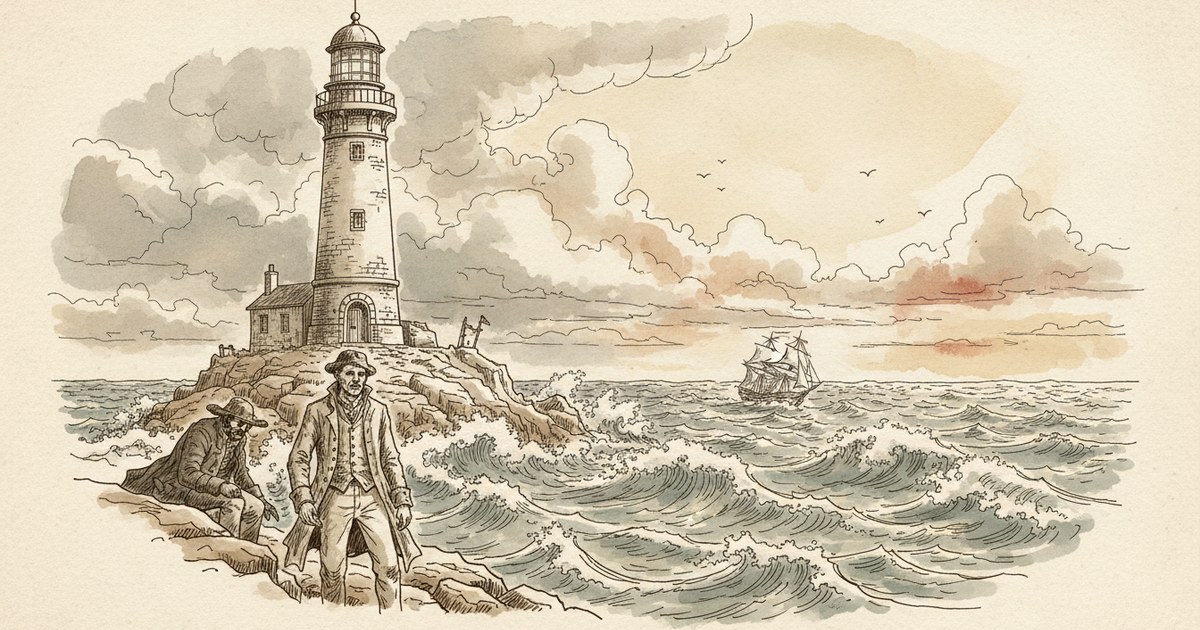
Three men are already alone when the trouble starts. They have been dropped on a bare island off Cape Horn to keep a light burning for ships pushing through one of the worst passages on earth. The station is new. The work is simple in theory: tend the lantern, watch the sea, endure the wind. But Verne does not treat isolation as a noble test of character. He treats it as a condition predators know how to exploit.
That is the first thing The Lighthouse at the End of the World corrects for readers who still think of Jules Verne as the cheerful engineer of impossible journeys. This is not the Verne of ingenious contraptions and buoyant discovery. This is a late Verne novel stripped to rock, weather, greed, and fear. Its power comes from how little romance it allows the setting. The island is not sublime scenery. It is a workplace at the edge of the map, and once violence enters it, the book becomes a study in how thin civilization looks when there is no audience to perform it for.
The bandits who come ashore are not calculating strategists. They are opportunists who recognize an advantage and press it. Verne gives them no ideology and no grievance — only appetite, and the cover of geography. Against them, one surviving lighthouse keeper named Vasquez must decide whether keeping the light burning is worth the exposure it costs him. That tension — visibility as both duty and danger — turns the novel from a survival story into something close to an argument about what infrastructure requires of the individuals who maintain it.
The Novelist of Progress, Minus the Comfort
Verne grew up in Nantes, within earshot of the Loire estuary, watching ships work their way out toward the Atlantic. His father, a lawyer, intended him for the bar. Verne stayed in Paris and wrote plays instead — and then, eventually, the novels that made him one of the most translated writers in history. That early conflict between institutional expectation and personal conviction runs quietly through all his work. His heroes are people who go where the map says nothing is.
For thirty years, the going was cheerful. His publisher Pierre-Jules Hetzel shaped the Voyages Extraordinaires series into optimistic adventure: Journey to the Centre of the Earth, Twenty Thousand Leagues Under the Sea, Around the World in Eighty Days. These are books in love with what technology can open up. Danger arrives, but it arrives inside an architecture of curiosity. The world gets larger. The reader gets to come along.
Then Hetzel died in 1886. That same year, Verne’s nephew Gaston, in the grip of a psychotic episode, shot him in the foot with a pistol. Verne walked with a limp for the rest of his life. The late novels that followed — Propeller Island, Master of the World, The Lighthouse at the End of the World — show a writer no longer interested in machinery as salvation. He was still interested in systems. But now he wanted to show what happens when systems are turned against the people they were built to protect. The biographical fact is not incidental: a man who spent decades writing about the transformative power of modern infrastructure, then watched a member of his own family use a pistol on him at close range, had earned the right to be less sanguine about progress.
The Lighthouse was published in 1905, the year Verne died at seventy-seven. Scholars have debated how much of the final text was revised by his son Michel, but the novel’s cold tone reads as Verne’s own: he had spent forty years cataloguing the technologies that bind civilization together, and spent his last decade examining what it looks like when those technologies are simply extinguished. The lighthouse is the purest expression of that reversal. Instead of a machine conquering nature, here is a machine that someone wants dark — because a dark passage means wrecked ships, and wrecked ships mean salvage rights. The light is civilization’s claim on chaos. The bandits’ goal is to put it out.
A Room You Cannot Leave and a Light You Cannot Let Die
The novel’s structure is spare to the point of austerity. Three keepers arrive. Two die early. Vasquez — the one who survives — spends most of the book hiding on an island occupied by men who would kill him if they knew he was there. The plot is almost geometrically simple: one man, one duty, one mortal obstacle. What prevents it from reading as adventure-story mechanics is Verne’s insistence on the physical weight of everything. The cold is not atmospheric. The fog is not mood-setting. They are operational problems Vasquez has to solve if the light is going to burn at all.
There is a sequence midway through the novel where Vasquez must reach the lighthouse tower without being seen. Verne gives you the approach in granular detail — the angle of approach, the timing, the cover provided by a specific rock formation, the sound the door makes. None of it is thrilling in the conventional sense. It is methodical, almost procedural, and that procedural quality is exactly the point. Keeping a light burning for strangers at sea is not romantic when you are the one doing it in the dark with armed men hunting you. Verne makes you feel the cost of what routine maintenance requires when the routine has been destroyed.
What lifts the novel above a siege narrative is the question it refuses to answer directly: why does Vasquez keep doing it? He is not being watched. He has no way to call for help. He could go dark and survive. Verne never gives him a speech about duty. He just keeps showing Vasquez moving toward the light — calculating his exposure, paying the cost, repeating the act. The argument is made entirely through action, and it lands harder for that restraint. The reader supplies the meaning because Verne refuses to.
The bandits, for their part, are not villains the way Verne usually draws villains. They have no diabolical scheme. They want to wreck ships and strip the cargo. They are efficient and amoral and almost boring in their purposefulness. That boredom is the point. Verne understood that ordinary greed, given enough geographic cover, does not need to be dramatic to be devastating. The island provides the cover. The rest follows automatically.
The Translation Landscape
Most English readers who have encountered The Lighthouse at the End of the World have done so through one of the early public-domain versions produced in the years immediately following Verne’s death — translations from Sampson Low or Arco that prioritized fidelity to plot over any attention to Verne’s prose rhythm. These versions are serviceable as story delivery systems. As reading experiences, they flatten the novel’s austerity into something merely plain. Verne’s sentences in the original French are short, load-bearing, and deliberate; the early English versions tend toward the bureaucratic, and the cumulative effect is a book that feels less taut than it actually is. The tension Verne built into his pacing simply does not survive the transfer.
More recent scholarly translations — including the critically annotated editions produced for the Wesleyan University Press Verne series, which has worked to recover the serious literary Verne from beneath decades of adventure-fiction marketing — treat the prose more carefully and restore some of the compression Verne intended. These editions are valuable for readers who want footnotes and critical apparatus alongside the text. What they sometimes trade away is forward momentum; annotation creates pauses that a novel this spare cannot always absorb. the edition linked below aims at different territory: a reading experience that feels immediate and unobstructed, where the sentence does its work without announcing itself. A passage like Vasquez timing his approach to the lantern room reads in this translation the way Verne wrote it — as a clock ticking, not a description of a clock ticking.
Why This Translation?
The case for the edition linked below comes down to register. Verne wrote The Lighthouse at the End of the World in plain, controlled French — not elevated prose, not literary performance, but the language of a man who had spent decades writing about practical problems and practical solutions. A translation that reaches for elegance misses the point. This translation does not reach for elegance. It reaches for clarity, and in a novel where the drama lives in logistics and physical detail — the angle of a rock face, the timing of a door, the weight of wind against a man trying not to be seen — that is exactly the right call. The sentences land with the weight Verne intended.
The edition is available in paperback and priced for readers rather than collectors. If you have been meaning to encounter the late Verne — the Verne after the optimism ran out, after the foot injury and the dead publisher and the long reckoning with what progress actually costs — this is a clean, unadorned way in. The paperback edition is available here. The book is short enough to read in an afternoon and dense enough to stay with you considerably longer than that.
Is The Lighthouse at the End of the World a children’s book?
Not in any meaningful sense. Verne is routinely shelved with adventure fiction for young readers because of his early novels, but this late novel is grim and spare. Two of the three lighthouse keepers die in the opening section. The violence is not graphic, but it is not softened either. Adult readers who come to it expecting the buoyancy of Around the World in Eighty Days will find something considerably darker and more unforgiving.
How does this book compare to Verne’s more famous novels?
Twenty Thousand Leagues Under the Sea and Around the World in Eighty Days are novels of expansion — the world getting larger, systems working more or less as intended. The Lighthouse at the End of the World runs in the opposite direction: a single man, a single duty, a shrinking perimeter. It is closer in feeling to a siege novel than to anything Verne wrote in his prime. Readers who know only the famous works should treat this as a companion piece to them — the same obsession with infrastructure and modern systems, but stripped of every reassurance.
Is the translation faithful to the original French?
This translation works directly from Verne’s French text, preserving the structure and pacing of the original. The aim throughout is readable English that carries the weight of the source material — not a paraphrase, not a literary re-imagining, but a translation that trusts Verne’s prose to do its own work once it crosses the language boundary.
Where is the novel set, and does the location matter?
The novel is set on Isla de los Estados — Staten Island in English, a real island at the southeastern tip of South America, east of Tierra del Fuego. The Argentine government built a lighthouse there in 1884, the year before Verne began writing. The geographical specificity is load-bearing: this is not a symbolic nowhere. The island is real, the passage is real, and the danger ships faced rounding Cape Horn was real and ongoing. Verne was writing about an actual problem that actual infrastructure was built to solve — which is precisely what gives the novel its particular, unromantic weight.
Also worth reading

Dumas Wrote Outsiders Because He Was One
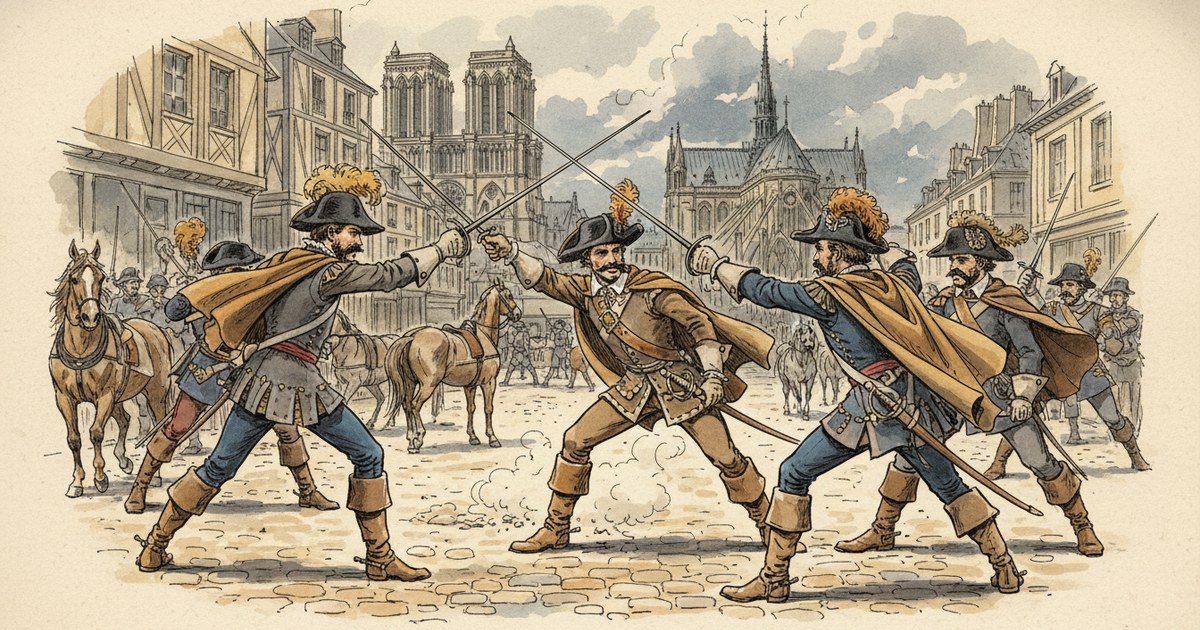
In the opening chapters of The Three Musketeers, d’Artagnan manages, in the span of a single afternoon, to schedule three separate duels with three men he has never met. He bumps into Athos, apologizes badly, and is challenged. He steps on Porthos’s bandolier, offends him, and is challenged again. He laughs at Aramis’s letter, insults his dignity, and is challenged a third time. He then discovers, standing in the dueling ground at dusk, that all three of his opponents are friends—and that he is supposed to fight them one after another. He is eighteen, alone in Paris, and has almost no money. He grins.
That grin is the engine of this novel. Alexandre Dumas wrote The Three Musketeers in 1844 as a serial for Le Siècle, releasing it in weekly installments to a readership that could not get enough. What he understood, with an instinct that bordered on genius, was that readers do not primarily want plot. They want fellowship. They want to be in the room when men who are genuinely good at what they do decide to act together against something larger than themselves. Every sword fight, every midnight ride, every improvised disguise in this book is secondary to the central fact: these four men choose each other, and that choice holds.
The thesis of The Three Musketeers is not that loyalty is noble. It is that loyalty, when it is real and tested and costly, is the only thing that makes any of the rest of it bearable. Dumas argues this through accumulation—scene after scene in which d’Artagnan could walk away, in which any reasonable man would walk away, and does not. The novel earns its famous motto. “All for one and one for all” is not a slogan in this book. It is the outcome of two hundred pages of proof.
The Man Who Arrived in Paris With Nothing and Built Everything
Dumas did not invent d’Artagnan. He became him. In 1822, at twenty years old, Alexandre Dumas arrived in Paris from the provinces with fifty-three francs in his pocket, a letter of introduction he was not sure would be honored, and an absolutely unreasonable confidence in his own abilities. He had taught himself to read from his father’s military dispatches after the general died young, leaving the family in debt and the boy without much formal schooling. Within a decade Dumas was the most famous playwright in France. Within two decades he was the most read novelist in the world. The arc of d’Artagnan’s first year in Paris is not a romance. It is a memoir in disguise.
His father’s story mattered to the book in ways Dumas never stated directly. General Thomas-Alexandre Dumas was the son of a French nobleman and an enslaved woman in Saint-Domingue. He rose to become one of Napoleon’s most celebrated commanders, then fell out of favor, was captured, and died of a slow poisoning in 1806 when Alexandre was four. The boy grew up knowing that his father had been brilliant, loyal, and expendable—that the men in power would use a great soldier and then discard him when he became inconvenient. Cardinal Richelieu in The Three Musketeers is not merely a villain. He is the system that rewards genius only until it becomes a threat. The musketeers survive him not by being stronger but by being ungovernable—by owing their allegiance to each other rather than to any institution that could revoke it.
By the time Dumas wrote The Three Musketeers, he had earned and lost several fortunes. He built the Château de Monte-Cristo, threw open its doors to anyone interesting, and watched it drain him. He wrote with collaborators, most prominently Auguste Maquet, who helped research and structure the historical scaffolding while Dumas supplied the velocity and the voice. Critics used this against him. What they missed was that Dumas’s actual skill was not research—it was pace. He knew exactly how long a scene should breathe before the door opens and everything changes. That instinct is everywhere in The Three Musketeers, and it is his alone.
What the Book Actually Does
The Three Musketeers is set in 1625, the reign of Louis XIII, and the central plot—retrieve the queen’s diamond studs from London before the Cardinal can expose her indiscretion—is almost beside the point. What matters is the machinery Dumas builds around it: the speed at which trust forms between strangers, the way competence recognizes competence, the specific texture of men who are very good at violence but choose, most of the time, not to use it. The book moves like a well-ridden horse. You feel the rhythm before you understand where you’re going.
Milady de Winter arrives in the second half and the novel becomes something else entirely. She is not a plot obstacle. She is a force with her own grievances, her own intelligence, and her own code—and when d’Artagnan encounters her at full power, the cockiness that carried him through the first hundred pages becomes dangerous. Dumas gives her enough that the reader understands her without the book asking you to excuse her. That balance is harder than it looks. Most adventure fiction of this period simply does not manage it.
The scene that earns the most examination is the one readers tend to remember as uncomplicated action: the siege at the Saint-Gervais bastion, where the four musketeers share breakfast under cannon fire to win a bet. Dumas describes the food in careful detail—the wine, the cold chicken, the plates laid out with the enemy approaching—and the effect is not comedy. It is a statement about what these men have decided matters. They have chosen the meal over the cover. They are going to finish it. The reader laughs and understands something real at the same time.
What Dumas knew, and what makes the novel still function after 180 years, is that adventure is not primarily about danger. It is about watching people be excellent together. The duels and the chases and the schemes are the vehicle. The cargo is four men who genuinely enjoy each other’s company, and whose company the reader cannot stop wanting to be in.
The Translation Landscape
The history of The Three Musketeers in English is partly a history of the novel being domesticated into something safer and more decorative than it actually is. The oldest Victorian translations, some dating to the 1840s, captured the incident faithfully enough but ironed out Dumas’s rhythm—the short declarative sentences that follow a long descriptive one like a punch after a feint. They read as though a careful schoolmaster had reviewed them for excess. Robin Buss’s translation for Penguin Classics is considerably better: clear, accurate, and honest about the novel’s darker material. It handles Milady’s storyline without euphemism. If Penguin Classics is what you have, Buss is a sound choice. The weakness is a certain even-handedness that smooths Dumas’s deliberate tonal lurches—the moments where the prose suddenly accelerates or drops into near-silence to signal that something irreversible is about to happen.
Richard Pevear’s translation, published in 2006, brings rigorous attention to the French. Pevear is scrupulous about what Dumas actually wrote rather than what a translator expects Dumas to have meant, and for readers who want fidelity above all else, his version delivers it. The tradeoff is a certain deliberateness of pace in the dialogue exchanges—places where Dumas’s wit lands as a crack of speed in the French and arrives in Pevear’s English as something a beat slower. Both Buss and Pevear are legitimate choices for readers who want a translation that takes the original seriously. What they offer is accuracy. What they do not always offer is propulsion. The modern English translation available through Classics Retold was built around that specific problem: keeping Dumas’s velocity without softening what the novel is actually doing.
Why This Translation?
The case for this edition rests on a single priority: the book should read at the speed Dumas wrote it. The Three Musketeers was serialized—it was designed to be devoured, to end each installment at the precise moment when stopping felt like an injury. A translation that produces elegant sentences at the cost of momentum is solving for the wrong thing. This modern English edition keeps the sentence structure light where Dumas kept it light, and earns its longer passages the same way the original did—by making the reader feel that the length is necessary, that the scene requires it. The result is a version that new readers finish, which is the first obligation of any translation of a novel that was built to be finished.
The paperback edition is available on Amazon. If you have never read The Three Musketeers—if you know the motto but have not watched d’Artagnan actually become the kind of man who deserves to say it—this is the edition to start with. If you read it years ago in a version that felt slow or stiff, this translation is the reason to go back. The grin is still there on the dueling ground at dusk. Everything it promises, the book delivers.
Is The Three Musketeers appropriate for younger readers?
The novel contains dueling, period-accurate political violence, and a villain whose storyline involves serious harm. Most readers handle it comfortably from around age twelve, but parents should know that Dumas does not sanitize Milady de Winter’s arc. The darkness is part of what makes the loyalty of the four musketeers feel like it costs something.
How accurate is The Three Musketeers to real French history?
The framework is historically grounded: Louis XIII, Cardinal Richelieu, the Duke of Buckingham, and the political tensions between France and England are all real. Dumas borrowed the character of d’Artagnan from a seventeenth-century memoir. But he was writing popular serial fiction in 1844, not historiography, and he adjusted timelines, invented incidents, and sharpened historical figures into types. The history is scaffolding. The novel is what Dumas built on top of it.
Do I need to read The Three Musketeers before Twenty Years After or The Vicomte de Bragelonne?
Yes. The Three Musketeers establishes who these men are and what they owe each other. The sequels—particularly Twenty Years After, which is nearly as good—depend entirely on the reader carrying that history forward. The emotional weight of seeing these characters older, more divided, and facing a world that no longer fits them only lands if you have watched them choose each other when they were young.
What makes this translation different from the free public domain versions available online?
The free versions circulating online are almost universally the Victorian-era translations, most from the 1840s through 1890s. They are in the public domain because they are old, not because they are good. Many use archaic diction, restructure Dumas’s sentences for Victorian taste, and handle the novel’s sharper material with period-appropriate evasion. This modern English translation was made specifically for contemporary readers—same story, same fidelity to the original French, built to move the way Dumas intended it to move.
Also worth reading
Proust Published His Worst Work First. Deliberately.
In 1896, Marcel Proust priced his debut book at thirteen and a half francs. The going rate for a book of comparable size was three. He had also secured a preface from Anatole France, the most celebrated writer in the country; commissioned watercolor illustrations from Madeleine Lemaire, a well-connected salon hostess; and persuaded his composer friend Reynaldo Hahn to provide four original musical pieces to accompany the poems inside. The book was a luxury object — embossed, illustrated, over-decorated — and it sold almost nothing. Critics noticed the extravagance before they noticed the writing. One reviewer called it “too self-conscious and pretty.” The Catholic novelist François Mauriac, who would later witness Proust dying in his cork-lined room, didn’t take him seriously as a writer until six years after publication, when Proust translated Ruskin.
The standard reading of this episode is that Proust overreached. That a rich doctor’s son, besotted with Parisian salon life and constitutionally unable to resist a gesture, bungled his own debut by turning it into an objet d’art rather than a book. But that reading assumes Proust wanted Pleasures and Days to succeed commercially, which is far from obvious. What he published in 1896 was a collection of stories, prose poems, and character sketches he had been circulating in literary magazines since he was twenty. He knew what it was. He had also been working, in parallel, on a far more ambitious novel, Jean Santeuil, that he would never finish. Pleasures and Days was a calculated offering to the salon world he’d already mastered — a farewell gift, handed over at a price that ensured only insiders could afford it, before he disappeared into something else entirely.
That is the argument this translation invites. Read in 1896 it looks like the work of a talented dilettante. Read now — read through the lens of In Search of Lost Time — it looks like a set of architectural drawings. The jealousy that will consume Swann is already here, dissected with cold precision in “The End of Jealousy,” where obsession outlasts its object and the lover discovers he can miss someone he no longer loves. The preoccupation with snobbery as a form of self-annihilation runs through every social portrait. The long, coiling sentences — sometimes achieving compression, sometimes sprawling — are already reaching for the syntactic form that will, two decades later, become the most recognizable prose style in European literature. Proust published his worst work first, deliberately, because it wasn’t quite his worst: it was his laboratory, made public on his own terms.
It is worth pausing on what Anatole France actually wrote in that preface, because it tells you exactly what Proust was doing with the entire production. France called the young author “a depraved Bernardin de Saint-Pierre” — a compliment dressed as a mild rebuke, praising the sweetness while flagging the excess. Proust would have known precisely how that line would land with readers of his class. He had chosen France not just for the prestige but for the particular signal that prestige sent: this is a book for people who already know the reference, who understand that “depraved” in this context means deliciously over-refined. The price, the illustrations, the preface, the musical supplements — each element was aimed at an audience of, perhaps, three hundred people in Paris. Proust hit that audience squarely and ignored everyone else. That is not a failed commercial debut. That is an extremely precise one.
The Doctor’s Son Who Chose the Salons
Proust was born in 1871 to a father who was a celebrated physician and a mother who presided over his cultural education with anxious devotion. His father wanted him to be a diplomat. Proust had other plans, though he wasn’t ready to admit them. By his mid-twenties he had done what the sons of his class were supposed to do — he’d studied law, completed military service, circulated in the right drawing rooms — while writing obsessively in the margins of all of it. His asthma, which had first appeared when he was nine and would govern the remaining five decades of his life, gave him both a pretext for withdrawal and a heightened relationship to sensory experience, the kind that cannot be chosen. He paid attention to things the way the chronically ill sometimes do: too closely, too intently, as if each perception might be the last clean one before the next attack.
What the salons gave him was a laboratory, not a destination. The aristocrats and upper bourgeoisie he moved among — the Guermantes in real life before they became characters — furnished him with a complete map of social cruelty, of the mechanisms by which people destroy their own dignity in pursuit of status, of the way beauty and snobbery can occupy the same gesture. He was also, by every account, shameless in working those rooms. He personally lobbied for Anatole France’s preface. He fought a duel with the journalist Jean Lorrain — duels were not unusual in literary Paris in the 1890s, and they were occasionally fatal — after Lorrain published insinuations about his relationship with Reynaldo Hahn that Proust considered personally insulting. The dandy, the salon fixture, the dilettante: these were roles he understood completely, and used deliberately. They gave him cover for the observation that was always happening underneath.
He would not emerge as a serious literary figure until 1919, when the Goncourt Prize for the second volume of In Search of Lost Time finally forced Paris to reconsider. By then, Pleasures and Days had been out of print for decades. Its first reprint came only after the prize, as readers scrambled backward. André Gide, who had famously rejected Swann’s Way for publication, waited until 1932 — ten years after Proust’s death, with the full architecture of the novel visible — to pronounce Pleasures and Days an “annunciation” of everything that followed. The word is apt. You read announcements in reverse, once you already know what they announced.
The specific social world Proust was mapping had its own grammar, and he had learned it young. The salon of Madame Arman de Caillavet — where France himself held court every Sunday — operated on a hierarchy of wit so refined that the wrong joke could effectively exile a guest for a season. Proust attended, watched, and filed everything. The character sketches in Pleasures and Days that seem like lightweight social comedy are actually transcriptions of this system, rendered with the accuracy of someone who had spent years studying it not to belong to it but to understand the cost of belonging. The precocious coldness of those sketches — the affection that never tips into sentimentality — is not a young writer’s pose. It is the trained observer’s discipline, already fully formed at twenty-five.
A Book That Reads Differently the Second Time Through
What Pleasures and Days offers, now, is the experience of watching a mind organize itself. The stories are not equal — Proust said himself that many were “dashed down in a few hours and never revised,” and some read that way — but the best of them are doing something distinct. “A Young Girl’s Confession” traces the self-destruction of a character who understands her own degradation with complete lucidity and cannot stop it anyway. The knowing and the doing are entirely separated. That gap — between what we understand about ourselves and what we manage to be — is the gap that In Search of Lost Time will spend seven volumes exploring. It is here already, in thirty pages. “The End of Jealousy” pushes further: a man discovers that his jealousy survives the death of its cause, that what he mourns is not the woman but the suffering she organized around herself, the particular shape of his own obsession. Swann will rediscover this, in much greater detail, twenty years later in Proust’s novel. Here it is the first draft, clean and compact.
The social portraits are sharper than they’re usually given credit for. Proust is not mocking the salon world; he is mapping it with the attention of someone who has decided to love a thing and dissect it simultaneously. The snobbery in these pages is shown as a specifically modern form of self-loss — a way of substituting the opinions of the room for the content of one’s own mind. Read at twenty-five, this is precocious and a little precious. Read after In Search of Lost Time, it lands differently: you hear the thesis being stated simply, without the apparatus that will later surround it. The voice is younger, the reach occasionally overextends, but the argument is already made.
There is one piece in particular that stops you cold if you know what’s coming. In the brief prose poem “Moonlight Sonata,” Proust describes a woman listening to Beethoven and finding, in the music, the exact shape of a grief she had not known she was carrying. The music does not create the feeling; it reveals that the feeling was always there, waiting for the right form. This is not a marginal observation in a minor early piece. It is the seed of the entire Vinteuil sonata episode in Swann’s Way, where a few bars of music become the involuntary key to an entire relationship, an entire lost time. Reading it here, in this compact early version, you feel the peculiar vertigo of watching a writer discover his own subject — and not yet know it.
Why This Translation?
David Petault’s new English version brings the text’s double register — its surface elegance and its underlying coldness — into sharper focus than older translations have managed. The prose breathes. Where Proust’s sentences reach for something they don’t quite grasp, the translation lets that show rather than smoothing it into false confidence. This is the right approach for a book that is partly about incompletion: the young Proust reaching toward forms he hadn’t yet invented. Pleasures and Days: A New Translation is available now in paperback and for Kindle — the essential starting point for anyone who wants to understand not just what Proust became, but how, and at what cost, and in full view of a room full of people who weren’t paying attention.
The translation challenge with this particular book is unusual. Most translators working on Proust face the problem of the late style: those immense, parenthetical, clause-within-clause sentences that have to be held together across enormous distances without losing the thread. With Pleasures and Days, the problem is different. The sentences are younger — sometimes too neat, sometimes genuinely awkward, occasionally soaring into something that anticipates the full Proustian instrument. A translation that irons all of this into a single consistent register falsifies the book. The edition featured here preserves the unevenness, which means it preserves the truth of what this book actually is: not a polished minor work but a live record of a style finding itself. That is worth reading in its own right, entirely apart from its relationship to the novels that followed.
Should You Read This Before or After In Search of Lost Time?
The honest answer is: after, if you can. Reading Pleasures and Days cold, without the context of the great novel, is a perfectly reasonable experience — you get a talented, somewhat precious young writer with flashes of genuine penetration. But reading it after even the first volume of In Search of Lost Time turns it into something else entirely. Every theme that Proust will spend the next two decades elaborating appears here in miniature, like a composer’s sketchbook sitting next to a completed symphony. You can hear the motifs. The jealousy studies, the social dissections, the preoccupation with the gap between self-knowledge and self-governance, the idea that time spent in certain rooms is never really lost but only deferred — all of it is present, stated plainly, waiting for the architecture that will eventually surround it.
That said, there is a real argument for reading it first, and it goes like this: if you come to Pleasures and Days already knowing the novel, you will read it as a document about Proust. If you come to it fresh, you read it as a document about you — about recognition, about the way certain stories feel true before you have the language to explain why. The young woman in “A Young Girl’s Confession” who destroys herself with complete self-awareness does not require In Search of Lost Time to be devastating. She is devastating on her own terms. The danger of always reading early works as juvenilia is that you stop letting them speak for themselves. Pleasures and Days earns its place in the reading order wherever you put it. The novel just makes it echo longer.
Frequently Asked Questions
What is Pleasures and Days actually about?
It is a collection of short stories, prose poems, and character sketches that Proust published in 1896 when he was twenty-four. The pieces range from psychological studies of jealousy and self-destruction to sharp portraits of Parisian salon society and lyrical meditations on music, memory, and time. The themes that will define In Search of Lost Time — involuntary memory, snobbery as self-loss, the durability of obsession — appear here in compressed, early form.
Why did Pleasures and Days sell so poorly when it came out?
The book was priced at thirteen and a half francs in a market where comparable volumes cost three, making it accessible to only a small audience of wealthy insiders — which appears to have been intentional. Critics were distracted by the luxury presentation: the preface by Anatole France, the watercolor illustrations by Madeleine Lemaire, and the musical supplements by Reynaldo Hahn drew more comment than the writing itself. The book sold so few copies that it went out of print and was not reprinted until after Proust won the Goncourt Prize in 1919.
Do I need to have read Proust’s other work to appreciate this book?
No prior reading is required — the best pieces, including “A Young Girl’s Confession” and “The End of Jealousy,” function as complete, self-contained works. That said, readers who have spent time with In Search of Lost Time will find an additional layer of meaning, recognizing the seeds of the Swann jealousy plot, the Vinteuil musical motif, and the novel’s central preoccupation with the gap between self-knowledge and self-change. It rewards reading in either order for different reasons.
What makes this translation different from older English versions?
Earlier English translations of Pleasures and Days — including the 1978 version by Louise Varese — tended to smooth out the stylistic unevenness of Proust’s early prose, producing a more polished but ultimately less accurate text. The translation we recommend preserves the deliberate inconsistencies: the places where Proust’s sentences are genuinely awkward, the places where they suddenly soar, and the places where they are reaching for a syntactic form the writer had not yet fully invented. That unevenness is the historical record of a major style in the act of becoming itself.
Also worth reading

Hugo Wrote for the People, Not Scholars
French literature from the eighteenth through the twentieth century is the deepest single tradition in world fiction. Not the oldest, not the most exported, but the deepest — in the sense that its preoccupations compound across generations, each century rewriting the one before. Voltaire dismantles optimism; Hugo restores it through sheer force of feeling; Flaubert arrives to dismantle everything Hugo built; Proust watches the wreckage and decides to memorize it. The tradition is a long argument with itself.
Most English readers encounter it badly. A Madame Bovary assigned in survey courses. A film adaptation of Les Misérables with the barricade scenes cut short. A translation of Candide that irons out the jokes. These reading guides exist to correct that — to return the books to the specific quality of attention they were written to demand.
Translation is not a secondary concern when it comes to French literature — it is the primary one. The French sentence is architectural. Its irony is structural, built into the grammar itself; its wit depends on rhythm, on the precise position of a word, on a cadence that arrives half a beat later than you expect. When a translator flattens that rhythm in pursuit of plain English readability, what disappears is not decoration but meaning. Voltaire’s jokes stop being jokes. Flaubert’s sentences, which in French feel like controlled detonations, become merely correct. Proust’s digressions, which in French spiral outward with unmistakable intentionality, begin to seem like failures of discipline. The difference between a good and a bad translation of a French novel is not a matter of nuance. It is the difference between the book and something that shares its plot.
Classics Retold exists to solve that problem. We do not produce translations — we read them, compare them, and identify the editions that honour the original with enough fidelity and enough courage to make genuine demands on an English reader. For every book in this guide, we have selected the translation we recommend on the basis of close reading: sentence by sentence, scene by scene. Where the translation question is genuinely contested — where two strong editions make different and defensible choices — we say so. The goal is not to tell you what to think about these books. It is to make sure you are reading the right version before you start thinking at all.
Where to Start
If you have never read French literature seriously, start with Voltaire. Candide is ninety pages, ruthlessly constructed, and funnier than anything its century produced in English. From there, Hugo’s Les Misérables — not the abridged edition — for the full experience of nineteenth-century romantic amplitude. Then Flaubert, who wrote in direct reaction to Hugo’s sentimentality, and whose prose style remains the most influential in any language. Proust is for later, when you have built up the patience the novel requires and rewards.
- Candide — where the tradition begins
- Les Misérables — the definitive Romantic novel
- Madame Bovary — the definitive Realist novel
- In Search of Lost Time — when you’re ready
The Enlightenment and Its Discontents
Voltaire published Candide in 1759 and insisted, despite all evidence, that he had nothing to do with it. The denial was tactical — the book was immediately banned in Geneva, Paris, and Rome — but it also pointed to something real about the text. Candide is not quite a novel. It is a philosophical proposition disguised as an adventure story, and the disguise is so complete that the proposition hits harder than it would have if delivered directly.
The proposition is this: Leibnizian optimism — the doctrine that we live in the best of all possible worlds — is not merely wrong but obscene. Voltaire had watched the Lisbon earthquake of 1755 kill sixty thousand people and seen theologians argue that the deaths must serve some divine purpose. Candide is his answer. Our reading guide on Candide examines what makes the novel’s comedy so precise — and why it has outlasted every earnest philosophical treatise of its century.
The scene that crystallises the book’s method comes near the end, when Candide and his battered companions finally acquire a small plot of land outside Constantinople and Pangloss, still incorrigible, still insisting that everything has worked out for the best, prepares to deliver another metaphysical lecture. Candide cuts him off with the novel’s most famous line: il faut cultiver notre jardin — we must cultivate our garden. In context, it is not a counsel of contentment. It is a counsel of exhaustion. Voltaire’s joke is that the only reasonable response to the best of all possible worlds is to stop talking about it and grow vegetables.

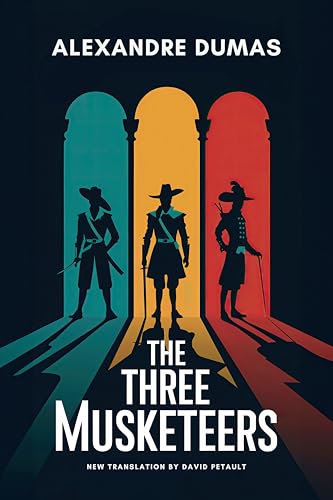


The Romantics
The nineteenth century produced three novelists whose ambitions were essentially architectural. Hugo wanted to build cathedrals out of language. Dumas wanted to construct machines of pure narrative pleasure. Stendhal, the quietest of the three, wanted to dissect the psychology of ambition with the precision of a surgeon who was also, privately, in love with his subject.
Hugo wrote Les Misérables over the course of twenty years, publishing it in 1862 when he was in political exile. Our guide to Les Misérables addresses the novel as what it actually is: an act of political witness that happens to be a great story. His earlier novel, The Hunchback of Notre-Dame, is formally tighter — a book about the cathedral as much as the people inside it.
What abridged editions always cut — and what their cuts reveal about a fundamental misreading of Hugo’s intentions — are the digressions: the long chapter on the Paris sewer system, the extended meditation on the Battle of Waterloo, the history of the Petit-Picpus convent. These are not interruptions to the story. They are Hugo’s argument that Jean Valjean’s suffering cannot be understood without understanding the entire structure that produced it. The sewer is where the city’s waste goes, and the sewer is also where Valjean carries a dying man to safety. Hugo’s digressions are always doing two things at once. Abridged editions do neither.
Dumas operates in a different register entirely. The Three Musketeers has been pedagogized into tedium by school curricula — treated as entertainment for children, which it isn’t. The novel is a study in loyalty, masculine friendship, and the gap between idealism and political reality. It is also, page for page, one of the most propulsive narratives ever written in any language.
The scene that demonstrates what Dumas is actually doing comes in the early chapters, when d’Artagnan arrives in Paris from Gascony — poor, provincial, riding a horse described as bright yellow and valued at three écus — and proceeds within a single afternoon to schedule duels with all three musketeers by offending each of them in rapid succession. It is comic, but it is also a precise psychological portrait: d’Artagnan is so determined to prove himself that he cannot stop provoking people. The bravado is real, but so is the desperation underneath it. Dumas understood that those two things are usually the same thing.
Stendhal’s The Red and the Black is perhaps the first genuinely modern novel — the first to concern itself with the inner life of a social climber in a way that produces neither condemnation nor endorsement, only understanding.
Stendhal based his protagonist Julien Sorel partly on a real case: a young seminarian named Antoine Berthet who shot a former employer in church in 1827 and was guillotined the following year. What interested Stendhal was not the crime but the decades of resentment and thwarted ambition that preceded it — the way a society that claimed to reward merit in fact rewarded birth, and what that contradiction did to the psychology of a brilliant young man who had absorbed the promise and then discovered the reality. Julien Sorel is not sympathetic exactly. But Stendhal makes sure you understand him completely, and understanding is more unsettling than sympathy.
Realism and Its Aftermath
Flaubert hated the Romantics. He hated their sentimentality, their grandiosity, their willingness to let feeling substitute for precision. Madame Bovary, published in 1857 and immediately prosecuted for obscenity, is the rebuttal. Emma Bovary has been formed by Romantic fiction — she expects her life to feel the way novels feel — and the book watches her discover that it doesn’t. Our guide to Madame Bovary focuses on the novel’s temporal compression and on what Flaubert’s famous prose style actually does on the sentence level.
Flaubert spent five years writing Madame Bovary and was known to work for an entire week on a single page, reading each completed sentence aloud to test its rhythm. The result is a prose style in which every word is doing precisely the work assigned to it and nothing else — a style in which the famous authorial impersonality is itself a form of cruelty. The agricultural fair scene, in which Rodolphe seduces Emma while a pompous official delivers a speech about the virtues of manure and livestock management below their window, is the novel’s masterwork: irony operating on three levels simultaneously, without Flaubert once indicating which level you should be attending to.
Proust arrives fifty years after Flaubert and appears at first to be everything Flaubert opposed — discursive, associative, apparently formless. But the surface is deceptive. In Search of Lost Time is as ruthlessly constructed as Candide, its architecture just harder to see from inside a single volume. Our reading guide to In Search of Lost Time addresses the question English readers always ask first: how to begin, and whether to finish.
The madeleine passage — in which the narrator dips a small cake into tea and is overwhelmed by a memory he cannot immediately identify — is the most famous moment in the novel, and it is also, for most readers, the first encounter with what Proust is actually doing. The passage is not about nostalgia. It is about the difference between voluntary memory, which is willed and therefore approximate, and involuntary memory, which arrives unbidden and is therefore true. Proust’s entire seven-volume structure rests on that distinction. Every digression, every extended meditation on jealousy or art or the nature of time, is an elaboration of what happened when the madeleine dissolved in the tea. Once you understand that, the length stops feeling like an indulgence.
The Twentieth Century
If the nineteenth century in French literature was the century of the social novel — of class, ambition, and the machinery of power — the twentieth century turned inward. Its great subjects were consciousness, absurdity, freedom, and what a human being owes to a world that has given no indication of owing anything in return. The writers who defined this period were not primarily academic philosophers, though several of them wrote philosophy as well as fiction. They were novelists who understood that the felt experience of an idea — the way it lands in the body, in the moment of reading — is not the same as the idea argued in the abstract, and that fiction could do something philosophy could not.
Albert Camus published The Stranger in 1942 and The Plague in 1947, and the two novels together constitute a sustained examination of what it means to live without guaranteed meaning. The Stranger opens with one of the most destabilising sentences in any language: “Mother died today. Or maybe yesterday, I don’t know.” The flatness is the point. Meursault, the novel’s narrator, is not callous — he is honest in a way that the social world around him cannot accommodate, and the novel is the story of how that world punishes him for it. What makes Camus genuinely difficult — and genuinely irreducible to a philosophical position — is that Meursault is neither a hero nor a warning. He is simply a consciousness, registering experience with more accuracy than comfort allows. The Plague works on a larger scale: an Algerian city quarantined by an epidemic becomes an image of occupied France, and the question of whether to resist — and how, and at what cost — is distributed across a cast of characters who answer it differently and with equal plausibility. Camus did not believe in God and did not believe in despair. The space between those two refusals is where both novels live.
Antoine de Saint-Exupéry’s The Little Prince, published in 1943, is the best-selling French-language book ever written and almost certainly the most consistently misread. It is shelved in the children’s section because it has illustrations and a child as its central figure. It belongs there about as accurately as Gulliver’s Travels does. Saint-Exupéry was a pioneering aviator who had survived multiple crashes across three continents, had reported on the Spanish Civil War, and had watched France fall to Nazi occupation. When he sat down to write The Little Prince, he was in exile in New York, estranged from his wife, drinking heavily, and struggling with injuries from a crash that had left him in chronic pain. He knew, with some certainty, that he would not survive the war. The little prince who has left his small planet, who carries with him the memory of a single rose he loved and perhaps loved inadequately — this is a book about grief and exile and the things we fail to protect until it is too late. Saint-Exupéry disappeared over the Mediterranean in July 1944, on a reconnaissance mission, and was never found. The novel’s ending is not a fantasy. It is a farewell.
Simone de Beauvoir published The Second Sex in 1949, and the book changed how the twentieth century thought about women, freedom, and what it means to become a person rather than simply be assigned one. Its opening argument — “One is not born, but rather becomes, a woman” — is the sentence around which the entire analysis pivots. De Beauvoir’s claim is that femininity is not a natural condition but a historical and cultural construction, and that the construction has been so thorough, so embedded in language and law and literature, that most women have participated in their own confinement without being able to name it. The Second Sex is philosophy, but it is also literary criticism, anthropology, and personal testimony, and the combination produces a book that is harder to dismiss than any purely abstract argument could be. It was immediately scandalised in France and immediately translated into English, where it had an equally immediate and lasting effect. Beauvoir belongs in any account of French literature not merely as a feminist thinker but as a writer whose prose, even in translation, carries the peculiar force of someone who has thought something through to its end and is no longer willing to be polite about the conclusions.
The Novel of Ideas
Laclos’s Les Liaisons Dangereuses, published in 1782, seven years before the Revolution, is an epistolary novel about aristocrats who weaponize seduction. It caused a scandal on publication and has never stopped causing one. The translation question — which English edition to trust — is one the guide addresses directly, because the wrong translation turns Laclos’s surgical prose into drawing-room gossip.
What makes the novel genuinely disturbing — more disturbing than its reputation as a tale of aristocratic wickedness would suggest — is that the Marquise de Merteuil and the Vicomte de Valmont are not simply villains. They are the two most intelligent people in the book, and their letters reveal a clarity about power, desire, and social performance that the novel’s more virtuous characters entirely lack. The Marquise in particular is writing, across her letters, a sustained feminist analysis of the society that has made seduction her only available form of power. Laclos, writing seven years before the Revolution, understood that an aristocracy rotten enough to produce Merteuil was an aristocracy that had already lost its justification. The guillotine arrives, historically, a decade after the last letter.
Jules Verne is almost never read as the political writer he was. 20,000 Leagues Under the Sea is usually packaged as an adventure novel for young readers. But Captain Nemo is a figure of anti-colonial rage, and the Nautilus is a utopian project — a society of one, built in deliberate exile from the world above. Our guide to Jules Verne’s Political Vision recovers what the bowdlerized English translations have long suppressed.
In later Verne novels — particularly The Mysterious Island, which reveals Nemo’s full history — we learn that he is Prince Dakkar, an Indian nobleman whose family was massacred by British colonial forces during the 1857 rebellion. The Nautilus, read in this light, is not a marvel of technology. It is a weapon of mourning. Every time Nemo sinks a warship, he is answering a specific historical atrocity. The original English translations, produced by publishers nervous about offending British readers, softened or erased this context entirely. They turned a novel about colonial violence into a Victorian adventure story. The difference between those two books is not a matter of translation style. It is a matter of whether the book is allowed to mean what it means.
The tradition these writers belong to is not merely literary. It is argumentative, adversarial, and deeply concerned with how power organizes itself and how fiction might resist that organization. Reading French literature in good translation is not an act of cultural tourism. It is engagement with a conversation that has been going on for three hundred years and is not finished.
How to Read French Literature
French literature rewards method. It is not a tradition you can dip into randomly and expect to get full value from — the books talk to each other too directly, and missing the conversation means missing a significant part of what each individual book is doing. A few practical principles will help.
On your first pass through the tradition, read chronologically. Start with Voltaire, move through Hugo and Stendhal and Flaubert, arrive at Proust and then Camus. The sequence is not arbitrary — each writer is, consciously or not, arguing with the one before, and reading in order means you arrive at those arguments already equipped to understand them. After your first pass, read thematically: all the novels of ambition together (Stendhal, Balzac, Flaubert), all the novels of political witness together (Hugo, Camus, de Beauvoir). The tradition looks different from each angle, and both angles are useful.
Never read an abridged Hugo. This is not a suggestion — it is the minimum condition for reading Hugo at all. The digressions in Les Misérables are not interruptions to the story. They are the story’s argument about why the story matters. An abridged Les Misérables is a novel about an escaped convict and an obsessed policeman. The unabridged version is a novel about the entire structure of nineteenth-century French society and why it produces escaped convicts and obsessed policemen in the first place. These are different books. One of them is Hugo.
For Proust, the only workable approach is full commitment to the first volume. Swann’s Way is long, and it does not apologize for its length, but it is also — once you have adjusted to its rhythms — one of the most pleasurable reading experiences in the tradition. Commit to it entirely before deciding whether to continue. Do not read the first fifty pages and make a judgment. The novel earns its length, but it does not earn it immediately — it earns it retrospectively, in the way that a piece of music earns its opening bars only once you have heard the whole. If you reach the end of Swann’s Way and are not compelled to continue, that is a legitimate response. But make the decision from there, not from the middle.
Finally: always check who translated the edition you are buying before you buy it. This is not optional. A Madame Bovary translated in 1886 is a different book from one translated in 2010 — not because the French has changed, but because English has, and because translation reflects the assumptions of its moment as much as it reflects the original. Nineteenth-century translators of Flaubert routinely softened his irony and cleaned up his prose because they found his indifference to moral judgment unsettling. Their translations are not wrong exactly, but they are translations of a different Flaubert — a more comfortable one. The translator matters as much as the edition. The reading guides on this site name the translation we recommend for every book covered, and explain the reasoning. Use that information before you start.







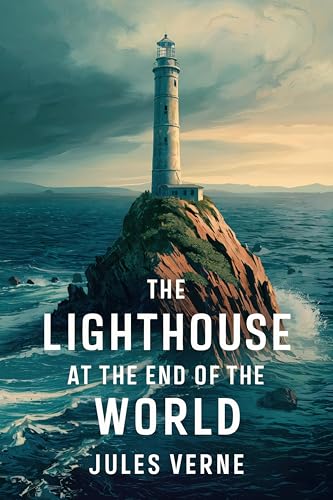



Frequently Asked Questions
What is the best French novel to read first?
Candide by Voltaire is the ideal entry point into French literature for almost every reader. At roughly ninety pages, it is short enough to finish in a single sitting, but its comedy, its philosophical precision, and its controlled fury give you an immediate sense of what distinguishes French literary culture from English — the willingness to treat ideas as weapons and to make wickedly good jokes with them at the same time. Every major theme of the tradition — the problem of suffering, the corruption of institutions, the gap between what societies claim and what they do — is present in miniature.
Which French authors should every reader know?
Six authors form the spine of the tradition: Voltaire, whose Candide established the French novel as a vehicle for philosophical argument; Victor Hugo, whose ambition and emotional force defined the Romantic century; Gustave Flaubert, whose prose style became the template for literary realism in every language; Marcel Proust, who pushed the novel further into consciousness than anyone before or since; Albert Camus, who made existential philosophy feel like lived experience rather than academic argument; and Simone de Beauvoir, whose The Second Sex changed not just French literature but the intellectual history of the twentieth century. Any serious reader of the tradition will eventually need all six.
Does translation quality really matter for French literature?
For French literature specifically, translation quality matters more than for almost any other tradition, because so much of what makes French writing French is carried in its rhythm, its irony, and its wit — all of which are structural, not decorative, and all of which are the first things to collapse in a careless translation. Voltaire’s jokes depend on timing; Flaubert’s moral vision is embedded in sentence cadence; Proust’s digressions mean something different depending on whether they read as deliberate spirals or mere looseness. A poor translation of a Russian novel may blunt its emotional force. A poor translation of a French novel can invert its meaning entirely.
How is French literature different from English literature?
French literature is more argumentative, more willing to treat the novel as a vehicle for ideas rather than simply for story, and more interested in the relationship between fiction and political reality. Where English literature has tended — with significant exceptions — toward character, psychology, and social observation conducted at close range, French literature has more consistently asked large questions: about the nature of freedom, the legitimacy of institutions, the relationship between the individual and history. This is not a difference of quality but of orientation. French novels are, on the whole, more interested in being right about something than in being liked, and that adversarial quality is part of what makes the tradition so permanently alive.
This post contains affiliate links. As an Amazon Associate, we earn from qualifying purchases.

You must be logged in to post a comment.