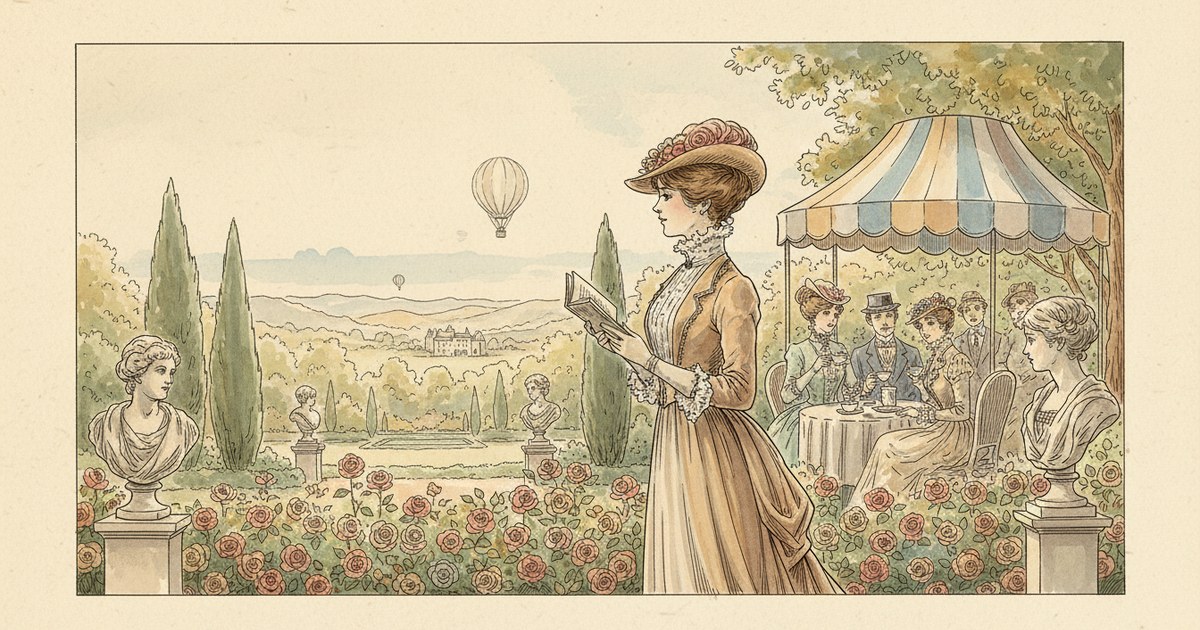
In 1896, Marcel Proust priced his debut book at thirteen and a half francs. The going rate for a book of comparable size was three. He had also secured a preface from Anatole France, the most celebrated writer in the country; commissioned watercolor illustrations from Madeleine Lemaire, a well-connected salon hostess; and persuaded his composer friend Reynaldo Hahn to provide four original musical pieces to accompany the poems inside. The book was a luxury object — embossed, illustrated, over-decorated — and it sold almost nothing. Critics noticed the extravagance before they noticed the writing. One reviewer called it “too self-conscious and pretty.” The Catholic novelist François Mauriac, who would later witness Proust dying in his cork-lined room, didn’t take him seriously as a writer until six years after publication, when Proust translated Ruskin.
The standard reading of this episode is that Proust overreached. That a rich doctor’s son, besotted with Parisian salon life and constitutionally unable to resist a gesture, bungled his own debut by turning it into an objet d’art rather than a book. But that reading assumes Proust wanted Pleasures and Days to succeed commercially, which is far from obvious. What he published in 1896 was a collection of stories, prose poems, and character sketches he had been circulating in literary magazines since he was twenty. He knew what it was. He had also been working, in parallel, on a far more ambitious novel, Jean Santeuil, that he would never finish. Pleasures and Days was a calculated offering to the salon world he’d already mastered — a farewell gift, handed over at a price that ensured only insiders could afford it, before he disappeared into something else entirely.
That is the argument this translation invites. Read in 1896 it looks like the work of a talented dilettante. Read now — read through the lens of In Search of Lost Time — it looks like a set of architectural drawings. The jealousy that will consume Swann is already here, dissected with cold precision in “The End of Jealousy,” where obsession outlasts its object and the lover discovers he can miss someone he no longer loves. The preoccupation with snobbery as a form of self-annihilation runs through every social portrait. The long, coiling sentences — sometimes achieving compression, sometimes sprawling — are already reaching for the syntactic form that will, two decades later, become the most recognizable prose style in European literature. Proust published his worst work first, deliberately, because it wasn’t quite his worst: it was his laboratory, made public on his own terms.
It is worth pausing on what Anatole France actually wrote in that preface, because it tells you exactly what Proust was doing with the entire production. France called the young author “a depraved Bernardin de Saint-Pierre” — a compliment dressed as a mild rebuke, praising the sweetness while flagging the excess. Proust would have known precisely how that line would land with readers of his class. He had chosen France not just for the prestige but for the particular signal that prestige sent: this is a book for people who already know the reference, who understand that “depraved” in this context means deliciously over-refined. The price, the illustrations, the preface, the musical supplements — each element was aimed at an audience of, perhaps, three hundred people in Paris. Proust hit that audience squarely and ignored everyone else. That is not a failed commercial debut. That is an extremely precise one.
The Doctor’s Son Who Chose the Salons
Proust was born in 1871 to a father who was a celebrated physician and a mother who presided over his cultural education with anxious devotion. His father wanted him to be a diplomat. Proust had other plans, though he wasn’t ready to admit them. By his mid-twenties he had done what the sons of his class were supposed to do — he’d studied law, completed military service, circulated in the right drawing rooms — while writing obsessively in the margins of all of it. His asthma, which had first appeared when he was nine and would govern the remaining five decades of his life, gave him both a pretext for withdrawal and a heightened relationship to sensory experience, the kind that cannot be chosen. He paid attention to things the way the chronically ill sometimes do: too closely, too intently, as if each perception might be the last clean one before the next attack.
What the salons gave him was a laboratory, not a destination. The aristocrats and upper bourgeoisie he moved among — the Guermantes in real life before they became characters — furnished him with a complete map of social cruelty, of the mechanisms by which people destroy their own dignity in pursuit of status, of the way beauty and snobbery can occupy the same gesture. He was also, by every account, shameless in working those rooms. He personally lobbied for Anatole France’s preface. He fought a duel with the journalist Jean Lorrain — duels were not unusual in literary Paris in the 1890s, and they were occasionally fatal — after Lorrain published insinuations about his relationship with Reynaldo Hahn that Proust considered personally insulting. The dandy, the salon fixture, the dilettante: these were roles he understood completely, and used deliberately. They gave him cover for the observation that was always happening underneath.
He would not emerge as a serious literary figure until 1919, when the Goncourt Prize for the second volume of In Search of Lost Time finally forced Paris to reconsider. By then, Pleasures and Days had been out of print for decades. Its first reprint came only after the prize, as readers scrambled backward. André Gide, who had famously rejected Swann’s Way for publication, waited until 1932 — ten years after Proust’s death, with the full architecture of the novel visible — to pronounce Pleasures and Days an “annunciation” of everything that followed. The word is apt. You read announcements in reverse, once you already know what they announced.
The specific social world Proust was mapping had its own grammar, and he had learned it young. The salon of Madame Arman de Caillavet — where France himself held court every Sunday — operated on a hierarchy of wit so refined that the wrong joke could effectively exile a guest for a season. Proust attended, watched, and filed everything. The character sketches in Pleasures and Days that seem like lightweight social comedy are actually transcriptions of this system, rendered with the accuracy of someone who had spent years studying it not to belong to it but to understand the cost of belonging. The precocious coldness of those sketches — the affection that never tips into sentimentality — is not a young writer’s pose. It is the trained observer’s discipline, already fully formed at twenty-five.
A Book That Reads Differently the Second Time Through
What Pleasures and Days offers, now, is the experience of watching a mind organize itself. The stories are not equal — Proust said himself that many were “dashed down in a few hours and never revised,” and some read that way — but the best of them are doing something distinct. “A Young Girl’s Confession” traces the self-destruction of a character who understands her own degradation with complete lucidity and cannot stop it anyway. The knowing and the doing are entirely separated. That gap — between what we understand about ourselves and what we manage to be — is the gap that In Search of Lost Time will spend seven volumes exploring. It is here already, in thirty pages. “The End of Jealousy” pushes further: a man discovers that his jealousy survives the death of its cause, that what he mourns is not the woman but the suffering she organized around herself, the particular shape of his own obsession. Swann will rediscover this, in much greater detail, twenty years later in Proust’s novel. Here it is the first draft, clean and compact.
The social portraits are sharper than they’re usually given credit for. Proust is not mocking the salon world; he is mapping it with the attention of someone who has decided to love a thing and dissect it simultaneously. The snobbery in these pages is shown as a specifically modern form of self-loss — a way of substituting the opinions of the room for the content of one’s own mind. Read at twenty-five, this is precocious and a little precious. Read after In Search of Lost Time, it lands differently: you hear the thesis being stated simply, without the apparatus that will later surround it. The voice is younger, the reach occasionally overextends, but the argument is already made.
There is one piece in particular that stops you cold if you know what’s coming. In the brief prose poem “Moonlight Sonata,” Proust describes a woman listening to Beethoven and finding, in the music, the exact shape of a grief she had not known she was carrying. The music does not create the feeling; it reveals that the feeling was always there, waiting for the right form. This is not a marginal observation in a minor early piece. It is the seed of the entire Vinteuil sonata episode in Swann’s Way, where a few bars of music become the involuntary key to an entire relationship, an entire lost time. Reading it here, in this compact early version, you feel the peculiar vertigo of watching a writer discover his own subject — and not yet know it.
Why This Translation?
David Petault’s new English version brings the text’s double register — its surface elegance and its underlying coldness — into sharper focus than older translations have managed. The prose breathes. Where Proust’s sentences reach for something they don’t quite grasp, the translation lets that show rather than smoothing it into false confidence. This is the right approach for a book that is partly about incompletion: the young Proust reaching toward forms he hadn’t yet invented. Pleasures and Days: A New Translation is available now in paperback and for Kindle — the essential starting point for anyone who wants to understand not just what Proust became, but how, and at what cost, and in full view of a room full of people who weren’t paying attention.
The translation challenge with this particular book is unusual. Most translators working on Proust face the problem of the late style: those immense, parenthetical, clause-within-clause sentences that have to be held together across enormous distances without losing the thread. With Pleasures and Days, the problem is different. The sentences are younger — sometimes too neat, sometimes genuinely awkward, occasionally soaring into something that anticipates the full Proustian instrument. A translation that irons all of this into a single consistent register falsifies the book. The edition featured here preserves the unevenness, which means it preserves the truth of what this book actually is: not a polished minor work but a live record of a style finding itself. That is worth reading in its own right, entirely apart from its relationship to the novels that followed.
Should You Read This Before or After In Search of Lost Time?
The honest answer is: after, if you can. Reading Pleasures and Days cold, without the context of the great novel, is a perfectly reasonable experience — you get a talented, somewhat precious young writer with flashes of genuine penetration. But reading it after even the first volume of In Search of Lost Time turns it into something else entirely. Every theme that Proust will spend the next two decades elaborating appears here in miniature, like a composer’s sketchbook sitting next to a completed symphony. You can hear the motifs. The jealousy studies, the social dissections, the preoccupation with the gap between self-knowledge and self-governance, the idea that time spent in certain rooms is never really lost but only deferred — all of it is present, stated plainly, waiting for the architecture that will eventually surround it.
That said, there is a real argument for reading it first, and it goes like this: if you come to Pleasures and Days already knowing the novel, you will read it as a document about Proust. If you come to it fresh, you read it as a document about you — about recognition, about the way certain stories feel true before you have the language to explain why. The young woman in “A Young Girl’s Confession” who destroys herself with complete self-awareness does not require In Search of Lost Time to be devastating. She is devastating on her own terms. The danger of always reading early works as juvenilia is that you stop letting them speak for themselves. Pleasures and Days earns its place in the reading order wherever you put it. The novel just makes it echo longer.
Frequently Asked Questions
What is Pleasures and Days actually about?
It is a collection of short stories, prose poems, and character sketches that Proust published in 1896 when he was twenty-four. The pieces range from psychological studies of jealousy and self-destruction to sharp portraits of Parisian salon society and lyrical meditations on music, memory, and time. The themes that will define In Search of Lost Time — involuntary memory, snobbery as self-loss, the durability of obsession — appear here in compressed, early form.
Why did Pleasures and Days sell so poorly when it came out?
The book was priced at thirteen and a half francs in a market where comparable volumes cost three, making it accessible to only a small audience of wealthy insiders — which appears to have been intentional. Critics were distracted by the luxury presentation: the preface by Anatole France, the watercolor illustrations by Madeleine Lemaire, and the musical supplements by Reynaldo Hahn drew more comment than the writing itself. The book sold so few copies that it went out of print and was not reprinted until after Proust won the Goncourt Prize in 1919.
Do I need to have read Proust’s other work to appreciate this book?
No prior reading is required — the best pieces, including “A Young Girl’s Confession” and “The End of Jealousy,” function as complete, self-contained works. That said, readers who have spent time with In Search of Lost Time will find an additional layer of meaning, recognizing the seeds of the Swann jealousy plot, the Vinteuil musical motif, and the novel’s central preoccupation with the gap between self-knowledge and self-change. It rewards reading in either order for different reasons.
What makes this translation different from older English versions?
Earlier English translations of Pleasures and Days — including the 1978 version by Louise Varese — tended to smooth out the stylistic unevenness of Proust’s early prose, producing a more polished but ultimately less accurate text. The translation we recommend preserves the deliberate inconsistencies: the places where Proust’s sentences are genuinely awkward, the places where they suddenly soar, and the places where they are reaching for a syntactic form the writer had not yet fully invented. That unevenness is the historical record of a major style in the act of becoming itself.
Also worth reading

Leave a Reply