On August 20, 1672, a mob in The Hague tore the De Witt brothers apart. Johan, the Grand Pensionary of Holland, and his brother Cornelis were stripped, beaten, stabbed, and shot — then pieces of them were sold as souvenirs. It was one of the ugliest political murders of the century, carried out by a crowd convinced they were serving order. Dumas opens The Black Tulip with this scene, and he does not look away. He makes you stand in the crowd and watch a civilization eating its own.
Then — in the very next chapter — he pivots to a man tending his garden.
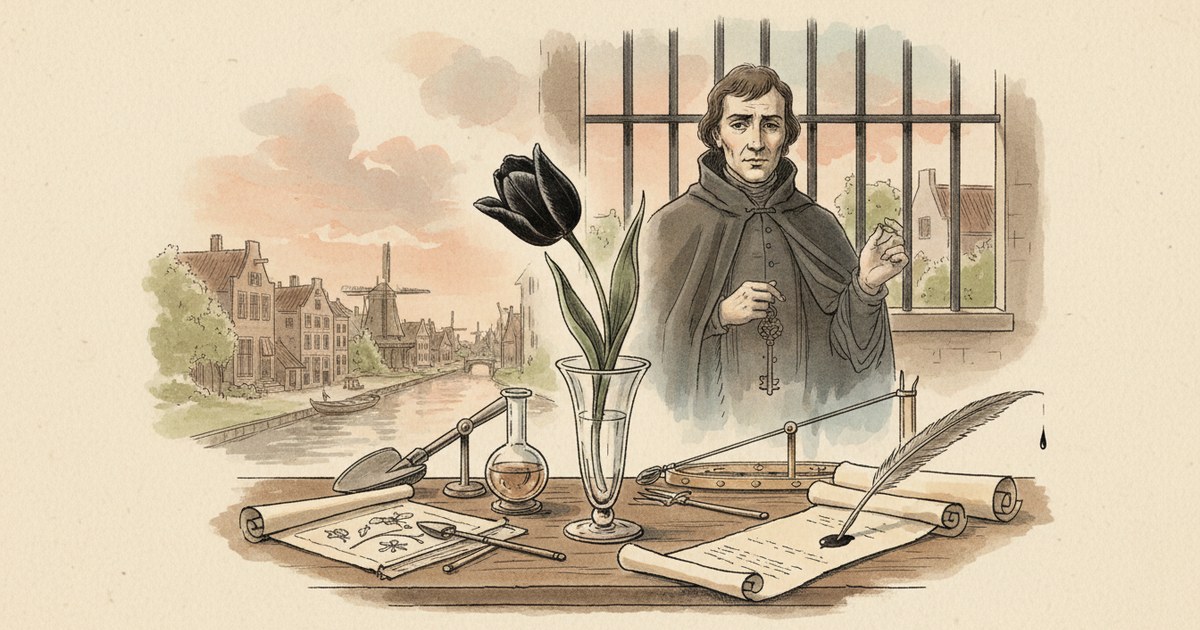
That pivot is the argument of the entire novel. While history tears itself apart in the streets, Cornelius Van Baerle, a prosperous young tulip-grower in Dordrecht, is attempting something the world has never seen: a truly black tulip. Not dark purple, not near-black — jet black, without flaw. The city of Haarlem has offered 100,000 florins to whoever achieves it. Cornelius doesn’t want the money. He wants the flower. Dumas understood something about that kind of obsession — that it’s not escapism but its own form of courage. To insist on beauty while the mob howls outside your gate is a political act.
The Son of a General the Empire Preferred to Forget
Alexandre Dumas was born in 1802 in Villers-Cotterêts, a market town an hour northeast of Paris. His father, Thomas-Alexandre Dumas, had been — briefly, improbably — one of the most feared cavalry commanders in the French Revolutionary Army. Born in Saint-Domingue to a French nobleman and an enslaved Haitian woman, Thomas-Alexandre had risen through sheer ferocity of talent to become a general of division. Napoleon then spent the rest of his career making sure that achievement went unrewarded. By the time Alexandre was four, his father was dead, broken by years of neglect and a imprisonment in Naples. The family was left nearly penniless, the pension denied.
This is not a biographical footnote. It is the marrow of everything Dumas wrote. He grew up knowing exactly what it looked like when powerful men decided that a person of exceptional ability was nonetheless inconvenient — and what it looked like when institutions closed ranks to protect that decision. He was largely self-educated, working as a notary’s clerk while reading everything he could find, and when he finally broke through in Paris, first with history plays and then with the novels that made him famous, he kept returning to the same situation: the man of genuine worth at the mercy of a system with no interest in his worth.
The Black Tulip, published in 1850, was written late in that career, when Dumas had already given the world The Three Musketeers and The Count of Monte Cristo. He was fifty, famous, financially chaotic, and apparently still thinking about what it meant to be destroyed by forces that had nothing to do with your actual guilt. Cornelius Van Baerle is arrested not for anything he did but for papers he was holding for his godfather — the same Johan de Witt whose murder opens the novel — without even knowing what they contained. The system that kills the De Witts also swallows Cornelius. Dumas isn’t making a metaphor. He’s describing a mechanism he recognized.
The collaboration with Auguste Maquet, who contributed research and structural scaffolding to many of Dumas’s novels, is worth noting precisely because The Black Tulip doesn’t read like a collaboration. It reads like a man with a specific grievance working it out at speed. The obsessive detail about tulip cultivation — the soil preparation, the grafting, the naming conventions — has the texture of someone who found in horticulture a language for the kind of patience and precision that history keeps punishing.
The Flower That Grows in the Dark
The plot mechanism Dumas uses is almost sadistically elegant. Cornelius’s neighbor, Jacob Boxtel, was himself a serious tulip-grower — until Cornelius, without meaning to, built a greenhouse that cast a shadow over Boxtel’s garden. That shadow killed Boxtel’s prize collection and turned a reasonable man into something monstrous. He spends the rest of the novel trying to steal Cornelius’s achievement. The black tulip becomes the site where envy, ambition, beauty, and justice all converge.
In prison in the Loevestein fortress, Cornelius meets Rosa, the jailer’s daughter. Their courtship is conducted through the bars of his cell, and Dumas gives it a quality that his swashbuckling adventures often don’t stop for: slowness. Cornelius teaches Rosa to read by writing lessons on scraps of paper passed through the grating. She grows his tulip bulb in a plot of earth outside the prison walls, reporting its progress back to him. The novel’s most quietly devastating passage is the one where Cornelius, unable to see the tulip himself, listens to Rosa describe it as it opens. He is a man who has spent his adult life tending flowers with his own hands, and now the only plant he cares about exists entirely in someone else’s description of it. Dumas doesn’t underline this. He trusts you to feel it.
The theft and the confrontation before the Haarlem committee are staged with the timing of a playwright — which Dumas was, before he was a novelist, and it shows. But the novel’s actual climax is quieter: the moment when the black tulip is officially registered under the name Rosa Barlaensis, combining Cornelius’s surname with Rosa’s given name. The flower is named for both of them. The obsession and the love turn out to have been the same thing.
What makes The Black Tulip worth reading alongside the more famous Dumas titles is its compression. At roughly 250 pages, it doesn’t have room for the plot surplus that occasionally buries Monte Cristo. Every chapter advances something. The pace of the opening — massacre, garden, arrest — gives you the whole novel’s logic in forty pages, and then Dumas spends the remaining two hundred earning it.
The Translation Landscape
The existing English translations divide roughly into two camps. The Victorian-era versions, most of them anonymous or semi-anonymous, are available free in various digital archives and are largely unreadable — not because the French is difficult, but because nineteenth-century English translators of French popular fiction had a habit of flattening theatrical dialogue into something resembling legal correspondence. Boxtel’s jealous ranting, which in French has the cadence of a man talking himself into monstrousness, tends to emerge as a series of grave declarative sentences. The texture that makes Dumas feel alive gets ironed out. Robin Buss’s Penguin Classics translation, the most widely cited modern version, is a genuine improvement: accurate, clean, and particularly good at the prison scenes where the register needs to stay intimate without becoming sentimental. Where it occasionally loses ground is in the set pieces — the mob scene, the Haarlem committee — where Dumas is writing at full theatrical volume and a more literal approach produces something slightly muffled.
the edition linked below positions itself in the space those set pieces leave open. The translation keeps the rhythmic aggression of the opening crowd scene — short declarative sentences that hit like a drumbeat — while letting the tulip-cultivation passages breathe at their own slower pace. A single passage makes the difference legible: the moment Boxtel first sees Cornelius’s greenhouse shadow falling across his garden. In the Buss, it’s a competent rendering of a plot point. In this translation, it reads like what it is: the exact moment a man’s life divides into before and after. That distinction is not decorative. It’s what the next two hundred and fifty pages depend on.
Why This Translation?
The Black Tulip is not a difficult book, but it is a precise one — and precision in translation means something different here than it does with, say, Flaubert, where you’re trying to preserve a surface. With Dumas, you’re trying to preserve momentum, and momentum is the hardest thing to carry across languages because it lives in sentence rhythm, not vocabulary. the edition linked below was made with that problem front and center: the goal was an English text that moves at the speed Dumas intended, where the twenty pages of mob violence and the twenty pages of horticultural patience feel like they belong to the same novel because they do.
The paperback edition is available on Amazon and includes a translator’s note on the historical context of the rampjaar — the Dutch “year of disaster” — that situates the De Witt murders without turning the opening into a history lecture. If you’ve read Dumas before, this is the novel that shows you a different gear. If you haven’t, it’s a better starting point than most people expect: tight, fast, and structurally honest about what it’s trying to do. the edition linked below is here.
Is The Black Tulip based on a true story?
Partially. The De Witt brothers’ murder on August 20, 1672 — which opens the novel — is historical fact, one of the most notorious political killings of the Dutch Golden Age. The tulip-growing competition and the character of Cornelius Van Baerle are Dumas’s invention, but they’re set against scrupulously accurate historical backdrop: the Dutch tulip mania of the seventeenth century was real, as was the intense culture of competitive breeding among wealthy growers.
What does the black tulip symbolize in the novel?
The tulip functions as the novel’s argument made visible: that the pursuit of something genuinely beautiful, when conducted with total commitment, is itself a form of resistance against the ugliness of political life. Dumas is careful not to make it allegorical in any simple sense — Cornelius genuinely wants the flower, not what it represents — but the structural contrast between the mob violence of the opening and the obsessive patience of the tulip-growing is unmistakably deliberate.
How does The Black Tulip compare to Dumas’s other novels?
It’s shorter and tighter than either The Three Musketeers or The Count of Monte Cristo, with less of the digressive subplot energy those novels rely on. It shares with Monte Cristo a core interest in wrongful imprisonment and the question of what patience costs a person, but it resolves that interest through love rather than revenge — which makes it a quieter novel, and in some ways a more honest one.
Is The Black Tulip a romance?
It has a central love story, but calling it a romance undersells it. The relationship between Cornelius and Rosa develops entirely in conditions of constraint — prison bars, smuggled letters, secondhand descriptions of a flower he can’t see — and Dumas treats that constraint as the substance of the love, not an obstacle to it. What they build together is a tulip and a shared language of literacy and patience. The romance is real, but it grows in the dark, which is the point.
Also worth reading

Leave a Reply