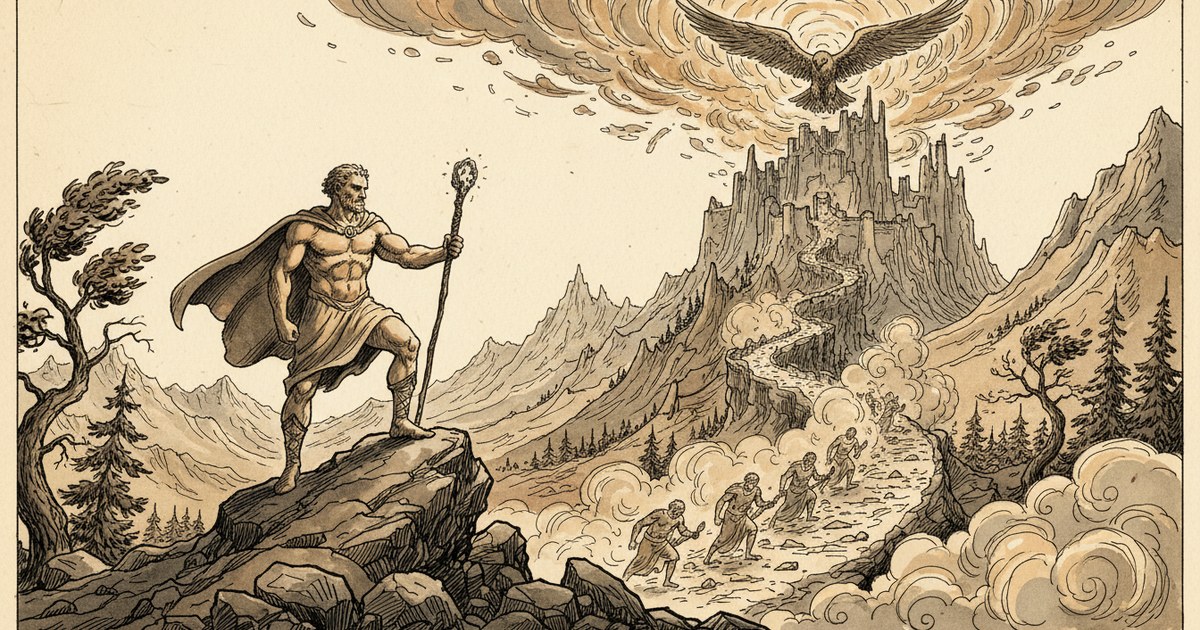
In the winter of 1887, Friedrich Nietzsche was writing in a rented room in Nice, barely able to read by lamplight, his eyesight collapsing, his stomach wrecked, his books selling in the dozens. He filled notebook after notebook with fragments — arguments interrupted by counter-arguments, aphorisms crossed out and rewritten, outlines that kept shifting. He called this mass of material his magnum opus and never finished it. His sister Elisabeth found the notebooks after his breakdown in 1889, arranged them to her liking, added a title he had sketched and abandoned, and published the result as The Will to Power in 1901. The Nazis later adopted it as a philosophical handbook. Most people who invoke Nietzsche today are, without knowing it, invoking Elisabeth’s editorial decisions as much as her brother’s thought.
This is the contaminated inheritance of one of the most misread philosophers in the Western tradition. The phrase “will to power” has been used to justify domination, conquest, and the cult of the strongman — everything Nietzsche spent his career attacking. He despised German nationalism. He broke with Wagner over it. He called the German state “the coldest of all cold monsters.” The misreading isn’t accidental; it required effort, selective quotation, and a sister with political ambitions. What the notebooks actually contain — when read whole, in sequence, without Elisabeth’s arrangement — is something far stranger and more demanding: a diagnosis of European nihilism and a proposal for what comes after the death of God that has nothing to do with domination and everything to do with the difficulty of creating value from scratch.
The thesis of this translation is also a corrective act. Power, in Nietzsche’s usage, does not mean power over others. It means the capacity to impose form on chaos — to take the raw material of existence, with its suffering and contingency and absence of inherent meaning, and make something of it that holds together. The will to power is the will to become the author of your own values rather than inheriting them secondhand from a tradition you no longer believe. That is a harder thing to sell than domination. It is also the thing Nietzsche was actually arguing.
The Best Translation of The Birth of Tragedy
Three translations define the field. Walter Kaufmann’s 1967 Vintage edition remains the standard: precise, readable, footnoted without being pedantic. Ronald Speirs’s Cambridge edition (2000) is more literal and favoured in academic contexts. Douglas Smith’s Oxford World’s Classics is the most accessible prose — good for first-time readers who want the ideas without the Victorian stiffness of the older Haussmann translation. This edition offers a modern English text that prioritises readability without softening the argument.
The Philosopher Who Philosophized with a Hammer
Nietzsche was born in 1844 in Röcken, a village in Prussian Saxony, the son of a Lutheran pastor who died of a brain disease when Friedrich was four. He grew up in a household of women — mother, sister, grandmother, aunts — and later said this gave him an intimate understanding of resentment, not because the women were resentful but because he watched what happened when intelligent people were given no outlet for their intelligence. He was a prodigy: appointed professor of classical philology at Basel at twenty-four, before he had even finished his doctorate. His first book, The Birth of Tragedy, argued that Greek culture was built not on serene rationality but on the tension between Apollonian order and Dionysian chaos — a reading so unorthodox that it effectively ended his academic career before it began. His colleagues stopped citing him. Students stopped enrolling in his courses. He spent the rest of his working life outside the university, writing in cheap rooms across Switzerland and Italy and France, in poor health, largely ignored.
The isolation matters because it shaped the texture of his prose. He was not writing for a lecture hall. He was writing for a hypothetical reader who might exist sometime in the future — the “philosopher of the future” he kept invoking — and this gave his style its peculiar combination of intimacy and provocation. He is always addressing someone directly, always trying to disturb rather than reassure. The aphoristic form he developed in his middle period was not a stylistic affectation; it was the only form adequate to his project, which was to think against the grain of systematic thought. A system, he believed, was a comfort — a way of pretending the world was more orderly than it was. Fragments were honest. They left the contradictions intact.
By the time he was assembling the notebooks that would become The Will to Power, he had already written his best work: Thus Spoke Zarathustra, Beyond Good and Evil, On the Genealogy of Morality. The notebooks were a laboratory, not a finished argument, and reading them as such — as the working papers of a thinker in motion rather than a completed doctrine — changes what you find in them. The will to power, in this context, is not a conclusion. It is a hypothesis he is still testing.
What the Notebooks Are Actually Saying
The core argument, assembled across hundreds of fragments, runs something like this: European civilization has been sustained for two thousand years by a system of values — Christian morality, the idea of objective truth, the belief in a purpose to history — that is now unsustainable because it has destroyed its own foundations. The scientific worldview that Christianity helped create has turned its methods back on Christianity and found it wanting. God is dead not because anyone killed him but because the intellectual tools Christianity gave us make it impossible to believe in him any longer. The consequence is nihilism: the sense that nothing means anything, that all values are arbitrary, that there is no ground beneath the ground. Nietzsche did not celebrate this. He was terrified by it. The question he was trying to answer was: what do you do next?
His answer is what makes the book urgent rather than merely historical. You do not find new foundations — there are no new foundations to find. You become the kind of person who does not need foundations, who can say yes to existence without requiring that existence justify itself on metaphysical grounds. The Übermensch — so often translated as “Superman” and so often pictured as a blond conqueror — is actually a figure of extreme self-discipline and creative responsibility: someone who has internalized the full weight of nihilism and still chooses to create, to value, to act. This is not a comfortable idea. It is one of the most demanding things ever asked of a reader. And the translation here renders it with enough precision and enough readability that the demand actually lands.
Why This Translation
The history of English-language Nietzsche is a history of choices that shaped what readers were allowed to think. The Walter Kaufmann translations — dominant for decades — are accurate but interpretive, smoothing over the jagged edges of Nietzsche’s style in ways that domesticate his strangeness. This new translation restores the abruptness, the tonal shifts, the moments where Nietzsche sounds like he is arguing with himself, because those moments are the argument. For anyone who has bounced off Nietzsche before, or who has read him only through secondary sources and received ideas, The Will to Power: A New Translation is the version that gives you the philosopher rather than the myth.
The real Nietzsche is harder than the myth — and considerably more useful to anyone who has ever had to build meaning in the absence of the scaffolding they expected to find.


Leave a Reply