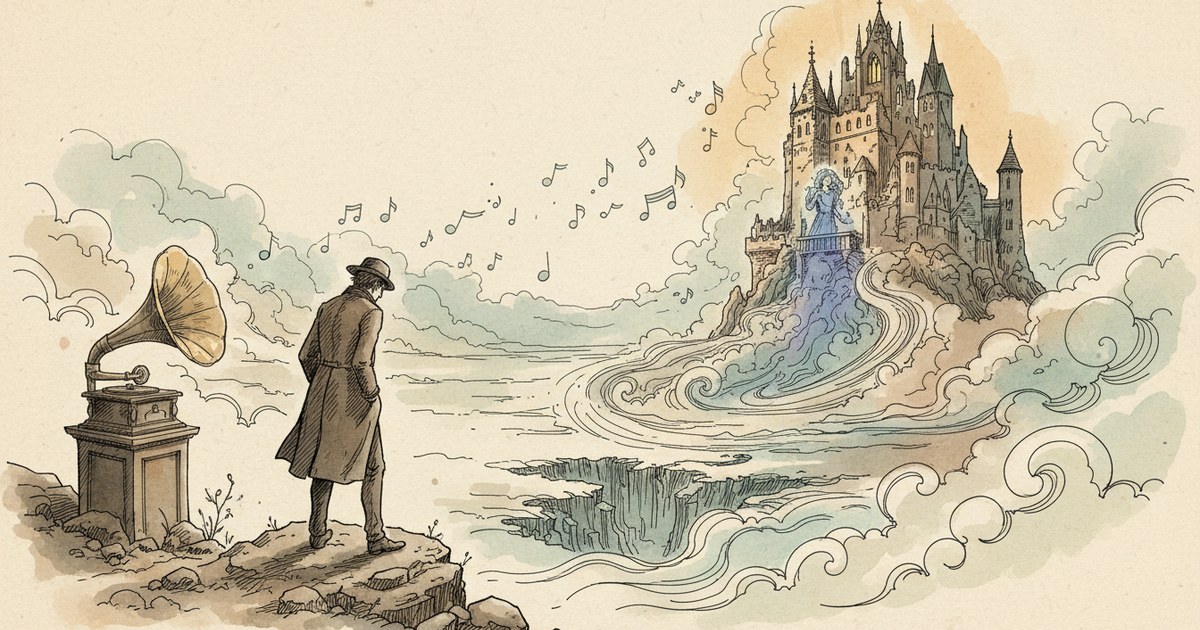
A young Transylvanian count stands at the foot of a ruined castle and hears a dead woman singing. He knows she is dead because he watched her die — on stage, mid-aria, her final note dissolving into collapse. He has spent years grieving her. The villages surrounding the castle know she is dead, which is why they have kept their distance from these walls for a decade, boarding up the gates and staying off the road after dark. And yet the voice drifts from a tower above: precisely her voice, unmistakably her phrasing, note for perfect note. Count Franz de Télek does what any grieving man would do in Transylvania in 1892. He assumes the supernatural.
Jules Verne holds that frame. He lets it breathe long enough to feel natural, even earned. The villagers’ terror feeds it. The count’s grief feeds it. The novel’s opening chapters move through gothic machinery with what seems like genuine conviction — the crumbling castle, the shepherd who goes missing, the isolation of the Carpathian mountains at dusk. Then Verne dismantles all of it. La Stilla is not haunting the castle. She is playing on a loop, on a phonograph recording that the obsessive Baron Gortz captured during her final performance, while she was still alive, before she knew she was dying. He has been replaying it ever since.
Published in 1892, five years before Dracula and three years after Edison began marketing the phonograph commercially, The Carpathian Castle is the first novel to treat recorded media as horror. Not science fiction in the adventure sense — no voyage, no expedition, no race against distance. Not gothic in the supernatural sense — no actual haunting, no actual resurrection. Something colder than either: the terror of perfect reproduction, of a voice that keeps performing after its owner is gone. Verne saw the shape of this problem before anyone had language for it, and the novel reads now like a dispatch from a century we have spent the last twenty years living inside.
The Optimist Who Stopped Believing His Own Argument
The Verne who wrote The Carpathian Castle was not the Verne who wrote Twenty Thousand Leagues Under the Sea. The early novels — Journey to the Center of the Earth, Around the World in Eighty Days, From the Earth to the Moon — treat technology as liberation and adventure as its own sufficient argument. The scientist-heroes are competent, the machines cooperate, and progress arrives on schedule. That Verne was, in part, a construction. His publisher Pierre-Jules Hetzel had been shaping the work since 1863, cutting anything too dark, steering Verne’s imagination toward the instructive and the optimistic. Hetzel wanted science to be exciting. Verne was not always sure it was safe.
Hetzel died in 1886. The manuscripts Verne had written after his better instincts and the ones he had already filed away, unpublished, told a different story. Paris in the Twentieth Century, written in 1863 but rejected by Hetzel and not published until 1994, depicts a future of total technological efficiency and complete cultural sterility. The Eternal Adam, published posthumously, ends with civilization erased. The Carpathian Castle appeared in 1892, six years after Hetzel’s death, and it shows Verne working out what he had been thinking all along: that technology is not neutral, that the ability to reproduce something is not the same as preserving it, and that obsession — when given sufficient machinery — becomes indistinguishable from possession.
The biographical fact that matters here is not that Verne was French or prolific or difficult in his final years, but that he was genuinely troubled by what the phonograph meant. He understood, perhaps before most of his contemporaries, that the recording was not the person — and that this distinction, once it became invisible, once the recording was good enough, would produce a particular kind of madness. Baron Gortz is that madness in pure form: a man who has replaced a dead woman with her own perfect echo and who has ceased to understand the difference. Verne does not frame this as villainous. He frames it as the logical endpoint of grief, given sufficient technology. That is what makes it disturbing rather than merely lurid.
By the time he finished the novel, Verne was sixty-four, his eyesight failing, his leg permanently injured from a shooting incident with his nephew six years earlier. The utopian confidence of the early Extraordinary Journeys had curdled into something more suspicious. The Carpathian Castle is dedicated to no particular journey and ends in fire. The count is left staring at rubble. Nothing has been learned. Nothing could have been.
A Voice That Outlasted the Body That Made It
The structure of the novel is a controlled misdirection. Verne builds the gothic scaffold with enough care that you genuinely follow it — the superstitious villagers, the shepherd who vanishes, the lights seen in the tower, the dread that accumulates around an old ruin. He is working the genre consciously, not naively, which is why the turn hits harder than a simple twist would. By the time we understand what Baron Gortz has done, we have already accepted the frame Verne is dismantling. The gothic atmosphere was never decoration. It was the trap.
What Gortz has done is this: he loved La Stilla with the total, annihilating devotion that Verne’s obsessives reliably bring to their fixations. When she announced she would leave the stage to marry Count Franz, Gortz’s response was not to accept her departure but to refuse it. He positioned a phonograph apparatus behind the stage curtain during her final performance — the one she intended as her last — and recorded her. She died before the aria ended. Gortz left with the recording. He retreated to the Carpathian castle and has been playing it on a loop for five years, which is why the locals hear a woman’s voice drifting from a building that nobody has entered. He has not preserved her. He has replaced her with the last minutes of her.
The final movement of the novel adds a layer that anticipates cinema by four years. When Franz finally penetrates the castle, he does not find a recording device alone. He finds a projection — a magic lantern arrangement that throws La Stilla’s image against a wall while her recorded voice fills the room. Gortz has assembled a kind of primitive home theater out of grief and available technology, and it has worked well enough to sustain him for five years. The moment Franz shatters the projection, when the illusion breaks, Gortz’s mind breaks with it. The distinction between the woman and the reproduction was the only thing keeping him functional, and he had long since stopped perceiving it as a distinction at all. Verne published this in 1892. The Lumière brothers held their first paid cinema screening in 1895.
What the novel earns the right to argue — what all this machinery is in service of — is the question of whether a recording of someone constitutes a relationship with them. Gortz has had five years of what felt, to him, like company. The voice answered nothing, varied nothing, developed nothing. It did not age or tire or change its mind about leaving the stage. It was perfect in the way that only dead things are perfect. Verne understood this as a horror specific to modernity: not the horror of the supernatural, but the horror of sufficiency. The recording is good enough. That is precisely the problem.
The Translation Landscape
The Carpathian Castle has not been well served by English translators. The earliest English version, produced in the 1890s from the original French serial, reads as the product of a different century’s assumptions about what translated prose should do — which is to say it is faithful to the sentence and indifferent to the voice. The technical passages, where Verne is careful and specific about how Gortz’s apparatus works, arrive in English as flat exposition. The atmospheric passages, where Verne is deliberately calibrating suspense, flatten further. A key moment in the original — when Gortz first explains, in clinical detail, what the phonograph captured — has a quality of cold pride in the French that the Victorian translation renders as mere explanation. The result is a book that reads like a curiosity rather than an argument.
A later mid-century translation, which circulated widely in cheap paperback editions through the 1960s and 1970s, is more readable but makes a different error: it smooths out Verne’s tonal shifts, the places where the novel pivots from gothic register to something colder and more clinical. Those pivots are the whole point. When Verne shifts from atmosphere to mechanism, he is doing it deliberately — making you feel the gear-change, the deflation of the supernatural into the merely technical. A translation that blends these registers together loses the novel’s central effect. the edition linked below restores that deliberate unevenness, keeping Verne’s transitions sharp so that the novel’s argument about technology and grief lands with the precision he intended.
Why This Translation Earns Its Place
The challenge of translating late Verne is that his prose serves two masters simultaneously: the adventure-fiction tradition that made him famous, and the darker, more skeptical intelligence that his publisher spent twenty years containing. The Carpathian Castle sits at that intersection, and a translator who reads it only as genre fiction will produce genre fiction. This translation reads it as the argument it actually is — which means attending to what Verne is doing when he slows down and when he accelerates, when he withholds and when he specifies. The result is a novel that feels as unsettling now as it must have in 1892, when the phonograph was three years old and no one had yet worked out what it meant to own a dead person’s voice.
the edition linked below is available in paperback on Amazon. If you have spent any time thinking about what streaming platforms have done to music, or what AI voice cloning is doing to grief, this is the novel that got there first. Verne did not have the technology to be right about the technology. He had something more durable: an understanding of what people do with perfect reproductions of the things they have lost, and why perfect is worse than imperfect, and why the loop never really ends.
Is The Carpathian Castle science fiction or horror?
Both, in the way that only late Verne manages. The novel uses the conventions of gothic horror — the ruined castle, the isolated village, the unexplained phenomenon — and then explains everything through technology. The explanation does not dispel the horror; it deepens it. The book sits closer in spirit to a ghost story than to the adventure novels Verne is best known for, but the ghost is a phonograph recording, and that changes everything.
Do I need to have read other Verne novels first?
No. The Carpathian Castle is entirely standalone. If anything, coming to it without expectations formed by the adventure novels is an advantage — the novel makes more sense as a response to that earlier optimism, but it does not require familiarity with it. Read it cold and let it be strange on its own terms.
Why is this novel less well-known than Verne’s other work?
Partly because it resists the categories Verne is usually filed under. It is not a journey novel, not a boys-own adventure, not straightforwardly celebratory about technology. It belongs to the late, darker Verne that his publisher spent decades containing, and it has never had the marketing apparatus that sustained Twenty Thousand Leagues or Around the World in Eighty Days. The better question is why it is not more famous now, in an era when everything it is about has arrived.
Where can I buy this translation of The Carpathian Castle?
the edition linked below is available in paperback on Amazon. It is the edition to read if you want the novel to work as Verne intended — sharp, cold, and precise about exactly how much damage a perfect reproduction can do.
Also worth reading

Leave a Reply