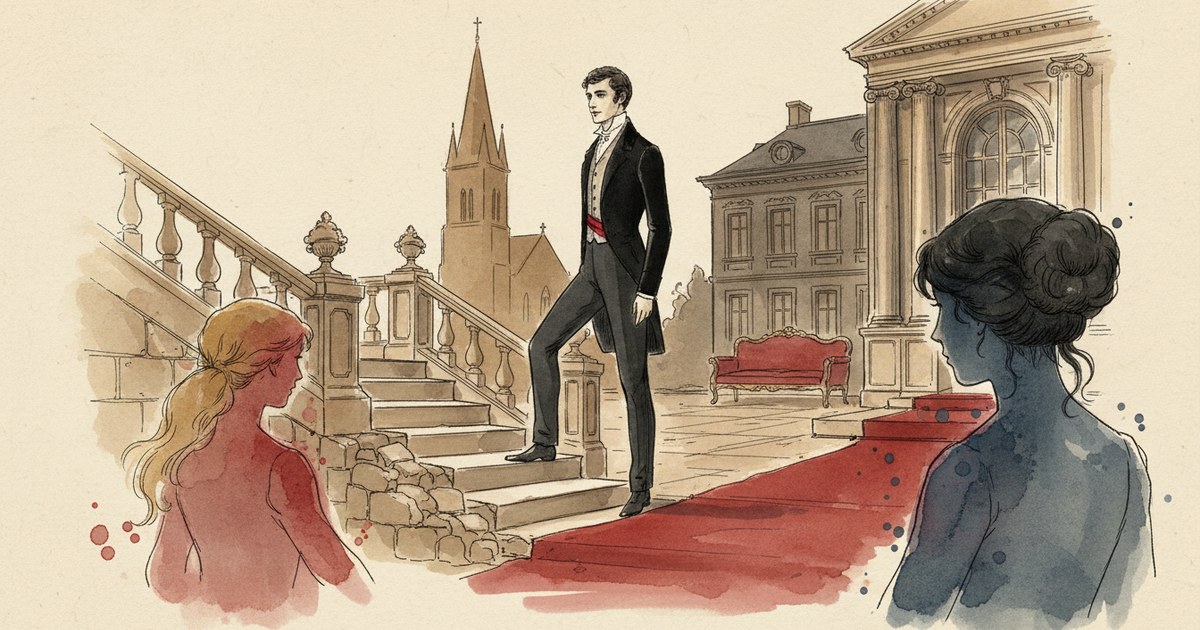
The first time Julien Sorel reaches for Madame de Rênal’s hand in the garden, he has already decided he must do it. Not because he wants her — not yet — but because he’s set himself a test of will. A carpenter’s son hired to tutor the children of the local mayor, he sits beside this woman in the summer dark and tells himself: if the clock strikes ten and I haven’t taken her hand, I am a coward. The clock strikes. He takes it. She doesn’t pull away. This is how Stendhal works: desire arrives as obligation, seduction as self-coercion. In that gap between what Julien feels and what he decides to feel, the whole engine of The Red and the Black runs.
The novel is about ambition, but the word flattens it. Julien isn’t ambitious the way a politician is ambitious. He is ambitious the way a person is who has been told — by birth, by class, by the accident of when he arrived in history — that his intelligence doesn’t count. Napoleon is gone. The army, which once let talent rise, is closed off. The church remains. So Julien memorizes the entire Latin New Testament, performs piety he doesn’t feel, and moves through the Restoration’s drawing rooms like an actor who has memorized everyone else’s lines. Stendhal’s thesis is blunt, delivered with irony: Julien’s anger is not a defect of character. It is the only rational response to a society that offers mobility as a promise and withdraws it at the door.
What makes the novel devastating, two centuries on, is that the machinery hasn’t changed — only the costumes. The church has been replaced by other institutions, the Restoration drawing room by other rooms with other dress codes, but the fundamental situation — the outsider who must perform belonging while calculating every move — is as legible now as it was in 1830. Stendhal wrote for readers who hadn’t been born yet. He knew it. The surprise is how few of his heirs have matched the precision.
The Soldier Who Outlasted His Own Empire
Henri Beyle was born in Grenoble in 1783, and he never quite forgave it. Provincial, bourgeois, the son of a lawyer he despised — everything Julien Sorel is designed to escape, Beyle had spent his early years escaping too. He remade himself under Napoleon’s campaigns, serving as a cavalry officer in Italy and witnessing, at close range, what a meritocracy looks like when it briefly exists. He crossed into Russia in 1812 with the Grande Armée and watched Moscow burn. That catastrophe is in The Red and the Black not as scene or symbol but as negative space — the shape of a world that had promised everything and delivered ruins. Julien’s universe is what comes after. Beyle knew exactly how that felt.
He settled eventually on “Stendhal” as his preferred pseudonym — one of over a hundred he used across his life, this one borrowed from a minor Prussian town with no particular significance. The name-switching matters. Beyle understood, before most novelists had the vocabulary for it, that identity is a costume worn with varying degrees of conviction, and that the performance of selfhood is exhausting in exact proportion to how far you’ve traveled from where you started. He also wrote a treatise on desire — On Love, published in 1822 — that introduced the term “crystallization” to describe how infatuation operates: the mind, like a bare branch dipped in a salt mine, coats the object of desire with imagined perfections until the branch itself disappears entirely. That mechanism is the operating system of The Red and the Black. Both Julien and Mathilde love projections, not people. Madame de Rênal is the one who doesn’t.
Stendhal published the novel in 1830 to modest sales and baffled reviews. He told a friend he expected to be understood around 1880. He was off by about thirty years — it was Zola and the naturalists who first recognized what he’d done — but the prediction itself is characteristic: absolute confidence in his own method, complete indifference to contemporary approval. That detachment produced the novel’s signature quality. Stendhal doesn’t sentimentalize Julien or condemn him. He watches him with the cold attention of a man who has run the same calculations himself and knows exactly where they lead.
The Logic of a Man Who Watches Himself Think
The technical achievement of The Red and the Black is the sustained use of free indirect discourse before anyone had named it. Stendhal lives inside Julien’s head — but at a remove. The narration slides between Julien’s perspective and a drier, more ironic intelligence observing him from just outside. “He would show them,” the narrator notes, after some social wound. The “he” is Julien; the irony belongs to Stendhal; the reader inhabits both simultaneously. You root for Julien even as you see him clearly, even as the narrator quietly catalogs every miscalculation. It’s a strange and uncomfortable position, and Stendhal holds you there for three hundred pages.
The novel’s structure mirrors the title’s opposition. The red is Napoleon, the army, the world where talent was its own credential. The black is the Church, the Restoration, the world where the performance of correct belief matters more than intelligence. Julien moves between them, never fully belonging to either, constantly translating himself for whatever audience he’s performing for at the moment. The two women in his life track this divide precisely: Madame de Rênal, intuitive and genuine, entirely without Parisian irony; and Mathilde de la Mole, daughter of a marquis, historically obsessed, who loves Julien specifically because she has cast him as a Danton-style tragic hero in her private theater. The dangerous moment, which Stendhal builds toward with enormous patience, is when Julien begins to believe her version of him.
The ending of this novel is famous, discussed in every survey course, and still lands harder than it has any right to. Without the specifics: there is a scene in a courtroom in which Julien, who has spent three hundred pages calibrating every word for maximum effect on whatever audience he faces, finally says exactly what he thinks. He knows what the consequences will be. He says it anyway. It is the one moment in the novel when the gap between what Julien feels and what he decides to feel closes entirely. The sentence Stendhal gives him is not heroic. It is honest — which in this world is the more dangerous choice.
Tolstoy studied Stendhal’s battle sequences before writing Austerlitz in War and Peace. Dostoevsky read The Red and the Black before writing Raskolnikov. The novel’s fingerprints are on every major work of psychological realism that followed it — but it reads, in good translation, not as a source text or a monument. It reads as a live wire.
The Translation Landscape
English readers have several options, and the differences between them matter more than they usually do with French novels — Stendhal’s style is economical and sardonic in a way that collapses under loose handling. Roger Gard’s Penguin Classics translation (1991) is the most widely assigned in universities: it hews close to Stendhal’s syntax and preserves the dry narrative register, though it stiffens in places where the original is offhand, making the ironic distance feel like scholarly distance. Catherine Slater’s Oxford World’s Classics edition comes with excellent period notes and a substantial introduction — genuinely useful for academic readers — but the translation itself runs formal throughout, occasionally leveling the tonal variation that gives the novel its whipsaw quality. Burton Raffel’s Modern Library version (2004) moves in the opposite direction, loosening Stendhal’s sentences into a more colloquial American idiom; it gains in pace what it loses in the precise calibration of social register, and social register is, in this novel, the entire subject.
The test case is a sentence from the garden scene itself — Julien’s internal monologue in the seconds before he reaches for Madame de Rênal’s hand. In older translations it reads as a man reasoning with himself, working through doubt. In the edition linked below the sentence is stripped to its mechanism: pure behavioral logic, feeling bracketed entirely by will. That’s how Stendhal wrote it. The distinction sounds fine-grained until you’ve absorbed three hundred pages of it, at which point the cumulative effect is everything — because the whole novel turns on whether you experience Julien as calculating or as suffering, and Stendhal’s answer is that there is no difference.
Why This Translation Belongs on Your Shelf
the edition linked below was built for exactly the reader who tried The Red and the Black in an older translation and assumed the difficulty was theirs. It wasn’t. Stendhal’s sentences are short and fast; a translation that renders them long and formal lies about the experience of reading him. This edition maintains the ironic gap — that productive distance between Julien’s self-justifying inner voice and the narrator’s cooler intelligence — without hardening it into academic prose. The result is a text that does what Stendhal intended: it makes you complicit in Julien’s calculations even as you see through them. You finish it slightly implicated. That’s the correct response.
If you haven’t read The Red and the Black, start here. If you read it years ago in a translation that felt like work, start here too. the edition linked below is available in paperback on Amazon — a complete modern English translation that restores the novel’s original speed without sacrificing the precision that makes it last. Stendhal expected to wait for his readers. You don’t have to make him wait any longer.
Is The Red and the Black difficult to read?
It’s psychologically demanding but not stylistically difficult — in good translation, the prose moves quickly. The challenge is that Stendhal expects you to hold two registers simultaneously: Julien’s self-justifying inner voice and the narrator’s dry ironic commentary on it. Once you’re tuned to that frequency, the novel becomes hard to set down.
What does the title mean?
Stendhal never explained it definitively, which is almost certainly deliberate. The most durable reading: red for the military uniform, the Napoleonic world where talent might have found its proper outlet; black for the cassock, the clerical route the Restoration left open to men of ability. Julien’s entire life is lived in the gap between those two options, belonging fully to neither.
Should I read The Charterhouse of Parma before or after?
The Red and the Black first. It’s the earlier and more concentrated novel — Stendhal at his most precise. The Charterhouse is looser, more operatic, written in fifty-two days and never revised; it benefits from having The Red and the Black as a reference point for what Stendhal achieves when he fully tightens the screws.
Is this translation suitable for academic study?
the edition linked below is a complete modern English translation of the unabridged text. Students who require substantial scholarly apparatus — detailed period introductions, textual variants, footnotes on Restoration politics — may want to supplement it with the Oxford or Penguin editions. For reading the novel as a novel, this translation is the clearest currently available in English.
Also worth reading

Leave a Reply