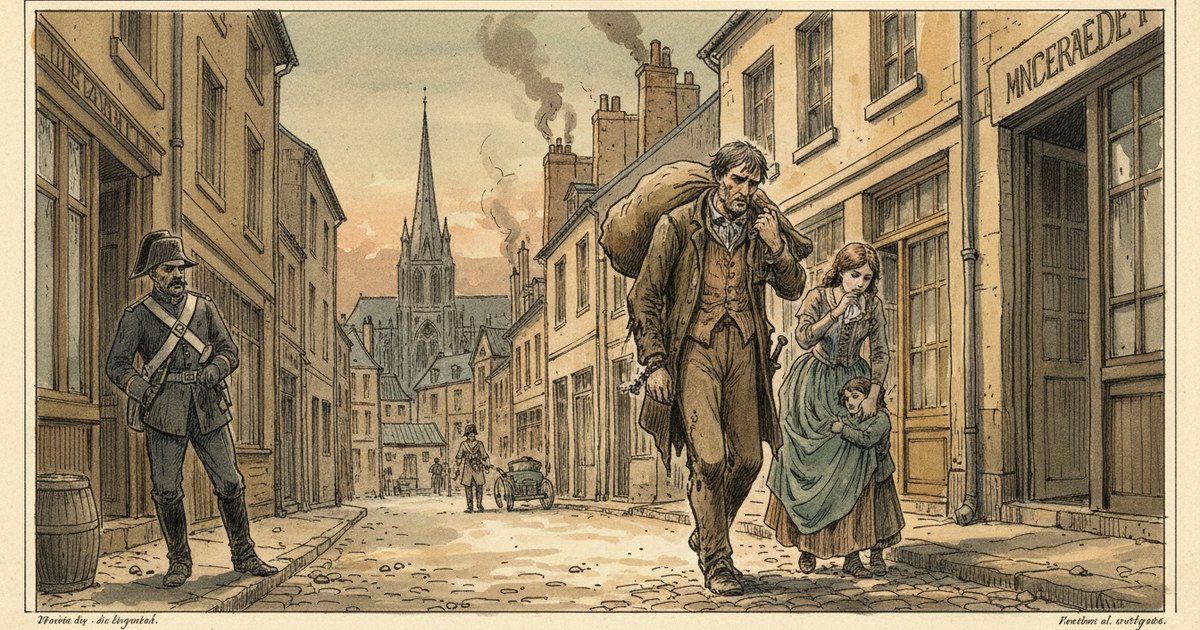
Fantine sells her hair on a Tuesday. She needs forty francs to pay the Thénardiers, who are raising her daughter Cosette in Montfermeil and keep sending letters demanding more. The wig-maker in Montreuil-sur-Mer gives her ten francs. She takes them. Later she sells her two front teeth — forty francs to a traveling dentist who extracts them on the spot. By the time Inspector Javert arrests her for throwing a fistful of snow at the man who stuffed ice down her dress, she is selling herself by the hour in the alley off the Rue Saint-Pierre.
Hugo does not linger on any of this. That is the point. He moves through Fantine’s destruction with the brisk efficiency of a ledger: ten francs, forty francs, a night’s work. The reader doesn’t get time to look away because the character doesn’t get time to stop. This is what Les Misérables actually argues, beneath the barricades and the candlesticks and two decades of pursuit: poverty is not a misfortune that befalls people. It is a mechanism that processes them.
Jean Valjean stole a loaf of bread to feed his sister’s seven starving children. He received five years in the galleys. He tried to escape four times; each attempt extended his sentence. Five years became nineteen. When he walked out of the galleys at Toulon in 1815, he carried a yellow passport — a document required by law to be shown to every innkeeper, every employer, every magistrate he encountered. In the four days following his release, not one person in five successive towns would rent him a room, sell him a meal, or let him sleep under a roof. A man with his sentence served, his debt paid, his debt apparently infinite.
The Man Who Watched France From the Outside
Victor Hugo published Les Misérables in April 1862 from Hauteville House on the island of Guernsey, where he had been living in political exile for eleven years. Louis-Napoleon had seized power in a coup in December 1851, and Hugo — then a deputy in the Legislative Assembly — had called the new emperor a criminal and a traitor to France. He was given forty-eight hours to leave. He did not return for nearly two decades.
The exile explains the book’s angle. Hugo writes about France the way you write about a country you love and cannot enter: with extraordinary attention to its details and no patience for its self-justifications. He had stood in Paris in June 1832 and watched the uprising from the street — the barricades of the Rue de la Chanvrerie that occupy the novel’s final third are not literary invention but physical memory. Writing those scenes from across the Channel and eleven years of distance gave him the remove to see not just what happened but what it meant and who paid for it.
Born in 1802, the son of a Napoleonic general, Hugo spent his early childhood moving between Spain, Italy, and Elba as his father’s postings changed. He did not grow up poor. He grew up watching empire administer populations — moving people between jurisdictions as the military required — and he learned early the gap between what a state declares about itself and what it does to individuals. By his thirties he had traveled politically from royalist to liberal republican to democratic socialist. That transit is the spine of Les Misérables. It is a novel written by a man who revised his own convictions multiple times and believed revision was a moral obligation.
In September 1843, his daughter Léopoldine drowned in the Seine near Villequier, at nineteen, alongside her husband of six months. Hugo learned about it two weeks later, reading a newspaper in a café. The grief silenced him publicly for nearly a decade. When he returned to sustained work, the moral urgency in the prose had changed register entirely. The social argument in Les Misérables — that the suffering of the poor is not accidental but manufactured — does not read like a political program. It reads like a man who has sat long enough with actual loss to stop being polite about what causes it.
What the Yellow Passport Actually Does
Volume One covers the years from Valjean’s release in 1815 to his flight from Montreuil-sur-Mer in 1823 — the years in which Hugo establishes every mechanism the rest of the novel will use. The scene most people know is the Bishop of Digne and the silver candlesticks: Valjean steals the bishop’s silverware, the gendarmerie catches him on the road, and the bishop tells the officers the silver was his own gift to Valjean. He then hands Valjean the candlesticks he had forgotten to take. This has become cultural shorthand for Christian mercy. Hugo’s actual interest is more precise. When the bishop refuses to prosecute, he does something the state apparatus is structurally incapable of: he declines to treat Valjean as a category. He insists on treating him as an individual capable of transformation.
The yellow passport makes Valjean a category. That is its designated function. It doesn’t record Jean Valjean the person. It records a classification — dangerous, watch carefully, refuse to trust — and that classification arrives in every room before he does. Every innkeeper who turns him away, every employer who declines to hire him: none of them are evaluating the specific man standing in front of them. They are responding to a document that has evaluated him in advance. Hugo’s argument is not that these people are cruel. It is that a system organized this way produces these outcomes reliably, regardless of anyone’s individual intentions.
Fantine’s arc makes the same argument with different evidence. She is not a criminal. She has broken no law. What she possesses is an illegitimate daughter in a society that treats illegitimacy as moral contamination, a factory position she cannot afford to lose, and a sequential series of men — the Thénardiers extracting money by letter, the foreman who fires her once her secret surfaces, the magistrate who sentences her without examining the facts — each operating within the rules of a system functioning exactly as designed. No one commits a crime to destroy Fantine. The law does it on schedule, cleanly, without requiring anyone’s malice.
The novel’s third demonstration runs quietly alongside Fantine’s story, at the Thénardiers’ inn in Montfermeil. Cosette sweeps the inn at night, hauls water from the well in a bucket larger than she is, sleeps under the stairs. The Thénardier daughters wear the clothes Fantine has been paying to dress Cosette in. What Hugo shows with patient precision is that exploitation does not require exceptional wickedness. It requires an unequal arrangement and no one obligated to intervene.
This is why Javert is not the novel’s villain. Javert is a man of total conviction who has internalized the system’s logic so completely that the system’s own self-contradiction — when it arrives — cannot be survived. He is in a specific sense the most honest character in the book: he has never pretended that justice is anything other than enforcement. He simply cannot conceive of what it would mean to be wrong about enforcement being justice.
The Translation Landscape
English readers have had several serious attempts at Les Misérables, and the differences between them are not cosmetic. The Lee Fahnestock and Norman MacAfee translation for Signet Classics (1987) has been the dominant American classroom edition for decades, and it earned that position. Fahnestock and MacAfee made a principled decision to preserve Hugo’s famous digressions — the extended chapters on the Battle of Waterloo, the Paris sewer system, the sociology of convent life — rather than treating them as obstacles to modern attention spans. These passages are where Hugo’s social argument operates at its largest scale. The prose is accurate and clear without being particularly alive at the sentence level, which is a reasonable trade-off for a novel of this length.
Julie Rose’s 2008 Modern Library translation took the opposite bet. Rose modernized Hugo’s register deliberately, bringing the dialogue especially close to contemporary American speech. In the novel’s working-class scenes — Fantine’s exchanges at the factory, the Thénardiers’ inn negotiations — the colloquial directness feels true to the characters and their circumstances. In Hugo’s sustained rhetorical passages, where he is writing as a moralist addressing a civilization about its own crimes, the modernized idiom creates a mismatch of scale. Rose’s translation earns its place as a lively entry point but loses power precisely where Hugo is working at full force. Norman Denny’s 1976 Penguin Classics translation is fluent and intelligent but reorganizes structural material that Hugo arranged deliberately; the prose flows at the cost of Hugo’s own architecture.
Christine Donougher’s 2013 Penguin Classics translation is the most careful current scholarly version. Donougher is particularly attentive to Hugo’s tonal range — the novel shifts without warning between political essay, lyric prose, and flat documentary, and holding all three in English simultaneously requires constant precision. Consider the sequence in which Valjean is turned away from inn after inn in Digne: Donougher preserves the syntactic repetition in Hugo’s French, door after closed door, which makes the exhaustion accumulative rather than merely summarized. The notes are thorough. For readers working with the text closely, this is the version to use.
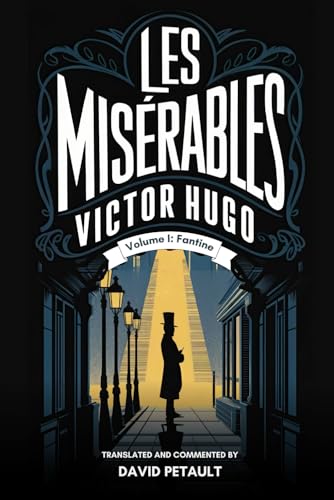
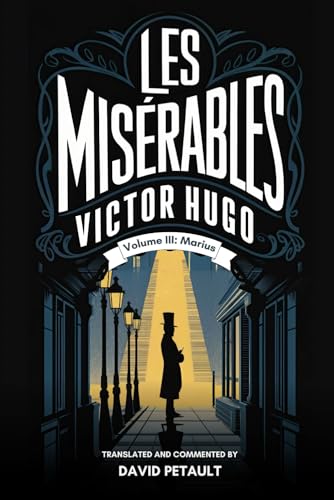
the edition linked below of Volume One is working toward a different reader. The prose is clear without being stripped, and the social argument comes through in the English without requiring the reader to fight through archaic constructions or Victorian indirection. Where Fahnestock and MacAfee build for completeness and Donougher builds for scholarly rigor, this edition builds for accessibility of entry — the first-time reader who needs to be pulled in by Fantine’s story before they can trust Hugo on the Paris sewer system. The translation doesn’t flatten Hugo’s voice. It removes the distance between the reader and what Hugo is actually saying.
Why Start With This Translation?
Les Misérables has a reputation for length that discourages readers before they reach the first sentence. the edition linked below of Les Misérables — Volume 1: A New Translation in Modern Accessible English addresses this directly. The opening movement of the novel — Valjean’s release, the bishop, Fantine’s fall, Cosette’s years at the Thénardiers — becomes a coherent and complete reading experience on its own terms. By the end of this volume, the reader holds the full moral argument: what the system does to Valjean, what it does to Fantine, what it does to a child left in the care of people who see her as a revenue source. Nothing has been resolved. Everything has been established.
For readers coming to Hugo for the first time, or returning after a previous attempt that stalled somewhere before Waterloo, this edition is the right place to begin. It does what the best accessible translation can do: it puts you in the room with a man who has just stolen a loaf of bread and asks whether nineteen years in the galleys is a reasonable response to hunger. Hugo already knows what you’ll answer. He just wants to make sure you can’t stop thinking about the question.
Frequently Asked Questions
What kind of reader should start with Hugo Made Poverty the Real Villain?
Readers interested in Victor Hugo and strong literary stakes will find Hugo Made Poverty the Real Villain a good entry point because it combines narrative momentum with a clear thematic payoff.
Is Hugo Made Poverty the Real Villain difficult to read today?
Not especially. The challenge is usually tone and context, not plot. A modern translation helps the book feel immediate without flattening its historical texture.
Why choose this translation of Hugo Made Poverty the Real Villain?
The best reason is clarity without loss of character. A strong translation preserves the author’s pressure, rhythm, and emotional temperature while removing needless stiffness.
What should readers notice most in Hugo Made Poverty the Real Villain?
Pay attention to how the book builds its tension through scene, voice, and moral pressure rather than summary. That is usually where the work still feels most alive.



Leave a Reply