Why the translation choice matters
Dante is unusually dependent on translation because almost every sentence asks the English reader to choose between competing goods: music, clarity, theology, political context, and narrative speed. Take the famous opening of the Inferno: Dante is “midway” through life, lost in a dark wood, and unable to find the straight path. In one English version, the line feels like solemn Victorian poetry; in another, like a densely annotated medieval text; in a modern prose version, like the beginning of a psychological crisis.
None of those approaches is automatically wrong. Dante wrote in terza rima, a chain-rhyme structure that is nearly impossible to reproduce naturally in English. A translator who preserves rhyme may capture something of the poem’s propulsion, but may also bend English into stiffness. A translator who abandons rhyme can give the reader a cleaner path through the story, but loses some of the architecture that made Dante’s poem feel inevitable.
That is why “the best translation” of The Divine Comedy depends on the reader. A student writing a paper needs notes, historical context, and close fidelity. A first-time reader may need a version that makes Hell, Purgatory, and Paradise legible before asking them to admire the engineering. This guide treats Classics Retold as a curator: we compare the major English editions, explain the tradeoffs, and point readers toward the version that best fits the way they intend to read Dante.
The major English editions
The English tradition of Dante translation is long and uneven. Henry Wadsworth Longfellow gave American readers a monumental nineteenth-century Dante, literal and dignified but now often remote. John Ciardi made Dante energetic and teachable for mid-century classrooms, though his rhymes can feel forceful. Allen Mandelbaum and C.H. Sisson moved toward cleaner modern verse. Robin Kirkpatrick and Anthony Esolen represent two different contemporary scholarly approaches: Kirkpatrick more formally ambitious, Esolen more conservative and commentary-rich.
For many readers, the practical question is not which translation is “greatest” in the abstract, but which edition will actually be read to the end. The Divine Comedy is three books, a theological universe, a political revenge machine, a love poem, and a map of the soul. The edition has to match the reader’s patience, background, and purpose.
| Edition | Translator | Year | Best for | Tradeoff |
|---|---|---|---|---|
| Penguin Classics | Robin Kirkpatrick | 2006–2007 | Readers who want a serious modern poetic edition | Formally ambitious, but sometimes less immediately clear |
| Oxford World’s Classics | C.H. Sisson | 1993 | Readers who want restrained, readable blank verse | Less of Dante’s chain-rhyme momentum |
| Modern Library | Anthony Esolen | 2002–2004 | Readers who want traditional theology and extensive notes | Can feel heavy for casual reading |
| Bantam Classics | Allen Mandelbaum | 1980–1984 | College courses and balanced literary reading | Clear and respected, but not the most vivid for every reader |
| New American Library | John Ciardi | 1954–1970 | Readers who want drive, voice, and classroom energy | Rhyming choices can date the language |
| Modern accessible prose edition | Contemporary English adaptation | Recent | First-time readers who want narrative clarity | Loses the poetic form and much of the terza rima effect |
Side-by-side passage comparison
The opening of the Inferno is the simplest test case. The Italian begins: “Nel mezzo del cammin di nostra vita / mi ritrovai per una selva oscura, / ché la diritta via era smarrita.” The scene is not merely geographical. Dante is morally lost, spiritually frightened, and suddenly aware that the ordinary path of life has vanished beneath him.
| Longfellow (1867) | Kirkpatrick-style modern verse | Modern accessible prose |
|---|---|---|
| Midway upon the journey of our life / I found myself within a forest dark, / For the straightforward pathway had been lost. | Halfway along the road we have to go, / I found myself obscured in a great forest, / bewildered, and I knew I had lost the way. | In the middle of my life’s journey, I found myself lost in a dark forest, having strayed from the right path. |
What the differences reveal
Longfellow preserves dignity and distance. “Forest dark” sounds memorable, but it also tells you immediately that you are reading an older English Dante. The inversion is beautiful if you like nineteenth-century poetic diction; it is a barrier if you want Dante’s fear to feel immediate.
A modern verse translation tries to keep some of the poem’s motion while making the sentence less antique. The result can be strong, but the pressure of lineation and rhythm still shapes the English. That pressure matters: Dante’s poem is not simply a story told in verse, but an argument made through form. Readers who care about the poem as poetry should not ignore that.
Modern prose gives up the contest with Dante’s form and aims at comprehension. The advantage is obvious: the reader understands the situation at once. The disadvantage is just as real: Dante’s architecture becomes less audible. A prose edition can be the right doorway into the poem, especially for a first reading, but it should not be mistaken for the full poetic experience.
Which translation to read
If you are reading Dante for a course, or if you want one edition with serious literary authority, start with Robin Kirkpatrick’s Penguin Classics or Allen Mandelbaum’s Bantam translation. Both give you a Dante that can support study, rereading, and argument. Kirkpatrick is more formally adventurous; Mandelbaum is often smoother.
If you want theological and historical guidance, Anthony Esolen’s Modern Library edition is a strong choice. It is not the lightest way into Dante, but it takes the poem’s Christian architecture seriously and gives readers a framework for the references, doctrines, and political grudges that otherwise pass by in a blur.
If this is your first encounter with The Divine Comedy and you mostly want to understand the journey before studying the machinery, choose a clear modern English edition. You will sacrifice rhyme and some poetic density, but you may gain the thing that matters most on a first reading: enough momentum to keep going from the dark wood to the final vision.
A readable modern edition to consider
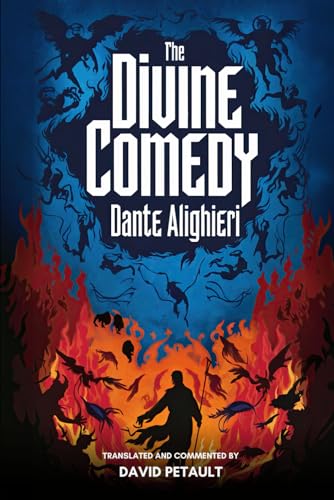
For readers who want Dante in direct contemporary English, the edition linked below is best understood as an accessible reading copy, not as a replacement for the major scholarly translations. It is for the reader who wants the story, the moral drama, and the emotional movement of the poem without stopping every few lines to decode older diction or formal compromises.
That makes it a useful first Dante, especially for book clubs, younger readers, and anyone who has bounced off the poem before. If you later want the full poetic and scholarly apparatus, move on to Kirkpatrick, Mandelbaum, Esolen, or another annotated verse edition. Classics Retold recommends this kind of modern prose edition as an entry point: a way into Dante, not the final word on Dante.
Related guides on Classics Retold
For more context on Dante’s life, exile, and the political imagination behind the poem, these related guides may help before or after reading the Comedy.
- The Divine Comedy and Dante’s exile — why the poem still feels personal, political, and dangerous.
Frequently Asked Questions
Which translation should first-time readers choose in 2026?
Robin Kirkpatrick’s 2006 Penguin Classics translation offers the best balance of readability and fidelity to Dante’s meaning for new readers. His prose maintains the narrative momentum while preserving the theological and political nuances that make Dante’s journey meaningful. The extensive but unobtrusive notes help readers navigate references without interrupting the story’s flow.
Should I read a verse translation that preserves Dante’s poetry or a prose version for clarity?
Prose translations like Kirkpatrick’s or Mark Musa’s sacrifice Dante’s intricate rhyme schemes but deliver clearer meaning and faster reading. Verse translations such as Anthony Esolen’s maintain the musical quality but can feel forced when English grammar conflicts with Italian rhythm. Choose verse if you plan to read aloud or want the full aesthetic experience, prose if you prioritize understanding the story and ideas.
Do I need a translation with extensive footnotes and commentary?
Heavy annotation helps with Dante’s countless references to 13th-century politics, classical mythology, and medieval theology, but it can fragment your reading experience. Robert Hollander’s translation includes the most comprehensive notes for serious students, while Kirkpatrick provides just enough context to keep you oriented. Start with moderate annotation—you can always consult scholarly editions later for deeper study.
How do modern translations compare to classic versions like Longfellow’s?
19th-century translations like Longfellow’s preserve Victorian literary elegance but use archaic language that obscures Dante’s direct, conversational tone. Modern translators better capture Dante’s immediacy and political bite, though they sometimes lose the grandeur that made earlier versions feel epic. Contemporary readers will find modern translations more accessible, while Longfellow remains valuable for understanding how English literature absorbed Dante’s influence.
Leave a Reply