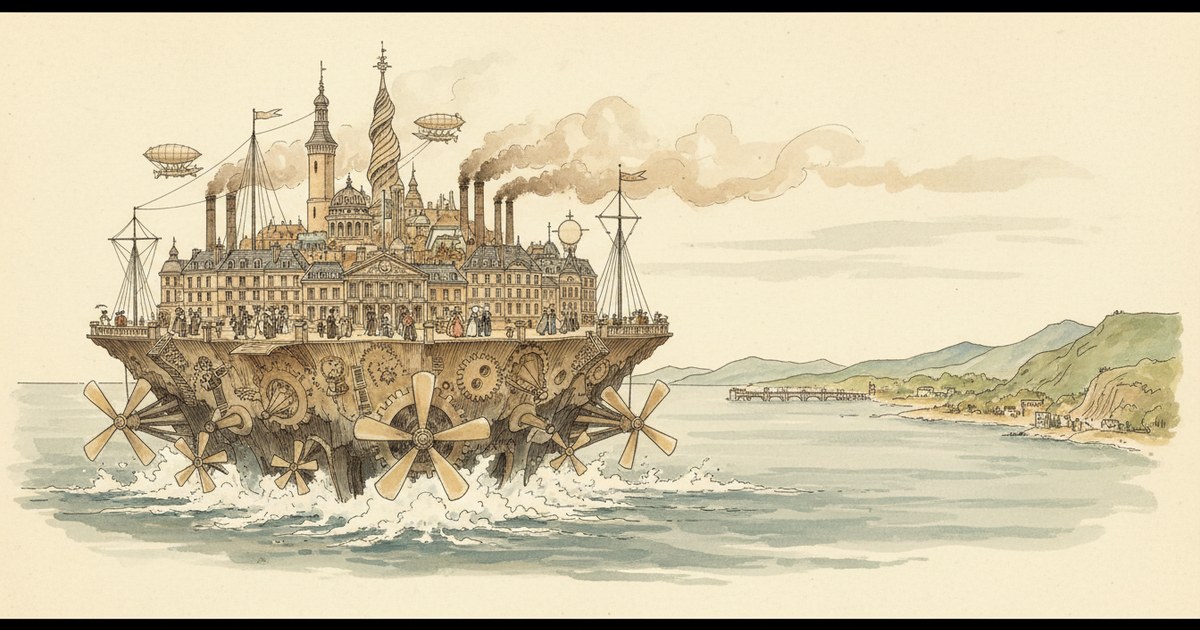
Four French musicians are kidnapped in California. Not violently — there’s a car waiting at the train station, courteous men in good suits, and before the string quartet fully understands what has happened, they are on board a moving island the size of a small city, hired to play concerts for millionaires who have purchased their way off the earth entirely. This is the opening of Propeller Island, Jules Verne’s 1895 novel, and it takes about twelve pages before you realize Verne isn’t writing adventure fiction. He’s writing a warning.
Standard Island — that’s the island’s name, precise and corporate — is an engineering marvel: a steel platform roughly a kilometer across, driven through the Pacific by giant propellers, populated by the ultra-wealthy who pay rent to a private company for the privilege of living there, free of any nation’s laws or obligations. Verne fills the first third of the book with technical specifications delivered in deadpan detail: the electrical grids, the freshwater systems, the artificial harbor. He makes you believe in it completely, and then he makes you watch it come apart.
The thesis is this: wealth concentrated past a certain point cannot govern itself. The island’s two dominant families — the Tankerdons on the left, the Coverleys on the right — agree on nothing and need nothing from each other, which means they have no reason to compromise and every reason to compete. The musicians, professional outsiders paid to provide culture to people who have opted out of the world, watch this deterioration with the specific horror of people who understand exactly what they’re seeing and cannot leave. Verne doesn’t frame this as tragedy. He frames it as engineering — a system running correctly toward its inevitable failure mode.
The Man Who Stopped Believing in Progress
Verne wrote Propeller Island at sixty-seven, near the end of a career that had made him, depending on your country, either the father of science fiction or a writer of children’s adventure stories. By 1895 he had buried his publisher and long-time collaborator Pierre-Jules Hetzel, whose optimistic editorial hand had shaped Twenty Thousand Leagues Under the Sea and Around the World in Eighty Days into the buoyant entertainments they became. Without Hetzel, the cheerful ambivalence about technology that runs through the early Verne had nowhere to hide. What emerged was something colder.
The biographical facts that matter here are not the famous ones. It is not useful to know that Verne wrote facing the sea, or that he owned yachts. What matters is that he was writing at the precise moment when the American robber baron became a global phenomenon — when men like Carnegie and Vanderbilt were demonstrating, publicly and in real time, that vast private fortunes had no natural limit and generated no natural obligation. Verne, who had spent his entire career inside capitalist publishing structures and understood what it meant to produce on contract, recognized the mechanism intimately. He had been living a version of it.
His late novels share a quality that Propeller Island makes explicit: a conviction that the engineering solutions humans celebrate most loudly are the ones most precisely calibrated to produce disaster. Paris in the Twentieth Century, suppressed by Hetzel himself and not published until 1994, describes a technologically advanced society that has crushed the arts entirely. The Eternal Adam ends civilizations. This is not pessimism as mood. It is pessimism as method. Verne builds Standard Island the way an investigator reconstructs a crime scene — backward from the collapse, so that every detail of the construction is also evidence of how it fails.
That method gives Propeller Island its particular texture. The novel reads like a technical manual that knows it is also a eulogy. Verne describes the island’s power systems in loving detail not because he admires them but because he needs you to understand exactly which component will fail first and why. The biographical fact that matters is not whether Verne was optimistic or pessimistic by temperament — it is that he was a systematic thinker whose system had, by 1895, reached its conclusions.
A Floating City Running Its Failure Scenario
The quartet — Yvernes, Pinchinat, Frascolin, and Zorn — function as the novel’s conscience by accident. They are not moral heroes. They are professionals who need to be paid and want to go home, and their increasingly desperate observations of Standard Island’s political deterioration have the quality of expert witnesses testifying to something they wish they hadn’t seen. When the Tankerdon and Coverley factions begin positioning for control of the island’s governance, it is Frascolin — the most analytical of the four — who first identifies the structural problem. The island has no constitution. It has a company charter, and company charters do not contemplate stalemate.
Verne is extraordinarily specific about the shape of this deadlock. The two factions do not fight over ideology. They fight over the island’s heading — literally, which direction the propellers point. Standard Island’s governor-general can order any destination, but the two families each control enough votes to paralyze any decision they oppose. The island drifts. Verne doesn’t lean on this as metaphor; he lets the technical reality carry the weight. When the council deadlocks over whether to steer toward Hawaii or toward the Fiji archipelago, the island goes nowhere, burning fuel, accumulating risk, while the musicians practice scales in a concert hall built for an audience that is busy destroying itself.
The novel’s final act involves a cascade of consequences that Verne has prepared with the precision of a demolitions expert placing charges. Every element introduced in the first hundred pages returns. The musicians’ contract, the island’s route, the rival families’ finances, the mechanical specifications of the propellers themselves — everything that seemed like scene-setting turns out to be load-bearing. When the collapse comes, it does not feel like plot. It feels like a proof.
What makes Propeller Island worth reading now is not that it predicted anything in particular. It is that Verne got the mechanism right. The failure mode he describes — private sovereignty, concentrated wealth, no external obligation, no natural limiting force — is not a historical curiosity. It is a design currently in active use, refined and scaled. The string quartet is still there too, somewhere, watching from a stage they can’t leave.
The Translation Landscape
Propeller Island has had a thin life in English. The first translation, by W.J. Gordon, appeared in 1896 — one year after the French original — and was produced at the pace Victorian publishing demanded of Verne: quickly, for a reading public that wanted the plot and didn’t particularly require fidelity. Gordon’s version is competent in a period sense. It conveys the story without embarrassing itself, and handles the technical passages adequately. But it makes consistent choices that flatten Verne’s irony. Where Verne’s French is deliberately corporate and bureaucratic — dry in a way that signals critique — Gordon tends toward the warmly journalistic. The deadpan disappears. You are left with a peculiar adventure novel that seems almost to like the island it is describing.
For most of the twentieth century, Gordon’s 1896 text was effectively the only text: reprinted, repackaged, excerpted in Verne anthologies, and occasionally re-titled. Readers who encountered Propeller Island in English were encountering a book that had been de-ironized at the point of translation. The satire was present in outline but absent in tone. This matters more for Propeller Island than for Verne’s earlier novels because the satire is the novel. Twenty Thousand Leagues can survive a clumsy translation — the ocean is still there, the Nautilus still moves. Propeller Island, where the mode is the meaning, cannot absorb that loss without becoming a different book entirely.
Oxford World’s Classics has not produced an edition of this title, and the Penguin Classics catalog — comprehensive on Verne’s best-known work — passes over Propeller Island entirely. A small number of academic translations have appeared in journal excerpts and university press anthologies over the intervening decades, but none established a clear standard for general English readers. The book remained, in practical terms, available only in Gordon’s Victorian paraphrase or not at all. That gap is precisely what this translation was built to close.
Why This Translation?
The Classics Retold edition was prepared with a specific intent: to restore the bureaucratic register that Gordon’s version lost. Verne’s satire operates through diction — through the precise, affectless vocabulary of corporate governance applied to human catastrophe. Where Gordon writes “the island’s council resolved to proceed,” this translation preserves the full administrative syntax Verne used, because the syntax is doing satirical work that paraphrase erases. The result is a novel that reads the way Verne intended: not as an adventure slightly shadowed by pessimism, but as a satire that happens to contain an adventure. The quartet’s professional detachment — their careful, musicians’ attention to what they observe — comes through in a voice that is clinical without being cold.
This translation is available now in paperback. If you’ve read Twenty Thousand Leagues or The Mysterious Island and assumed you’d exhausted what Verne had to offer, Propeller Island is the corrective — the book where the optimism breaks down and what’s underneath it turns out to be worth reading far more carefully. Pick up the Classics Retold edition here. It is the sharpest English version of this novel in print, and it is the version that lets the satire do what Verne built it to do.
What is Propeller Island about?
Propeller Island (originally L’Île à hélice) is an 1895 novel by Jules Verne about four French musicians who are effectively kidnapped and brought to Standard Island — a vast, motorized steel platform populated by the ultra-wealthy, traveling the Pacific free of any national government or law. The novel follows the musicians as they observe the island’s two dominant factions drive it toward political and physical collapse. It is simultaneously an adventure novel, a technical marvel, and a sustained satire on private sovereignty and concentrated wealth.
How does Propeller Island compare to Verne’s better-known novels?
It is darker and more pointed than Twenty Thousand Leagues Under the Sea or Around the World in Eighty Days, both of which retain a fundamental optimism about human ingenuity. Propeller Island belongs to Verne’s late period, after his longtime publisher Hetzel died and the editorial pressure toward upbeat conclusions was removed. Readers who know only Verne’s celebrated work will find this novel startling — more satirical in intent, more precise in its pessimism, and in several ways more interesting as a result.
Is Propeller Island suitable for younger readers?
The novel contains no graphic violence and was published, like most of Verne’s work, as family-appropriate fiction. That said, its pleasures are primarily ironic rather than action-driven, and younger readers expecting the pacing of Journey to the Center of the Earth may find the political machinery slow to engage. It is best appreciated by readers who can hold the technical scaffolding in mind long enough to watch Verne dismantle it — roughly, readers from mid-secondary school onward who are comfortable with satire.
Why has Propeller Island been so overlooked compared to Verne’s other novels?
Several reasons compound each other. The novel was never absorbed into the popular Verne canon established in English translation during the late Victorian period. Its satire — which requires tonal fidelity to land — was blunted in the 1896 Gordon translation that became the default text. And unlike Twenty Thousand Leagues or The Mysterious Island, it lacks a charismatic central figure on the order of Captain Nemo. What it has instead is a mechanism: a political system failing in slow motion, observed by four musicians who cannot stop playing while it falls. That is a harder thing to market, and a richer thing to read.
Also worth reading

Leave a Reply