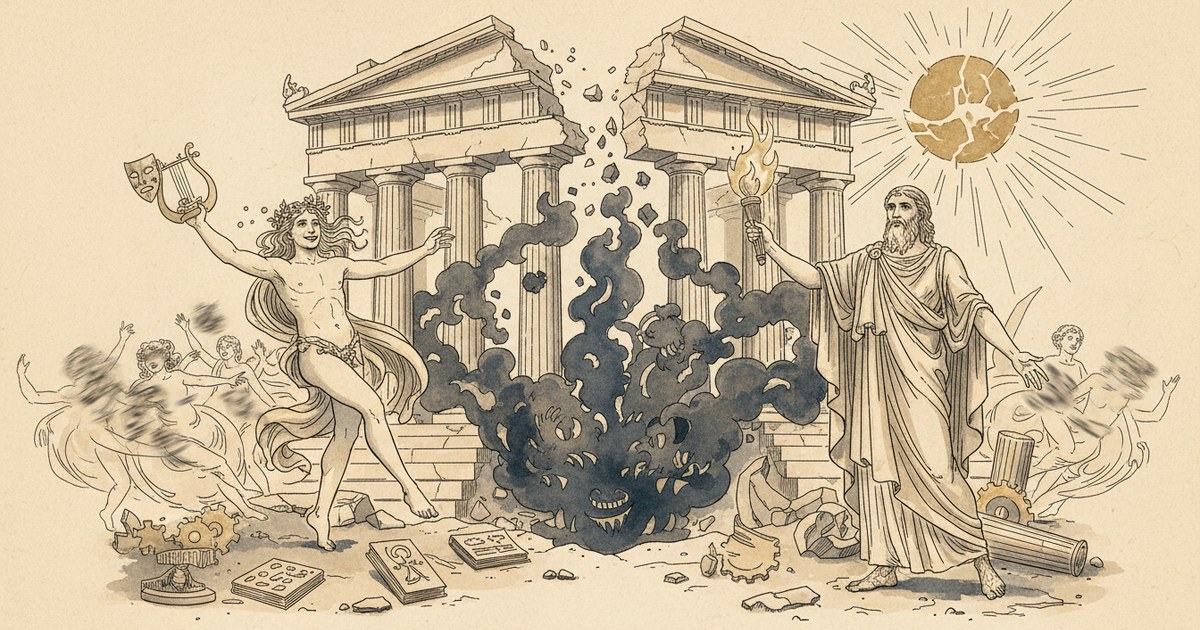
In January 1872, a twenty-seven-year-old professor of classical philology at Basel submitted a manuscript that his colleagues would spend the next decade trying to discredit. Ulrich von Wilamowitz-Moellendorff, who would become the most important classicist of the age, published a pamphlet within months calling it “a tissue of hallucinations.” Friedrich Nietzsche had committed a specific offense: he had read the Greeks as if they were trying to tell us something true about suffering, and written it up not as philological treatise but as philosophy — worse, as advocacy. University enrollment in his classical studies courses dropped immediately. He never recovered his standing in the field. The Birth of Tragedy cost him his academic career in classics. It also inaugurated an entirely different career, one that would outlast most of the nineteenth century’s scholarly reputations by several centuries.
The argument is this. Two drives run through all human experience: the Apollonian, which organizes, clarifies, and makes suffering bearable; and the Dionysian, which dissolves, intoxicates, and forces confrontation with what we spend most of our lives avoiding. Western culture, Nietzsche contends, has spent two thousand years pretending the first one won. It didn’t. The Greeks knew this — which is why their greatest art form placed a chorus of ecstatic worshippers at the center of the stage, surrounding the suffering individual, reminding the audience that the hero’s anguish was both particular and universal, meaningless and necessary, all at once. When Oedipus learns what he has done, no Apollonian beauty of form can protect him. The tragic form is precisely that: it doesn’t look away. It stares, and it asks you to find that staring endurable.
Once Nietzsche shows you the seam, you can’t unsee it. The Apollonian spirit is not civilization’s foundation but its most elegant lie. Every time a culture decides that suffering is an anomaly — something to be solved, smoothed over, or medicated — it makes the choice Nietzsche says the Socratic tradition encoded into philosophy two and a half millennia ago. The Birth of Tragedy is not a historical study of Athenian drama. It is a diagnosis delivered with the urgency of someone who thinks the patient is running out of time.
The Philologist Who Refused to Stay in His Lane
Nietzsche was born in 1844 in Röcken, Saxony, the son of a Lutheran pastor who died when Friedrich was four. That early loss was not merely biographical. It left him inside a household organized around faith and music — his mother played piano, his sister sang — without the figure who might have given that framework its doctrinal anchor. He grew up Lutheran in habit and temperament while becoming a disbeliever in fact, and the gap between longing for transcendence and refusing its institutional scaffold runs directly through everything he wrote, including this first book.
He was prodigiously gifted as a student. Leipzig’s philology faculty passed his name to Basel before he had completed his doctorate; they simply offered him the professorship. He arrived in Switzerland at twenty-four. It was in Basel that he met Wagner, and the friendship became consuming. The Birth of Tragedy is, among other things, a philosophical case for why Wagner’s music drama was the rebirth of Greek tragedy — an argument Nietzsche would later disown with spectacular venom. But in 1872, he meant every word of it, and that sincerity is what gives the book its reckless energy. He wasn’t decorating a position. He was betting his professional life on one.
His writing has the quality of someone moving fast toward a cliff he can sense but not see. The mental collapse of 1889, the decade of incapacity, the posthumous capture of his manuscripts by his sister Elisabeth — who edited and in some cases falsified them to serve the nationalist ends Nietzsche had explicitly opposed — all of this matters to how he reads. The Birth of Tragedy predates the full velocity of that trajectory, but the urgency is already there: the sense that the argument must land completely, now, because there may not be another chance to make it.
He taught at Basel for ten years before his health forced resignation. He wrote in bursts, in rented rooms, in physical agony from headaches and deteriorating eyesight. The books that followed — Untimely Meditations, Thus Spoke Zarathustra, Beyond Good and Evil, On the Genealogy of Morality — are all, in different registers, developments of the same uncomfortable recognition this first book reached in 1872: that the stories a civilization tells about itself are not descriptions of how it works but instructions for how to avoid knowing.
What the Tragic Chorus Actually Does
The modern reader’s instinct is to skim the chapters on the Dionysian mysteries and get to the philosophy. That’s a mistake. Nietzsche’s central claim is inseparable from its embodied, performative dimension. The chorus in Greek tragedy was not a narrative device. It was a collective body in a state of controlled ecstasy — experiencing something that isolated individuals could not survive. The individual onstage suffers and is destroyed. The chorus endures. What the audience witnesses is not simply the hero’s fall but the friction between principium individuationis — the illusion of the bounded self — and the Dionysian undercurrent that swallows individuals without ceasing. That friction is what produces the cathartic effect Aristotle described and never adequately explained.
This is what Socrates destroyed, in Nietzsche’s reading. Euripides introduced the reasoning, debating, self-justifying character — drama as argument rather than as ritual — and once dialogue replaced ecstasy at the center of the stage, tragedy became something else. Philosophy convinced itself that human life could be organized toward intelligibility, that suffering was a problem to be solved rather than a mystery to be borne. Nietzsche names this the Socratic optimism that has governed Western thought ever since: the belief that understanding is comfort, that if we can explain the Oedipus myth we have done something useful with it. He thinks we have done the opposite.
The section on music is the most personally urgent passage in the book. Nietzsche argues that music is the direct expression of the Dionysian — not representation, not symbol, but the thing itself in motion. Words and images, Apollo’s domain, organize experience into something graspable. Music undoes that. The German romantic tradition, and Wagner above all, is for the young Nietzsche the vehicle through which the Dionysian returns to a culture that had spent centuries trying to forget it. He is entirely serious about this. The seriousness is contagious even if you reject the claim.
Readers coming to this book from Beyond Good and Evil or the Genealogy will find a different register — warmer, more earnest, less aphoristic. Nietzsche later called it “badly written, ponderous, embarrassing,” but what he was disowning was the Wagner enthusiasm, not the core argument. That argument — that beauty requires the full acknowledgment of horror, not its removal — he never abandoned. He just found colder, sharper ways to make it.
The Translation Landscape
Walter Kaufmann’s 1967 translation, published by Vintage and bundled with “The Case of Wagner” and “Nietzsche Contra Wagner,” set the standard that most academic courses still use. Kaufmann brings deep philosophical literacy and a fluency that makes the argument accessible; his introduction remains one of the better short orientations to Nietzsche in English. The weakness is a certain period smoothness. The translation domesticates Nietzsche’s abruptness, and some of the aphoristic sharpness gets buffed away in service of readability. Passages that should feel like provocations read instead like considered positions. For coursework and first encounters with the intellectual architecture, Kaufmann is still defensible — but it is Nietzsche at reduced temperature.
Shaun Whiteside’s Penguin Classics translation (1993) corrects this in places — the prose is less mediated, more willing to let Nietzsche’s syntax be strange when the German is strange. But the scholarly apparatus is thin, which can strand the general reader when the classical allusions pile up. Douglas Smith’s Oxford World’s Classics edition (2000) restores some of that context with a solid critical introduction, though Smith’s English occasionally flattens the rhetorical pitch of Nietzsche’s more incendiary passages, making them sound cooler and more resolved than they are. the edition linked below approaches the text differently: modern sentence rhythms without sacrificing fidelity, with enough contextual support for a reader who is serious but not steeped in nineteenth-century German philosophy. It reads as something written under urgency — which is exactly what the original was.
Why This Translation Earns Its Place on the Shelf
The challenge with any Nietzsche translation is tonal range. He moves between lyric, polemic, and analysis sometimes within a single paragraph, and the translator who can hold all three registers without falling into lecture mode is rare. This edition manages it with unusual consistency. Where Kaufmann smooths and Smith occasionally stiffens, this translation leans into the argumentative heat — the sentences feel pressed from urgency rather than organized from above. The result is a Birth of Tragedy that lands as the young provocation it was, not as the classic it has since been carefully canonized into.
If you are encountering Nietzsche for the first time, this is where to start — not because it is the easiest introduction but because it is the most honest one. The book that nearly ended his academic career, that Wagner praised and the classicists savaged, that Nietzsche himself later tried to qualify with a preface full of embarrassed footnotes — this translation gives you the thing raw, before anyone had time to decide what it meant. the edition linked below is available in paperback here, and it is the edition we recommend for readers who want Nietzsche before he became Nietzsche.
Is The Birth of Tragedy a good starting point for Nietzsche?
It is the best starting point. The essential Nietzschean tension — between order and chaos, beauty and horror, the Apollonian lie and the Dionysian truth — appears here in its most concentrated and most energetic form. Later books sharpen individual arguments; this one lays the whole framework in a single gesture, and the earnestness of the young Nietzsche makes the stakes feel higher, not lower.
Do I need a background in classical studies to read it?
No. Nietzsche assumes familiarity with Aeschylus, Sophocles, and Euripides, but a well-annotated translation will carry you through the classical references. What the book actually requires is a willingness to take seriously the proposition that Greek tragedy was doing something philosophically urgent — not just aesthetically beautiful — and that the modern world is poorer for having lost whatever it was doing.
How does The Birth of Tragedy differ from Nietzsche’s later works?
It is warmer and more earnest than the Nietzsche most readers know from Thus Spoke Zarathustra or Beyond Good and Evil. The aphoristic style hadn’t crystallized yet. This is Nietzsche making a sustained argument — one long bet on a single thesis — rather than the fragmentary, compressed mode of the later books. Both registers are worth reading. They illuminate each other in ways that neither fully anticipates.
What exactly is the Apollonian and Dionysian distinction?
Apollo represents the drive toward form, individuation, clarity, and beauty — the illusion that experience can be organized into something coherent and survivable. Dionysus represents the drive toward dissolution, collective ecstasy, and confrontation with the undifferentiated ground beneath individual existence. Nietzsche’s claim is that great art, and Greek tragedy specifically, holds both in tension simultaneously — and that modern Western culture, by systematically suppressing the Dionysian, has made itself shallower than it knows.
Also worth reading

Leave a Reply