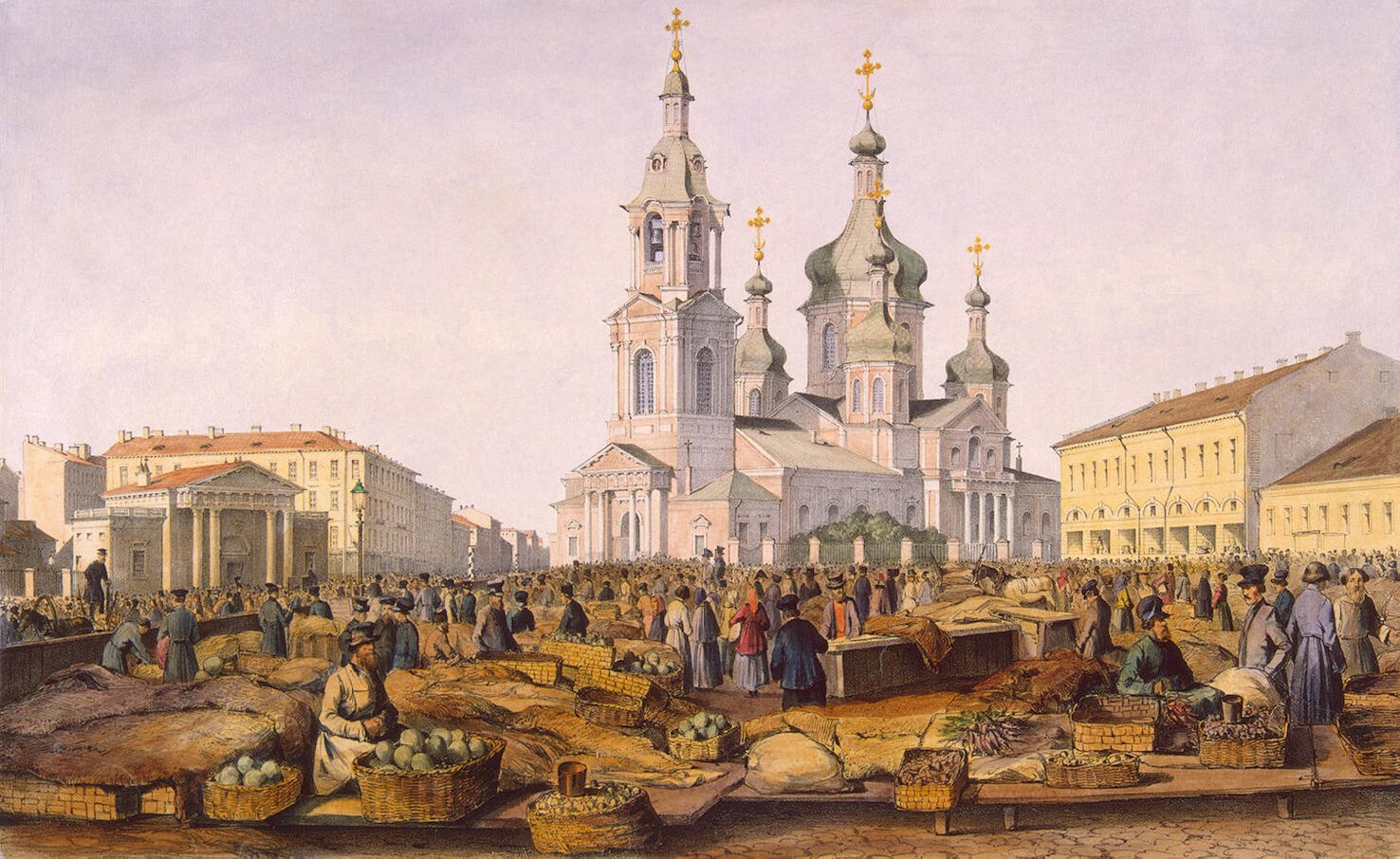
On 22 December 1849, Fyodor Dostoevsky stood in a square in St Petersburg with other members of a discussion circle, listened to a death sentence, and was tied to a post to be shot. Then a messenger arrived with a reprieve. The whole thing had been staged, and the sentence became hard labour in Siberia. Every book he wrote afterwards carries that morning in it: people pushed to the edge of what a mind can bear, arguing furiously about whether anything holds when the ground goes.
Start with Crime and Punishment, in Oliver Ready’s Penguin translation if you want a modern voice or Pevear and Volokhonsky’s Vintage edition if you want to hear the Russian underneath. Read Notes from Underground next, then The Brothers Karamazov in Pevear and Volokhonsky, then The Idiot and Demons. The table has the editions we would buy for each job.
Which Dostoevsky book first, and which edition


What order to read Dostoevsky in
The mature fiction was written in a short stretch, Notes from Underground in 1864, Crime and Punishment in 1866, The Idiot in 1868 and 1869, Demons in 1871 and 1872, The Brothers Karamazov in 1879 and 1880. He died in 1881. You do not need to read them in that order, and most people should not.
Our order is this. Crime and Punishment first, because it has a plot that pulls you forward: a murder in the first part, a detective game, a love story that is not sentimental. It teaches you his habits while you are too busy to notice them. Notes from Underground second, because it is short and distils the ideas the big novels keep arguing about. Then The Brothers Karamazov, which is the summit and rewards a reader who has already learned how he builds a scene. After that, The Idiot, then Demons, which is the most political and the most uneven.
If you want a very short taste before committing to 500 pages, White Nights and The Gambler are both easy to finish in a weekend. And if Notes from Underground is your preferred first step, that is a reasonable choice, but be warned that its first half has almost no story. Readers who bounce off it often come back to love the novels.
We already have a full comparison of editions for the first book: our Crime and Punishment translation guide goes through Ready, Pevear and Volokhonsky, McDuff, Katz and Garnett one by one.
Why Dostoevsky is hard to translate
Dostoevsky wrote fast, often to a deadline, and his Russian shows it. Sentences stumble, repeat a word three times in a line, break off with a dash, restart. Characters talk over each other, and each one has a distinct voice: the legalistic, the hysterical, the sly, the pious. The critic Mikhail Bakhtin called this quality polyphony, and a translator who evens out the voices flattens the books.
The oldest argument in English is about smoothing. Constance Garnett translated almost all of the major works in the early twentieth century, and for decades she was the English Dostoevsky. Critics later charged that she tidied the rough edges, cut repetitions, and made the narrators sound like cultured Edwardians. Pevear and Volokhonsky, working from the 1990s, went the other way and kept the repetitions and awkward syntax on purpose. Critics of their approach say the English can read as odd where the Russian reads as merely hurried.
A single sentence shows the problem. The opening of Notes from Underground is a narrator introducing himself to us, and the Russian word for his second flaw can mean spiteful, wicked, nasty or angry. Constance Garnett gives it as “I am a sick man.… I am a spiteful man. I am an unattractive man. I believe my liver is diseased.” Pevear and Volokhonsky choose “wicked” for the same word. One word moves the narrator from petty to something darker, and you can only tell which is right by reading on. That is why we say read a sample page before you buy.
The book-by-book guide
Crime and Punishment: start here

A poor student kills a pawnbroker and spends the rest of the novel trying to decide whether he is a Napoleon or a criminal. Oliver Ready’s 2014 Penguin version has been praised as colloquial and modern, and it is the one we would hand a first-time reader. Pevear and Volokhonsky are the choice if you would rather feel the strangeness of the Russian than have it smoothed. Our full Crime and Punishment guide covers the rest.
Notes from Underground: the short one

Part One is a monologue by a bitter retired clerk in a cellar; Part Two is the story of how he humiliated himself. It is brief, ferocious, and the closest thing in Dostoevsky to a manifesto. Pevear and Volokhonsky are strong here, because the narrator’s tics are the point: the self-interrupting, the taking back of what he just said. Michael R. Katz’s translation appears in a Norton Critical Edition with essays and background, which suits students. Kyril Zinovieff and Jenny Hughes translated it for Alma Classics, a lower-key alternative. See the Vintage edition. Also available: the Katz Norton Critical Edition and the Alma Classics translation by Zinovieff and Hughes.
The Brothers Karamazov: the one to build up to

A murdered father, three sons who each want something different, a trial, and a chapter about the Grand Inquisitor that people read on its own. This is the book that a translation can make or break, because it runs to some 800 pages of other people’s voices. Pevear and Volokhonsky won the PEN/Book-of-the-Month Club Translation Prize for it, and theirs is the most widely recommended modern version. David McDuff’s Penguin translation is a smoother ride, and Ignat Avsey’s for Oxford World’s Classics is another modern choice. We prefer Pevear and Volokhonsky for a reader who has finished one Dostoevsky already, and McDuff for one who wants the plot to move. See the Pevear and Volokhonsky edition. Our Brothers Karamazov translation guide compares every version in detail. The alternatives are the McDuff Penguin and the Avsey Oxford World’s Classics.
The Idiot: the beautiful, uneven one

Prince Myshkin, a good and naive man, returns to St Petersburg and is destroyed by people who cannot stand him. It is the most tender of the big novels and the loosest in structure. David McDuff’s Penguin translation is a dependable first choice, and the Guardian and the New York Times Book Review praised it, according to the quotes carried on its Amazon listing. Pevear and Volokhonsky’s Vintage version is the choice for readers who prefer their Dostoevsky strange. See the McDuff translation. Also available: the Pevear and Volokhonsky Vintage paperback.
Demons: the political one

Dostoevsky drew this novel from the 1869 murder of a student by members of a revolutionary conspiracy. It begins as a comedy of provincial manners and ends in arson and killing. It is the hardest of the big four to love and the one that readers return to most often after the others. Pevear and Volokhonsky’s Vintage translation is the standard one, with an Everyman’s Library hardcover for keeping. Robert A. Maguire’s Penguin Classics translation, edited by Ronald Meyer, is the alternative with notes and a glossary. See the Vintage edition. Also available: the Maguire Penguin Classics and the Everyman’s Library hardcover.
The Gambler: written against the clock

In 1866 Dostoevsky was in debt, much of it to gambling and to a publisher named Stellovsky who held a contract on his future work. He needed a new novel by a fixed date or he would lose the rights to his next books. He hired a young stenographer, Anna Snitkina, dictated The Gambler to her in roughly four weeks, and married her the following year. The novel itself is about a tutor who falls for a woman and for roulette, and it is easy to read in a day. Ronald Meyer’s Penguin Classics volume collects it with several other stories.
White Nights: the gentle one

Dostoevsky wrote this sentimental story in 1848, before the arrest, and it shows a lighter writer: a lonely dreamer in St Petersburg meets a girl on a bridge over four white nights. If you came to Dostoevsky expecting only darkness, this is the surprise. Ronald Meyer’s translation is available as a Penguin Little Black Classic, or as a Little Clothbound hardcover if you want something to give. See the Little Black Classic. Also available: the Little Clothbound hardcover.
Poor Folk: where it began

His first novel, from 1846, is told through letters between a poor clerk and a young seamstress. It is a good way to see the writer before the prison camp, and it is mostly worth reading after you know the later books. David McDuff’s Penguin volume also includes The Landlady and Mr Prokharchin.
Constance Garnett: the free option
Garnett’s translations are out of copyright, so free ebooks are everywhere, including Standard Ebooks and Project Gutenberg. They read as Edwardian English and they smooth Dostoevsky, but they cost nothing. Read the first chapter of one before you spend money on anything else. If it grips you, keep going. If it does not, that tells you something about the translation, not about Dostoevsky.
The man behind the books
After the mock execution Dostoevsky served four years of hard labour in a prison camp at Omsk, then years of army service in Siberia. He came back to St Petersburg in 1859 a different writer: religious, suspicious of radical theories, more interested in what suffering does to people than in what they believe. His marriages, money troubles and gambling are part of the story too. He wrote Crime and Punishment and The Gambler in the same year, 1866, under money pressure, and the speed shows in the repetitions that translators fight over.
That context matters when you choose an edition. A man writing under that pressure, with a stenographer waiting, did not polish his sentences into Edwardian prose. If you want a version that keeps the hurry, choose Pevear and Volokhonsky. If you want the same story with the rough edges sanded, choose McDuff or Ready.
Boxed sets and gift editions
The edition we would give is the Penguin Clothbound boxed set: Crime and Punishment, The Idiot and The Brothers Karamazov in David McDuff’s translations, in the Coralie Bickford-Smith cloth bindings. It is the cleanest way to hand someone the three big books at once. See the Penguin Clothbound boxed set. The single hardcovers are available too: The Idiot and The Brothers Karamazov. For a wider choice of sets across authors, see our guide to classic literature box sets.
Listen to it
Dostoevsky works well on audio, because the books are mostly people talking, and a good narrator can give each one a voice.
- Crime and Punishment, Oliver Ready’s translation, read by Don Warrington. Runs 25 hours 2 minutes. Listen on Audible.
- Notes from Underground, Pevear and Volokhonsky translation, read by Alan Turton. Runs 5 hours 25 minutes. Listen on Audible.
- The Brothers Karamazov, Pevear and Volokhonsky translation, read by Ben Miles. Runs 42 hours 16 minutes. Listen on Audible.
- The Brothers Karamazov, David McDuff’s translation, read by Luke Thompson. Runs 43 hours 6 minutes. Listen on Audible.
- The Idiot, Alan Myers’s translation, read by Jefferson Mays. Runs 27 hours 56 minutes. Listen on Audible.
- The Gambler, read by Simon Prebble. Runs 6 hours 14 minutes. Listen on Audible.
New Audible members can usually try a membership free. See Audible membership options.
Common questions
Should I read Crime and Punishment or Notes from Underground first?
Crime and Punishment for most people, because it tells a story. Notes from Underground if you want something short, and you are happy to be argued at for a hundred pages.
Is Pevear and Volokhonsky the best Dostoevsky translation?
It is the most widely recommended one and the closest to the Russian, which is why we lead with it for Notes, Karamazov and Demons. It is not the easiest English. Readers who find it stiff should try Ready for Crime and Punishment or McDuff for the others.
Is Constance Garnett still worth reading?
For free, yes, and as history. If you plan to read all of Dostoevsky, spend money on a modern translation for at least the book you care about most.
Should I read all of Dostoevsky with one translator?
You do not have to. The Penguin set gives you one consistent McDuff voice, which some readers like. Mixing translators costs you consistency but lets you pick the best for each book.
Where should a complete beginner stop?
After Crime and Punishment and Notes from Underground, you will know whether you want the long ones. Many readers go from there straight to The Brothers Karamazov and skip the rest for a year.