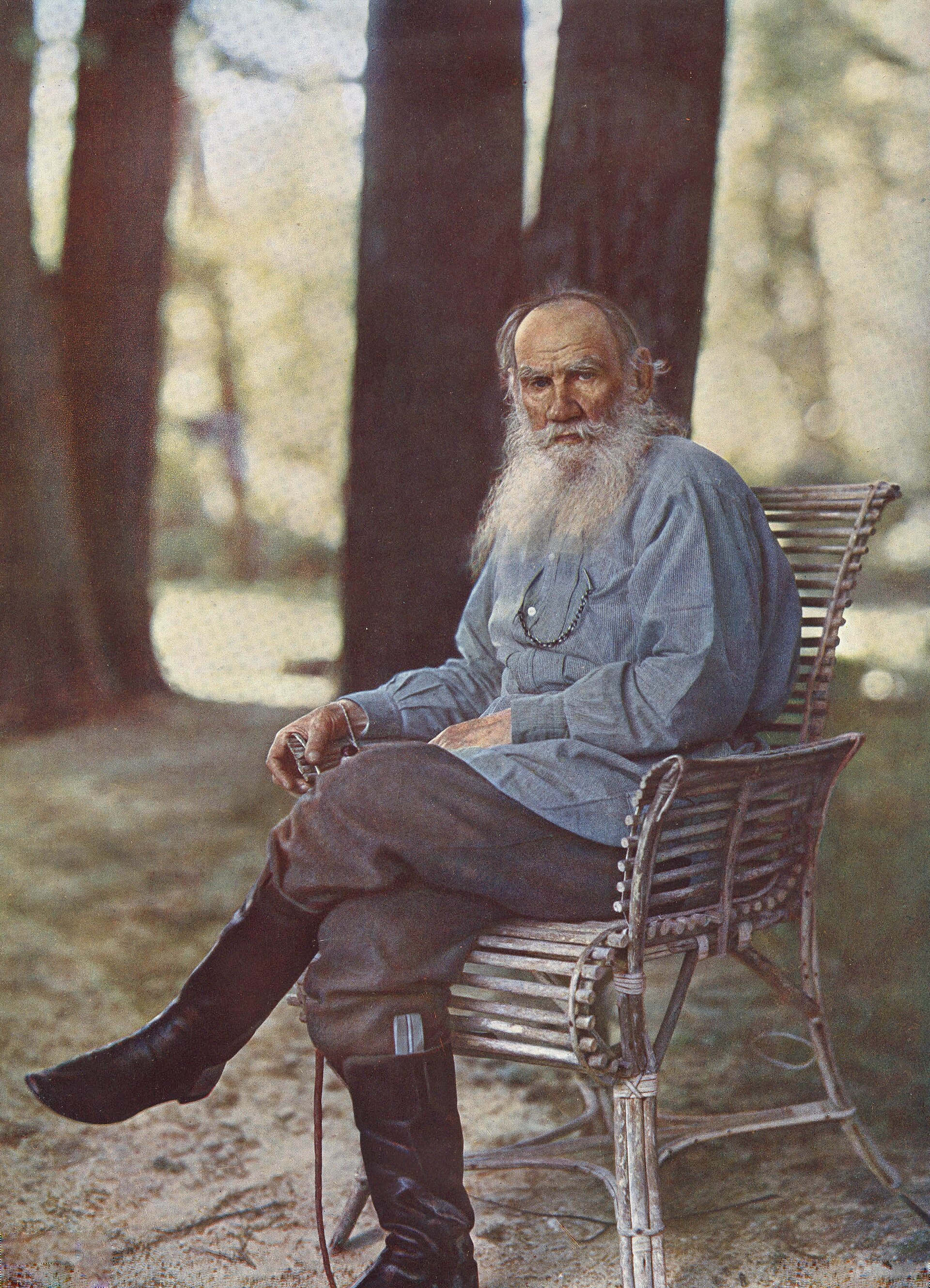
Leo Tolstoy died on 20 November 1910 in a railway stationmaster’s house at Astapovo, at the age of eighty-two. Ten days earlier he had slipped out of his own house at Yasnaya Polyana before dawn, leaving his wife a letter, because he could no longer live as a rich landowner while preaching that he should not. The man who wrote the two longest and most loved novels in Russian had ended up wanting to give it all away. That split between the artist and the moralist runs through everything he wrote, and it is why the question of where to start has more than one good answer.
Quick pick: start with a short book, The Death of Ivan Ilyich (Pevear and Volokhonsky if you want the Russian underneath, Briggs in the Penguin collection if you want plain modern English), or with Hadji Murat. Then read Anna Karenina in Pevear and Volokhonsky, then War and Peace in Briggs, then Resurrection in Briggs. This is the same set of picks as our guides to Anna Karenina and War and Peace. The table sorts the rest by what you want.
Which Tolstoy book first, and which translation


What order to read Tolstoy in
Tolstoy wrote for more than fifty years, and the books do not need to be read in the order he wrote them. Our order is this.
First a short book. The Death of Ivan Ilyich, from 1886, is a judge’s slow dying told in a few dozen pages, and it contains most of what Tolstoy knew about self-deception. If it hooks you, you are ready for the rest. Hadji Murat is the other door. It is the story of a Chechen leader caught between the Russian army and his own people, written late in life, and it reads fast. Choose it if you want a story with a landscape in it and no drawing rooms.
Then Anna Karenina, because it is the most perfectly built of the big novels and a reader can finish it. Then War and Peace, which asks more of you but repays it, and which is much easier once you have learned how Tolstoy handles a family. Then Resurrection, the last novel, which is the one to read after the other two have made you curious about where he ended up. The early trilogy of Childhood, Boyhood and Youth is best left until you are already a fan, as is the shorter fiction beyond Ivan Ilyich.
Many readers go straight to War and Peace, and a few do it successfully. It is long, about 1,300 pages in a complete paperback, and the first hundred pages are a drawing-room party with a great many names. We would not make it anyone’s first Tolstoy.
Why Tolstoy is hard to translate, and in a different way from Dostoevsky
Dostoevsky is hard because he is feverish and uneven. Tolstoy is hard because he is plain. His sentences are usually clear and his words ordinary, and a translator has little to hide behind. When he wants a feeling he repeats a word or a phrase, on purpose, and his English translators have never agreed on what to do about that. Marian Schwartz, whose Yale Anna Karenina is covered in our guide, set out to keep those repetitions that earlier versions removed. Others smooth them because English readers are trained to hear repetition as a flaw.
The second problem is names. A Russian is called by a first name and a patronymic, Stepan Arkadyevich, and by a pet form, Stiva, depending on who is talking and how close they are. In the older Maude translation the names were partly anglicised. Modern translators mostly keep them and give you a list of characters to look at when you get lost. This is a small point until you are four hundred pages in and cannot tell which Nikolai someone means.
The third problem is the French. Tolstoy’s aristocrats speak it as a matter of course, and War and Peace opens with a page of it. Briggs puts it into English. Pevear and Volokhonsky, and the revised Oxford Maude, keep it on the page and translate in footnotes. Briggs gives you a smoother read, and the others give you the sense of a society that spoke another language when it wanted to seem important. Neither is wrong, and the choice is yours. It is the main reason our War and Peace guide splits its picks the way it does.
The Tolstoy who wrote the books
He was born in 1828 at Yasnaya Polyana, the family estate south of Moscow, and he lived there for most of his life. He wrote War and Peace and Anna Karenina in his thirties and forties, as the head of a large household. In his fifties he went through what he called a crisis of meaning, wrote A Confession about it, and turned to a stripped-down Christianity that rejected the church, property and the state. Most of his later fiction, Ivan Ilyich and Resurrection among it, comes from that change. For more on how it shaped his last novel, see our essay on Tolstoy and Resurrection.
He also had English followers. Aylmer and Louise Maude knew Tolstoy personally and spent decades translating him, and Louise’s Resurrection appeared in 1900. That friendship is part of why the Maude translations carry such weight, and it is also why they have a period flavour: they were written by people who admired him, in the English of their time.
The books, one by one
The Death of Ivan Ilyich: the shortest way in

Ivan Ilyich is a respectable judge who has done everything correctly and learns, as he dies, that he has lived badly. It is about sixty pages in the standalone Vintage edition. Pevear and Volokhonsky are the more literal choice, and the book gives their approach a good test, because it is short enough to try. Briggs, whose version opens the Penguin collection, is plainer. His book also includes The Raid, Three Deaths, After the Ball and other stories, which makes it the better value for a reader who wants to go on. The Maude translation, which is also in print from various publishers, is the one Tolstoy’s own circle used. See the Pevear and Volokhonsky Vintage paperback. The collection is here: the Penguin Briggs collection. There is also a larger Pevear and Volokhonsky collection of stories, 528 pages, if you want more of their Tolstoy.
Hadji Murat: the other door

Tolstoy worked on it late in life, and it was published after his death. It follows a real Caucasus guerrilla leader who defects to the Russians and cannot get his family out. It is quick and cold, with little of the moral lecturing of the later fiction, and an easy first Tolstoy for a reader who prefers action. Pevear and Volokhonsky translated it for Vintage. Kyril Zinovieff and Jenny Hughes have an Alma Classics version, and Aylmer Maude’s older translation is also in print.
Anna Karenina: the first big novel

This is where most readers should go after a short book. Our guide picks Pevear and Volokhonsky for most readers, because their translation won the PEN/Book of the Month Club Translation Prize and stays close to Tolstoy’s phrasing, and Rosamund Bartlett for the best notes. Bartlett is also a Tolstoy biographer, which shows in the introduction. If you prefer a plainer English voice, the Maudes or Bartlett will suit you better than Pevear and Volokhonsky. See the Penguin Classics paperback. For the Bartlett: the Oxford World’s Classics edition.
War and Peace: the big one
Briggs is our pick, for the reasons in the guide: it is complete, smooth, and puts the French into English so you do not stop for a footnote. It is the one we would give a first-time reader. Pevear and Volokhonsky are the alternative if you want the French left in, and the Oxford Maude, revised by Amy Mandelker, is the classic choice that has loyal fans. For a gift copy, see the clothbound edition below. See the Briggs Penguin Classics paperback. For the other two: Pevear and Volokhonsky, Vintage and Maude, Oxford World’s Classics.
Resurrection: the last novel

It began with a story a friend told Tolstoy about a juror who recognised the woman on trial as a girl he had once wronged. Tolstoy took ten years to finish it. Briggs gives you a modern English text with notes and a chronology, and it is the one we would hand a newcomer. Louise Maude’s translation, from the time of the novel’s first English publication, is the choice for readers who like the period voice. The older Penguin by Rosemary Edmonds, from 1966, is still on sale, and we would pick Briggs over it. See the Briggs paperback. For the Maude: the Oxford World’s Classics paperback.
Childhood, Boyhood, Youth: the early trilogy

This was his first published fiction, in the 1850s, and it is a thinly disguised account of growing up on a country estate. It has no great plot and a great deal of feeling. Judson Rosengrant’s Penguin translation is the current English version and the one we recommend. Garnett’s older text is free to read if you only want to sample.
Which translator for which reader
Pevear and Volokhonsky are for readers who want to feel they are reading a Russian book. The sentences are close to Tolstoy’s, with the repetitions left in, and some readers find that stiff. Briggs is for readers who want a story, and he is the easiest English of the group. Bartlett is for readers who want notes and a biographer’s grasp of the world behind the book. The Maudes are for readers who like a classic, with a period voice that was shaped by friendship with the author, and for anyone who wants an older English Tolstoy that is easy to find. Schwartz, in the Yale Anna Karenina, is for readers who care about Tolstoy’s repetitions and do not mind a plain English line.
Constance Garnett translated Tolstoy too, and her text is free online. We would not buy her new, since the modern translators above are better supported, but she is a fair way to sample a book before you commit.
Gift editions
Penguin Clothbound Classics sells both big novels in cloth with Coralie Bickford-Smith covers. The Anna Karenina is the Pevear and Volokhonsky translation. The War and Peace is Briggs, with an afterword by Orlando Figes. They sit well together on a shelf. For readers who want the Maude translations, Everyman’s Library has a hardcover of Resurrection, from 2025, with an introduction by Andrew Kahn, and a hardcover of Anna Karenina. If the reader wants study help in one volume, Oxford has hardbacks of both novels.
- See the Anna Karenina Clothbound hardcover
- See the War and Peace Clothbound hardcover
- See the Everyman’s Resurrection hardcover
- See the Everyman’s Anna Karenina hardcover
- See the Everyman’s War and Peace boxed set
Everyman’s Library editions of Anna Karenina and War and Peace date from the early 1990s, so check stock before you order.
Listen to it
Tolstoy on audio is a very different commitment depending on the book. Ivan Ilyich is an evening. War and Peace is two weeks of commuting.
- The Death of Ivan Ilyich, read by Oliver Ford Davies. Unabridged, 2 hours 51 minutes, from Naxos AudioBooks. Listen on Audible.
- Hadji Murat, read by Jonathan Keeble. Unabridged, 4 hours 54 minutes, from SNR Audio. Listen on Audible.
- Anna Karenina, Pevear and Volokhonsky translation, read by Miranda Pleasence. Unabridged, 36 hours 59 minutes, from Penguin Audio. Listen on Audible.
- War and Peace, Maude translation, read by Edoardo Ballerini. Unabridged, 55 hours 30 minutes, from Brilliance Audio. Listen on Audible.
- Resurrection, read by Neville Jason. Unabridged, 20 hours 8 minutes, from Naxos AudioBooks. Listen on Audible.
The listings for Ford Davies, Keeble and Jason do not name a translation. New Audible members can usually try a membership free. See Audible membership options.
Common questions
Should I start with War and Peace?
You can, and some people do and love it. We would start with a short book or with Anna Karenina, because they teach you Tolstoy’s habits on a smaller scale.
Anna Karenina or War and Peace first?
Anna Karenina, for most people. It is shorter, more personal and easier to hold in your head. War and Peace is the bigger commitment and goes better once you have met his way of writing.
Which translation should a beginner buy?
Briggs for War and Peace and Resurrection, Pevear and Volokhonsky for Anna Karenina, and either Pevear and Volokhonsky or Briggs for Ivan Ilyich. That is one set of picks across the books, and it matches our full guides.
Is the Maude translation still worth buying?
Yes, for the Oxford revisions of War and Peace and Anna Karenina, and for readers who like an older voice. Modern readers who want easier English should look at Briggs or Bartlett first.
Is Tolstoy harder than Dostoevsky?
Different. Tolstoy is plainer and calmer on the page, and Dostoevsky is faster and stranger. If you are deciding between them, our guide to where to start with Dostoevsky will help.