Author: Classics Retold

  • Valera Predicted Every Academic’s Fatal Weakness

    Valera Predicted Every Academic’s Fatal Weakness

    Looking for the best Stefan Zweig translation in English? This guide compares readability, emotional precision, and modern accessibility so you can start with the edition that captures his full voice before the world ended.

    Find Your Best Zweig Translation

    Use this guide to compare editions before you choose your next read.

    The reputation of German-language literature precedes it badly. Dense. Philosophical. Difficult. The kind of reading that requires a degree you don’t have and a patience you haven’t cultivated. That reputation is partly earned — there is a tradition of German prose that is genuinely demanding — and mostly misleading. Kafka is not difficult. Zweig is not difficult. Nietzsche wrote aphorisms designed to be read in a single sitting and felt in the gut. The difficulty, where it exists, is the difficulty of any serious literature: it asks you to think while you read.

    German-language literature in this context means what it has always meant to those who study it seriously: literature written in German, regardless of nationality. Kafka was Czech. Zweig was Austrian. Nietzsche was German but spent most of his productive years in Italian boarding houses and Swiss mountains, writing in deliberate exile from the culture that had formed him. The language is the tradition; the borders are secondary.

    Translation matters more with German than with almost any other European language, and the reason is structural. German syntax is architecturally inverted: the verb arrives at the end of the clause, sometimes at the end of a very long clause, and the reader must hold the entire construction in suspension before the meaning resolves. A sentence that begins with a subject, accumulates qualifications, piles on subordinate clauses, and finally delivers its verb at the last possible moment creates a particular kind of suspense — intellectual, syntactical, almost physical. A bad translation flattens this into English word order and loses that suspense entirely. What was a carefully engineered delay becomes a simple declaration. The sentence still means the same thing, technically. But it no longer does the same thing to the reader. This is why two translations of the same Kafka novel can feel like two entirely different books.

    The role of a reading guide in this context is not to translate but to curate — to identify the editions that preserve what the original was doing, that make responsible choices about the impossible trade-offs between fidelity and readability, and that carry the reader as close as possible to the experience of reading the German. The translations featured here have been selected on exactly those grounds. Where a newer translation corrects the distortions of an older one, that is noted. Where the translation question is genuinely contested — as it is with Kafka, where scholars still disagree — the reasoning behind the recommended edition is explained. The goal is to get you to the right book by the right route.

    Where to Start

    Start with Zweig. Not because he is the greatest — he would himself resist that claim — but because he is the most immediately available. The World of Yesterday is the place to begin: a memoir of a civilization in the process of destroying itself, written by a man who understood what he was watching. From Zweig, move to Kafka, whose work is short enough to read in a weekend and strange enough to occupy a lifetime. Nietzsche is for when you want to understand the philosophical atmosphere that produced both of them.

    Goethe and the Classical Tradition

    Before Kafka, before Nietzsche, before the catastrophes that defined the German twentieth century, there was Goethe — and Goethe is where German literary ambition was first fully articulated. Johann Wolfgang von Goethe spent sixty years writing Faust, a work in two parts that remains the founding document of German literary aspiration. The premise is familiar: a man sells his soul to the devil. What makes Goethe’s version different, and what makes it the central myth of the German tradition, is what Faust wants in exchange. Not pleasure. Not power. Not wealth. Knowledge. Faust wants to understand everything, and when he realizes he cannot, he makes his bargain. Part I of Faust is approachable and genuinely dramatic — the compact with Mephistopheles, the seduction and destruction of Gretchen, the scenes that have entered the culture so thoroughly that most readers recognize them without having read the source. Part II is a different matter entirely: an allegorical journey through classical mythology, medieval empire, and aesthetic philosophy that is one of the most demanding works in any language and one of the most rewarding for those who persist. The gap between the two parts is not merely a matter of difficulty. It is a gap between a young man’s energy and an old man’s wisdom, between drama and vision.

    The Sorrows of Young Werther, published in 1774, is Goethe at his most immediate and, historically, his most dangerous. The novel invented a type — the hypersensitive young man overwhelmed by feeling, unable to fit himself into a world of practical compromises, in love with a woman he cannot have. Werther shoots himself at the end. What Goethe cannot have anticipated, though perhaps should have, was the response: a wave of copycat suicides across Europe, young men dressed in Werther’s costume — blue coat, yellow waistcoat — found dead with the novel open beside them. It was the first literary contagion, and it established something that would define the German Romantic tradition: the idea that literature was not merely about life but capable of acting on it, for better or catastrophically for worse.

    Friedrich Schiller was the other half of what literary historians call the Weimar Classical period — Goethe and Schiller working in the same small city in the 1790s and early 1800s, in correspondence and competition, defining what German literature was supposed to be. Where Goethe was synthetic and comprehensive, Schiller was urgent and political. His plays — The Robbers, Mary Stuart, William Tell — were the democratic conscience of German literature, written while the aristocracy still ran everything and while the French Revolution was demonstrating, at enormous cost, what happened when the people ran out of patience. Schiller believed in freedom as a philosophical principle and dramatized it in historical settings because the present was too dangerous. The plays remain stageable and urgent. Mary Stuart in particular — two queens, one prisoner, one throne — is as tightly constructed a political drama as anything in the European repertoire.

    Goethe & The Classical Tradition
    Doctor Faustino's Illusions: Modern English Translation

    Nietzsche — The Philosopher Who Wrote Like a Novelist

    Nietzsche is almost always read wrong in English — either as a proto-fascist whose work was corrupted by his sister, or as a self-help writer whose aphorisms can be extracted and applied to productivity. Both readings miss the point by a wide margin. Nietzsche was a philologist who became a philosopher because he found philosophy too timid, and his work is best understood as a sustained attack on the complacency of European culture in the second half of the nineteenth century.

    Thus Spoke Zarathustra is the most ambitious of his books and the strangest — a philosophical poem in the form of a prophet’s wanderings, deliberately written to resist summary. Our guide to Nietzsche’s best books addresses the reading order question, which matters more with Nietzsche than with almost any other writer: start in the wrong place and the whole project looks unhinged. Start in the right place and it looks like the most lucid critique of modernity anyone has written.

    The right place is not Zarathustra. Before that book becomes legible, Nietzsche needs to be read in his aphoristic mode — The Gay Science, where the declaration that God is dead first appears, not as a triumphant announcement but as a terrifying diagnosis; or Beyond Good and Evil, where the critique of morality is made with surgical precision rather than prophetic heat. The aphorisms are short, often brilliant, sometimes maddening, and they establish the vocabulary and the concerns that Zarathustra then dramatizes. Read in this order, the famous passage in The Gay Science — the madman running through the marketplace with a lantern at midday, crying that we have killed God and asking whether we understand what we have done — lands with the force Nietzsche intended: not as atheist celebration but as existential reckoning. We have destroyed the foundation of our values, he is saying, and we have not yet begun to understand what that means.

    Nietzsche
    Thus Spoke Zarathustra: A New Translation in Modern Accessible EnglishThe Gay Science: A New TranslationThe Will to Power: A New TranslationThe Birth of Tragedy: A New TranslationBeyond Good and Evil : A New TranslationUntimely Meditations: A New Translation

    Kafka — The Writer Who Named a Century

    Franz Kafka published almost nothing in his lifetime and instructed his friend Max Brod to burn the manuscripts after his death. Brod did not comply. The three unfinished novels and the complete stories that survived constitute one of the strangest and most influential bodies of work in any language — work so distinctive that it generated its own adjective, a word that now describes experiences Kafka himself would have recognized instantly.

    The Trial is the place to start: Josef K., arrested without charge and prosecuted without ever learning the nature of his crime, navigating a legal system that operates according to its own opaque logic. The novel was written in 1914 and 1915, before the century gave it its full resonance. The opening sentence — “Someone must have made a false accusation against Josef K., for he was arrested one morning without having done anything wrong” — is one of the most precisely engineered first sentences in European literature. The passive construction is not an accident: the accusation arrives from nowhere, made by no one identifiable, and the grammatical structure enacts the very condition it describes. Everything that follows is an attempt to find the subject of that sentence, the someone who accused him. The attempt fails. The system is not corrupt in any simple sense; it simply operates according to logic that the accused cannot access, and the horror is that this is presented as entirely normal.

    The Castle is the companion piece — a land surveyor arrives in a village and spends the entire novel attempting, and failing, to make contact with the authorities who summoned him. Both novels end mid-sentence. Both are complete.

    What makes The Castle distinct from The Trial is the texture of the failure. Where Josef K. is prosecuted, K. the land surveyor is simply ignored — worse, perhaps, in its way. He can see the Castle from the village. He can telephone it, and someone always answers. But the answers are evasive, the appointments are canceled, the officials are perpetually unavailable, and the villagers have long since accommodated themselves to a system of endless deferral. There is a scene in which K. speaks at length with a minor official named Bürgel in the middle of the night, and Bürgel explains — exhaustively, almost generously — exactly the circumstances under which a petitioner might successfully bring his case before the authorities. The circumstances are fantastically specific and happen to match K.’s situation precisely. K. falls asleep during the explanation. It is one of the funniest and most devastating scenes in modern literature.

    The translation question matters enormously with Kafka. His German is precise, spare, and almost affectless — a style that has been consistently over-dramatized in older English translations. The Muir translations, which introduced Kafka to English readers in the 1930s, impose a Gothic atmosphere that isn’t there in the original. More recent translations by Breon Mitchell and others correct this. Our guides address the specific translation choices for each book.

    Kafka
    The Trial: A New TranslationThe Castle: A New TranslationThe Carpathian Castle: A New TranslationAmerika (The Man Who Disappeared): A New TranslationA Country Doctor And Other Stories: In the Penal Colony, The Judgment: A New TranslationMetamorphosis: A New Translation in Modern Accessible English

    Stefan Zweig — Europe’s Most Readable Writer

    Stefan Zweig was the most widely read writer in Europe in the 1920s and 1930s — translated into more languages than any contemporary, published in editions that sold in the millions, celebrated from Brazil to Japan. Then came the war, exile, and death by suicide in Petrópolis in 1942. For thirty years after his death, he was largely forgotten in the English-speaking world. The rediscovery, which began in the 1990s and accelerated in the 2010s, has been nearly complete — Zweig is now recognized as one of the essential witnesses to what Europe was before it destroyed itself.

    The World of Yesterday is his memoir, written in exile, covering the Vienna of his youth through the catastrophes of both World Wars. It is one of the great documents of the twentieth century — not as history, exactly, but as testimony: the account of a man who understood, in real time, that he was watching the end of a world. Our essay Zweig Knew the World Was Already Over examines what made his vision so precise. His Jewish Legends represent a different, quieter Zweig — the writer working within a tradition rather than observing one collapse.

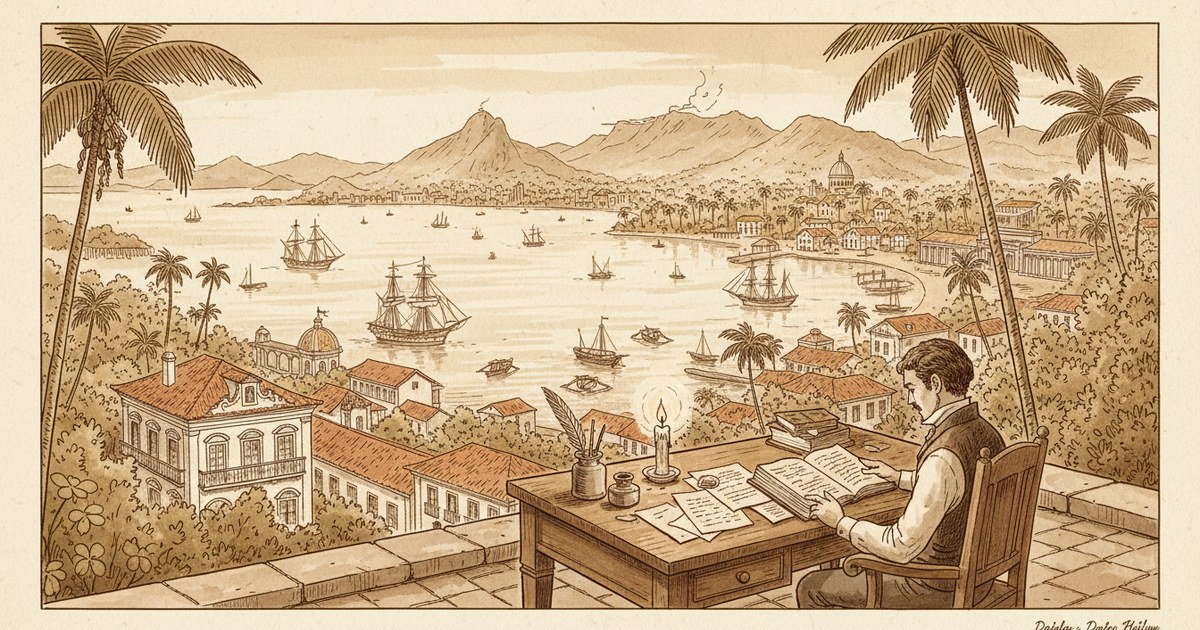
    The passage in The World of Yesterday that stops most readers is the description of Vienna before the First World War — a city of coffee houses and concert halls, of intellectual conversation and cosmopolitan ease, where it seemed genuinely possible that European civilization was ascending toward something rather than teetering above an abyss. Zweig describes this world not with naive nostalgia but with the particular anguish of someone who knows what came after. He is writing the memoir in 1941, in exile in Brazil, his Austrian passport cancelled, his books burned. The Vienna he describes is gone so completely that it requires an act of imagination to believe it existed. What makes the book devastating is that Zweig provides that imagination and then takes it away. You understand what was lost because he makes you see it, and then he makes you watch it disappear.

    Stefan Zweig
    The Stefan Zweig Collection - Volume 1: A New TranslationThe Stefan Zweig Collection - Volume 2: A New TranslationMarie Antoinette: The Portrait of an Average Woman: A New TranslationThe Stefan Zweig Collection - Volume 3: A New TranslationMagellan: Conqueror of the Seas: A New TranslationThe Stefan Zweig Collection - Volume 4: A New Translation

    The Twentieth Century Beyond Kafka and Zweig

    The German-language tradition did not begin with Kafka and Zweig, and it did not end with them. The twentieth century produced several other writers whose work is essential to any serious engagement with the tradition — and whose absence from English reading lists says more about the accidents of literary fashion than about their quality.

    Thomas Mann is the great German novelist in the way that Tolstoy is the great Russian novelist — a writer of such comprehensive ambition and sustained achievement that the tradition orients itself around him. Buddenbrooks, published in 1901 when Mann was twenty-six, is the great German family novel: four generations of a Lübeck merchant family in decline, the commercial instinct fading as the artistic one strengthens, told with the precision of a surgeon and the sympathy of a son. Mann was drawing on his own family history, and the emotional accuracy is inseparable from the formal control — the novel spans decades and dozens of characters without losing its thread or its feeling. The Magic Mountain, published in 1924, is more demanding and more rewarding in proportion: a young man named Hans Castorp arrives at a Swiss sanatorium to visit a cousin for three weeks and stays seven years. In those seven years, while Castorp debates philosophy with the tuberculosis patients and drifts through an extended holiday from ordinary life, Europe drifts toward war. The sanatorium is a symbol so fully realized that it stops feeling like a symbol and starts feeling like a place.

    Bertolt Brecht approached the literary tradition from the theatre rather than the novel, and what he built there was designed to work against everything theatre had been doing. The Threepenny Opera and Mother Courage and Her Children are the two essential works — the first a savage comic opera set among criminals and beggars, the second a study of a woman who follows armies to profit from war and loses everything she values to the same war she profits from. Brecht invented what he called the epic theatre, a set of techniques designed to prevent empathy — to interrupt the audience’s identification with the characters before it could produce the comfortable catharsis of conventional drama. He wanted audiences to think rather than feel, to remain critical observers rather than become absorbed participants. He was largely right that the theatre had been making audiences feel rather than think, and his corrective, however uncomfortable in the experience, produced plays that remain politically alive in ways that most theatre of the same period does not.

    W.G. Sebald is the great late discovery of German-language literature — a writer who was almost unknown until his sixties and who died in a car accident in 2001, leaving four major prose works and a question about what else he might have written. The Rings of Saturn, The Emigrants, and Austerlitz are prose works that move between memoir, history, and fiction without announcing which mode they are currently inhabiting. Photographs are embedded in the text without captions. Narrators speak in voices that are and are not Sebald’s own. The subject, always, is what time does to memory, what history does to individuals, and what German culture did to European Jewish life and then suppressed. Sebald spent most of his adult life in England, teaching German literature at the University of East Anglia, and his displacement is present in everything he wrote — a German writer who could not write in Germany about Germany, circling the subject from the outside, in English exile.

    How to Read German-Language Literature

    The tradition is large and the entry points matter. A few practical orientations:

    Start with Zweig or Kafka, not Goethe or Nietzsche. This is not because Goethe and Nietzsche are inferior — they are not — but because they require more context to read productively. Zweig is immediately available: his prose translates well, his subjects are human-scale, and his memoir The World of Yesterday provides a historical orientation to the whole period that makes subsequent reading richer. Kafka’s stories are short enough to read in a single sitting and strange enough to reward rereading indefinitely. Both writers give you an experience before they give you a system. Start with the experience.

    With Kafka, the translator matters enormously. This is not a minor scholarly preference — it is a practical reading question. The older Muir translations, which many older paperback editions still use, impose a Gothic drama on Kafka’s prose that is not present in the German original. His style is spare, precise, almost bureaucratic — the horror comes from the flatness of the description, not from elevated diction or atmospheric language. More recent translations correct this and return Kafka’s prose to the affectless register where its real power lives. The edition featured here has been chosen with this in mind.

    With Nietzsche, read the aphoristic books before Zarathustra. The Gay Science and Beyond Good and Evil are the preparation. They establish the vocabulary, the concerns, and the targets of Nietzsche’s critique in a form that is self-contained and immediately graspable — each aphorism is a complete unit of thought. Zarathustra, approached after these, becomes a dramatization of positions already understood. Approached cold, it can seem merely eccentric.

    Do not skip Austria. The Austrian literary tradition — Zweig, Robert Musil, Thomas Bernhard, Ingeborg Bachmann — is as rich as the German, and quite different in tone. Where the German tradition tends toward the systematic and the ambitious, the Austrian tends toward the ironic and the self-aware. Musil’s The Man Without Qualities is the great unfinished novel of the twentieth century, a work of such sustained intelligence and dark comedy that its incompletion feels appropriate — a novel about a civilization that ran out of time, left unfinished by a writer who ran out of time. Bernhard’s novels are tirades, monologues of such sustained venom and precision that they become their own form of music. Bachmann’s prose and poetry are among the most formally exacting works in the tradition. The Austrian tradition is not a footnote to the German. It is a parallel conversation.

    The Larger Context

    German-language literature does not exist in isolation. The tradition was in constant conversation with the French realists — Flaubert’s influence on the German novel was direct and acknowledged, and understanding Madame Bovary illuminates what the German novelists were responding to and reacting against. The philosophical tradition — Kant, Hegel, Schopenhauer, Nietzsche — runs beneath the fiction like a current, surfacing visibly in Kafka and Zweig and in the Austrian writers who came after them.

    Reading German-language literature seriously means reading across these borders — between fiction and philosophy, between Austria and Germany, between the nineteenth century and the catastrophes of the twentieth. The writers in this tradition were not working in separate rooms. They were participants in a single long argument about what European civilization was and what it was becoming. The argument ended badly. The books remain.

    Frequently Asked Questions

    What is the best German novel to start with?

    The two most reliable entry points are Zweig’s The World of Yesterday and Kafka’s The Trial. Zweig is the more immediately accessible of the two — his memoir reads with the momentum of a novel and provides historical orientation that enriches everything else in the tradition. Kafka’s The Trial is slightly more demanding but short enough to read in a weekend, and it remains one of the most viscerally immediate works in any language.

    Is German literature really as difficult as its reputation suggests?

    The reputation is real but applied too broadly. There is genuinely demanding work in the tradition — Musil’s The Man Without Qualities, Hegel’s Phenomenology of Spirit, Goethe’s Faust Part II — that requires sustained attention and some preparation. But Kafka’s stories are not difficult. Zweig’s prose is not difficult. Nietzsche’s aphorisms are designed for immediate impact. The difficulty, where it exists, is the difficulty of seriousness rather than obscurity: these writers expect you to think while you read, which is a different thing from being inaccessible.

    Which German-language authors are most important?

    Any serious list would include: Goethe, the founding figure of the literary tradition; Nietzsche, the philosopher who rewrote the terms of European thought; Kafka, whose three novels and stories generated their own adjective and their own tradition; Thomas Mann, the great German novelist of the twentieth century; Stefan Zweig, the essential witness to prewar European culture; Bertolt Brecht, who reinvented what theatre was for; W.G. Sebald, the great late voice on memory, history, and suppressed guilt; and Robert Musil, whose unfinished The Man Without Qualities is one of the most sustained acts of literary intelligence in the European tradition.

    Does it matter which translation of Kafka I read?

    Yes, significantly. Kafka’s German is spare, precise, and almost affectless — the horror of his fiction comes directly from the flatness of its register, the way catastrophic events are described in the tone of an office memorandum. The older Muir translations, which introduced Kafka to English readers in the 1930s and which many older paperback editions still carry, impose a Gothic atmosphere on this prose that is not present in the original and that fundamentally changes the reading experience. More recent translations restore the affectless precision that makes Kafka’s work distinctive, and the translation we recommend has been selected specifically for this quality.

    This post contains affiliate links. As an Amazon Associate, we earn from qualifying purchases.

    Recommended Edition
    Doctor Faustino’s Illusions — Juan Valera
    Modern English translation

    Kindle →Paperback →

  • Hugo Wrote for the People, Not Scholars

    Hugo Wrote for the People, Not Scholars

    French literature from the eighteenth through the twentieth century is the deepest single tradition in world fiction. Not the oldest, not the most exported, but the deepest — in the sense that its preoccupations compound across generations, each century rewriting the one before. Voltaire dismantles optimism; Hugo restores it through sheer force of feeling; Flaubert arrives to dismantle everything Hugo built; Proust watches the wreckage and decides to memorize it. The tradition is a long argument with itself.

    Most English readers encounter it badly. A Madame Bovary assigned in survey courses. A film adaptation of Les Misérables with the barricade scenes cut short. A translation of Candide that irons out the jokes. These reading guides exist to correct that — to return the books to the specific quality of attention they were written to demand.

    Translation is not a secondary concern when it comes to French literature — it is the primary one. The French sentence is architectural. Its irony is structural, built into the grammar itself; its wit depends on rhythm, on the precise position of a word, on a cadence that arrives half a beat later than you expect. When a translator flattens that rhythm in pursuit of plain English readability, what disappears is not decoration but meaning. Voltaire’s jokes stop being jokes. Flaubert’s sentences, which in French feel like controlled detonations, become merely correct. Proust’s digressions, which in French spiral outward with unmistakable intentionality, begin to seem like failures of discipline. The difference between a good and a bad translation of a French novel is not a matter of nuance. It is the difference between the book and something that shares its plot.

    Classics Retold exists to solve that problem. We do not produce translations — we read them, compare them, and identify the editions that honour the original with enough fidelity and enough courage to make genuine demands on an English reader. For every book in this guide, we have selected the translation we recommend on the basis of close reading: sentence by sentence, scene by scene. Where the translation question is genuinely contested — where two strong editions make different and defensible choices — we say so. The goal is not to tell you what to think about these books. It is to make sure you are reading the right version before you start thinking at all.

    Where to Start

    If you have never read French literature seriously, start with Voltaire. Candide is ninety pages, ruthlessly constructed, and funnier than anything its century produced in English. From there, Hugo’s Les Misérables — not the abridged edition — for the full experience of nineteenth-century romantic amplitude. Then Flaubert, who wrote in direct reaction to Hugo’s sentimentality, and whose prose style remains the most influential in any language. Proust is for later, when you have built up the patience the novel requires and rewards.

    The Enlightenment and Its Discontents

    Voltaire published Candide in 1759 and insisted, despite all evidence, that he had nothing to do with it. The denial was tactical — the book was immediately banned in Geneva, Paris, and Rome — but it also pointed to something real about the text. Candide is not quite a novel. It is a philosophical proposition disguised as an adventure story, and the disguise is so complete that the proposition hits harder than it would have if delivered directly.

    The proposition is this: Leibnizian optimism — the doctrine that we live in the best of all possible worlds — is not merely wrong but obscene. Voltaire had watched the Lisbon earthquake of 1755 kill sixty thousand people and seen theologians argue that the deaths must serve some divine purpose. Candide is his answer. Our reading guide on Candide examines what makes the novel’s comedy so precise — and why it has outlasted every earnest philosophical treatise of its century.

    The scene that crystallises the book’s method comes near the end, when Candide and his battered companions finally acquire a small plot of land outside Constantinople and Pangloss, still incorrigible, still insisting that everything has worked out for the best, prepares to deliver another metaphysical lecture. Candide cuts him off with the novel’s most famous line: il faut cultiver notre jardin — we must cultivate our garden. In context, it is not a counsel of contentment. It is a counsel of exhaustion. Voltaire’s joke is that the only reasonable response to the best of all possible worlds is to stop talking about it and grow vegetables.

    The Romantics — Hugo, Dumas, Stendhal
    The Hunchback of Notre-Dame : A New Translation in Modern Accessible EnglishThe Three Musketeers : A New Translation in Modern Accessible EnglishNinety-Three: A New TranslationTwenty Years After (The Three Musketeers Sequel) : A New Translation in Modern Accessible EnglishThe Charterhouse of Parma: New TranslationThe Black Tulip: A New Translation

    The Romantics

    The nineteenth century produced three novelists whose ambitions were essentially architectural. Hugo wanted to build cathedrals out of language. Dumas wanted to construct machines of pure narrative pleasure. Stendhal, the quietest of the three, wanted to dissect the psychology of ambition with the precision of a surgeon who was also, privately, in love with his subject.

    Hugo wrote Les Misérables over the course of twenty years, publishing it in 1862 when he was in political exile. Our guide to Les Misérables addresses the novel as what it actually is: an act of political witness that happens to be a great story. His earlier novel, The Hunchback of Notre-Dame, is formally tighter — a book about the cathedral as much as the people inside it.

    What abridged editions always cut — and what their cuts reveal about a fundamental misreading of Hugo’s intentions — are the digressions: the long chapter on the Paris sewer system, the extended meditation on the Battle of Waterloo, the history of the Petit-Picpus convent. These are not interruptions to the story. They are Hugo’s argument that Jean Valjean’s suffering cannot be understood without understanding the entire structure that produced it. The sewer is where the city’s waste goes, and the sewer is also where Valjean carries a dying man to safety. Hugo’s digressions are always doing two things at once. Abridged editions do neither.

    Dumas operates in a different register entirely. The Three Musketeers has been pedagogized into tedium by school curricula — treated as entertainment for children, which it isn’t. The novel is a study in loyalty, masculine friendship, and the gap between idealism and political reality. It is also, page for page, one of the most propulsive narratives ever written in any language.

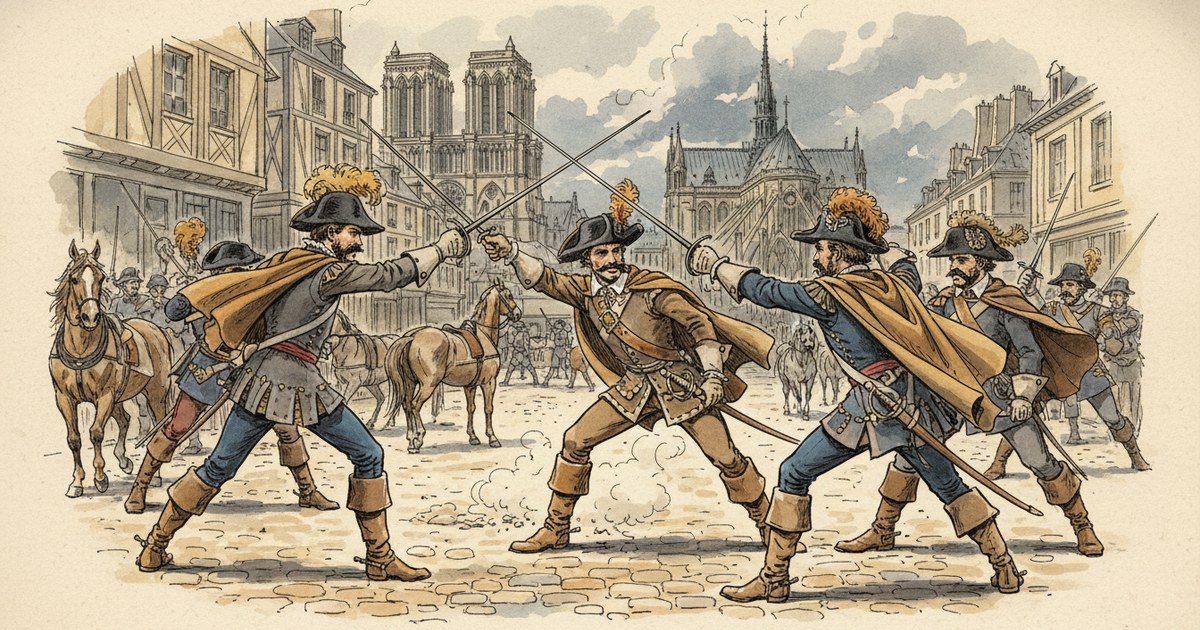
    The scene that demonstrates what Dumas is actually doing comes in the early chapters, when d’Artagnan arrives in Paris from Gascony — poor, provincial, riding a horse described as bright yellow and valued at three écus — and proceeds within a single afternoon to schedule duels with all three musketeers by offending each of them in rapid succession. It is comic, but it is also a precise psychological portrait: d’Artagnan is so determined to prove himself that he cannot stop provoking people. The bravado is real, but so is the desperation underneath it. Dumas understood that those two things are usually the same thing.

    Stendhal’s The Red and the Black is perhaps the first genuinely modern novel — the first to concern itself with the inner life of a social climber in a way that produces neither condemnation nor endorsement, only understanding.

    Stendhal based his protagonist Julien Sorel partly on a real case: a young seminarian named Antoine Berthet who shot a former employer in church in 1827 and was guillotined the following year. What interested Stendhal was not the crime but the decades of resentment and thwarted ambition that preceded it — the way a society that claimed to reward merit in fact rewarded birth, and what that contradiction did to the psychology of a brilliant young man who had absorbed the promise and then discovered the reality. Julien Sorel is not sympathetic exactly. But Stendhal makes sure you understand him completely, and understanding is more unsettling than sympathy.

    Realism and Its Aftermath

    Flaubert hated the Romantics. He hated their sentimentality, their grandiosity, their willingness to let feeling substitute for precision. Madame Bovary, published in 1857 and immediately prosecuted for obscenity, is the rebuttal. Emma Bovary has been formed by Romantic fiction — she expects her life to feel the way novels feel — and the book watches her discover that it doesn’t. Our guide to Madame Bovary focuses on the novel’s temporal compression and on what Flaubert’s famous prose style actually does on the sentence level.

    Flaubert spent five years writing Madame Bovary and was known to work for an entire week on a single page, reading each completed sentence aloud to test its rhythm. The result is a prose style in which every word is doing precisely the work assigned to it and nothing else — a style in which the famous authorial impersonality is itself a form of cruelty. The agricultural fair scene, in which Rodolphe seduces Emma while a pompous official delivers a speech about the virtues of manure and livestock management below their window, is the novel’s masterwork: irony operating on three levels simultaneously, without Flaubert once indicating which level you should be attending to.

    Proust arrives fifty years after Flaubert and appears at first to be everything Flaubert opposed — discursive, associative, apparently formless. But the surface is deceptive. In Search of Lost Time is as ruthlessly constructed as Candide, its architecture just harder to see from inside a single volume. Our reading guide to In Search of Lost Time addresses the question English readers always ask first: how to begin, and whether to finish.

    The madeleine passage — in which the narrator dips a small cake into tea and is overwhelmed by a memory he cannot immediately identify — is the most famous moment in the novel, and it is also, for most readers, the first encounter with what Proust is actually doing. The passage is not about nostalgia. It is about the difference between voluntary memory, which is willed and therefore approximate, and involuntary memory, which arrives unbidden and is therefore true. Proust’s entire seven-volume structure rests on that distinction. Every digression, every extended meditation on jealousy or art or the nature of time, is an elaboration of what happened when the madeleine dissolved in the tea. Once you understand that, the length stops feeling like an indulgence.

    The Twentieth Century

    If the nineteenth century in French literature was the century of the social novel — of class, ambition, and the machinery of power — the twentieth century turned inward. Its great subjects were consciousness, absurdity, freedom, and what a human being owes to a world that has given no indication of owing anything in return. The writers who defined this period were not primarily academic philosophers, though several of them wrote philosophy as well as fiction. They were novelists who understood that the felt experience of an idea — the way it lands in the body, in the moment of reading — is not the same as the idea argued in the abstract, and that fiction could do something philosophy could not.

    Albert Camus published The Stranger in 1942 and The Plague in 1947, and the two novels together constitute a sustained examination of what it means to live without guaranteed meaning. The Stranger opens with one of the most destabilising sentences in any language: “Mother died today. Or maybe yesterday, I don’t know.” The flatness is the point. Meursault, the novel’s narrator, is not callous — he is honest in a way that the social world around him cannot accommodate, and the novel is the story of how that world punishes him for it. What makes Camus genuinely difficult — and genuinely irreducible to a philosophical position — is that Meursault is neither a hero nor a warning. He is simply a consciousness, registering experience with more accuracy than comfort allows. The Plague works on a larger scale: an Algerian city quarantined by an epidemic becomes an image of occupied France, and the question of whether to resist — and how, and at what cost — is distributed across a cast of characters who answer it differently and with equal plausibility. Camus did not believe in God and did not believe in despair. The space between those two refusals is where both novels live.

    Antoine de Saint-Exupéry’s The Little Prince, published in 1943, is the best-selling French-language book ever written and almost certainly the most consistently misread. It is shelved in the children’s section because it has illustrations and a child as its central figure. It belongs there about as accurately as Gulliver’s Travels does. Saint-Exupéry was a pioneering aviator who had survived multiple crashes across three continents, had reported on the Spanish Civil War, and had watched France fall to Nazi occupation. When he sat down to write The Little Prince, he was in exile in New York, estranged from his wife, drinking heavily, and struggling with injuries from a crash that had left him in chronic pain. He knew, with some certainty, that he would not survive the war. The little prince who has left his small planet, who carries with him the memory of a single rose he loved and perhaps loved inadequately — this is a book about grief and exile and the things we fail to protect until it is too late. Saint-Exupéry disappeared over the Mediterranean in July 1944, on a reconnaissance mission, and was never found. The novel’s ending is not a fantasy. It is a farewell.

    Simone de Beauvoir published The Second Sex in 1949, and the book changed how the twentieth century thought about women, freedom, and what it means to become a person rather than simply be assigned one. Its opening argument — “One is not born, but rather becomes, a woman” — is the sentence around which the entire analysis pivots. De Beauvoir’s claim is that femininity is not a natural condition but a historical and cultural construction, and that the construction has been so thorough, so embedded in language and law and literature, that most women have participated in their own confinement without being able to name it. The Second Sex is philosophy, but it is also literary criticism, anthropology, and personal testimony, and the combination produces a book that is harder to dismiss than any purely abstract argument could be. It was immediately scandalised in France and immediately translated into English, where it had an equally immediate and lasting effect. Beauvoir belongs in any account of French literature not merely as a feminist thinker but as a writer whose prose, even in translation, carries the peculiar force of someone who has thought something through to its end and is no longer willing to be polite about the conclusions.

    The Novel of Ideas

    Laclos’s Les Liaisons Dangereuses, published in 1782, seven years before the Revolution, is an epistolary novel about aristocrats who weaponize seduction. It caused a scandal on publication and has never stopped causing one. The translation question — which English edition to trust — is one the guide addresses directly, because the wrong translation turns Laclos’s surgical prose into drawing-room gossip.

    What makes the novel genuinely disturbing — more disturbing than its reputation as a tale of aristocratic wickedness would suggest — is that the Marquise de Merteuil and the Vicomte de Valmont are not simply villains. They are the two most intelligent people in the book, and their letters reveal a clarity about power, desire, and social performance that the novel’s more virtuous characters entirely lack. The Marquise in particular is writing, across her letters, a sustained feminist analysis of the society that has made seduction her only available form of power. Laclos, writing seven years before the Revolution, understood that an aristocracy rotten enough to produce Merteuil was an aristocracy that had already lost its justification. The guillotine arrives, historically, a decade after the last letter.

    Jules Verne is almost never read as the political writer he was. 20,000 Leagues Under the Sea is usually packaged as an adventure novel for young readers. But Captain Nemo is a figure of anti-colonial rage, and the Nautilus is a utopian project — a society of one, built in deliberate exile from the world above. Our guide to Jules Verne’s Political Vision recovers what the bowdlerized English translations have long suppressed.

    In later Verne novels — particularly The Mysterious Island, which reveals Nemo’s full history — we learn that he is Prince Dakkar, an Indian nobleman whose family was massacred by British colonial forces during the 1857 rebellion. The Nautilus, read in this light, is not a marvel of technology. It is a weapon of mourning. Every time Nemo sinks a warship, he is answering a specific historical atrocity. The original English translations, produced by publishers nervous about offending British readers, softened or erased this context entirely. They turned a novel about colonial violence into a Victorian adventure story. The difference between those two books is not a matter of translation style. It is a matter of whether the book is allowed to mean what it means.

    The tradition these writers belong to is not merely literary. It is argumentative, adversarial, and deeply concerned with how power organizes itself and how fiction might resist that organization. Reading French literature in good translation is not an act of cultural tourism. It is engagement with a conversation that has been going on for three hundred years and is not finished.

    How to Read French Literature

    French literature rewards method. It is not a tradition you can dip into randomly and expect to get full value from — the books talk to each other too directly, and missing the conversation means missing a significant part of what each individual book is doing. A few practical principles will help.

    On your first pass through the tradition, read chronologically. Start with Voltaire, move through Hugo and Stendhal and Flaubert, arrive at Proust and then Camus. The sequence is not arbitrary — each writer is, consciously or not, arguing with the one before, and reading in order means you arrive at those arguments already equipped to understand them. After your first pass, read thematically: all the novels of ambition together (Stendhal, Balzac, Flaubert), all the novels of political witness together (Hugo, Camus, de Beauvoir). The tradition looks different from each angle, and both angles are useful.

    Never read an abridged Hugo. This is not a suggestion — it is the minimum condition for reading Hugo at all. The digressions in Les Misérables are not interruptions to the story. They are the story’s argument about why the story matters. An abridged Les Misérables is a novel about an escaped convict and an obsessed policeman. The unabridged version is a novel about the entire structure of nineteenth-century French society and why it produces escaped convicts and obsessed policemen in the first place. These are different books. One of them is Hugo.

    For Proust, the only workable approach is full commitment to the first volume. Swann’s Way is long, and it does not apologize for its length, but it is also — once you have adjusted to its rhythms — one of the most pleasurable reading experiences in the tradition. Commit to it entirely before deciding whether to continue. Do not read the first fifty pages and make a judgment. The novel earns its length, but it does not earn it immediately — it earns it retrospectively, in the way that a piece of music earns its opening bars only once you have heard the whole. If you reach the end of Swann’s Way and are not compelled to continue, that is a legitimate response. But make the decision from there, not from the middle.

    Finally: always check who translated the edition you are buying before you buy it. This is not optional. A Madame Bovary translated in 1886 is a different book from one translated in 2010 — not because the French has changed, but because English has, and because translation reflects the assumptions of its moment as much as it reflects the original. Nineteenth-century translators of Flaubert routinely softened his irony and cleaned up his prose because they found his indifference to moral judgment unsettling. Their translations are not wrong exactly, but they are translations of a different Flaubert — a more comfortable one. The translator matters as much as the edition. The reading guides on this site name the translation we recommend for every book covered, and explain the reasoning. Use that information before you start.

    Voltaire & The Enlightenment
    Candide: A New TranslationThe Voltaire Collection: Vol. 1: New TranslationThe Voltaire Collection: Vol. 2: New TranslationZadig: A New TranslationTreatise on Tolerance: New Translation
    Flaubert & Realism
    Madame Bovary: A New Translation
    Proust
    Swann's Way (In Search of Lost Time Vol. 1): A New TranslationPleasures and Days: A New TranslationIn the Shadow of Young Girls in Flower (In Search of Lost Time Vol. 2): A New TranslationThe Fugitive (In Search of Lost Time Vol. 6): A New TranslationFinding Time Again (In Search of Lost Time Vol. 7): A New TranslationThe Prisoner (In Search of Lost Time Vol. 5): A New Translation
    Laclos & The Novel of Ideas
    Twenty Thousand Leagues Under the Sea: A New Translation in Modern Accessible EnglishThe Mysterious Island: A New Translation in Modern Accessible EnglishThe Lighthouse at the End of the World: A New TranslationIn Search of the Castaways (The Children of Captain Grant): A New Translation in Modern Accessible EnglishJourney to the Center of the Earth: A New Translation in Modern Accessible EnglishPropeller Island: A New Translation in Modern Accessible English

    Frequently Asked Questions

    What is the best French novel to read first?

    Candide by Voltaire is the ideal entry point into French literature for almost every reader. At roughly ninety pages, it is short enough to finish in a single sitting, but its comedy, its philosophical precision, and its controlled fury give you an immediate sense of what distinguishes French literary culture from English — the willingness to treat ideas as weapons and to make wickedly good jokes with them at the same time. Every major theme of the tradition — the problem of suffering, the corruption of institutions, the gap between what societies claim and what they do — is present in miniature.

    Which French authors should every reader know?

    Six authors form the spine of the tradition: Voltaire, whose Candide established the French novel as a vehicle for philosophical argument; Victor Hugo, whose ambition and emotional force defined the Romantic century; Gustave Flaubert, whose prose style became the template for literary realism in every language; Marcel Proust, who pushed the novel further into consciousness than anyone before or since; Albert Camus, who made existential philosophy feel like lived experience rather than academic argument; and Simone de Beauvoir, whose The Second Sex changed not just French literature but the intellectual history of the twentieth century. Any serious reader of the tradition will eventually need all six.

    Does translation quality really matter for French literature?

    For French literature specifically, translation quality matters more than for almost any other tradition, because so much of what makes French writing French is carried in its rhythm, its irony, and its wit — all of which are structural, not decorative, and all of which are the first things to collapse in a careless translation. Voltaire’s jokes depend on timing; Flaubert’s moral vision is embedded in sentence cadence; Proust’s digressions mean something different depending on whether they read as deliberate spirals or mere looseness. A poor translation of a Russian novel may blunt its emotional force. A poor translation of a French novel can invert its meaning entirely.

    How is French literature different from English literature?

    French literature is more argumentative, more willing to treat the novel as a vehicle for ideas rather than simply for story, and more interested in the relationship between fiction and political reality. Where English literature has tended — with significant exceptions — toward character, psychology, and social observation conducted at close range, French literature has more consistently asked large questions: about the nature of freedom, the legitimacy of institutions, the relationship between the individual and history. This is not a difference of quality but of orientation. French novels are, on the whole, more interested in being right about something than in being liked, and that adversarial quality is part of what makes the tradition so permanently alive.

    This post contains affiliate links. As an Amazon Associate, we earn from qualifying purchases.

    Recommended Edition
    The Hunchback of Notre-Dame — Victor Hugo
    Modern English translation

    Kindle →Paperback →

  • Zweig Wrote Europe’s Suicide Note

    Zweig Wrote Europe’s Suicide Note

    Interested in Stefan Zweig but unsure where to start? This guide helps you find the best translation and edition for a first read — with guidance on Zweig’s tone, range, and why this moment matters.

    Find Your Best Zweig Translation

    Use this guide to compare editions before you choose your next read.

    Good — I know enough about Zweig from memory context. Let me think through this post carefully before writing: the thesis, the structure, the opening scene.

    The thesis: Zweig didn’t write about loss — he wrote from inside a civilization’s last hours, and that specific temporal position is what makes his prose feel like no other. He knew the world was already over while everyone else still thought it was recoverable.

    Opening: something specific — the moment Zweig arrived in Brazil in 1941, or better, a concrete scene from his writing itself.

    In 1942, Stefan Zweig sat down in Petrópolis, Brazil — a hill town where German-speaking exiles had gathered like sediment — and wrote a suicide note. He and his wife Lotte had taken barbiturates. Before they died, he finished polishing his memoir. That’s the detail that matters: the revision came last. Even at the end, the prose had to be right.

    This is not a man who wrote about catastrophe from a safe distance. Zweig was born into the gilded final decades of the Austro-Hungarian Empire and watched, with complete clarity, as everything he loved was methodically dismantled — the cafés, the correspondence, the cultivated European mind that believed art was a kind of shelter. By the time he reached South America, he had lost his Austrian passport, his library, his country, and most of his friends. What he hadn’t lost was the discipline to keep writing, and the particular quality of attention that comes from watching the world end in slow motion while everyone around you insists it isn’t happening.

    That quality — call it lucid grief — is what makes The Stefan Zweig Collection, Volume 4 feel unlike almost anything else in the German literary canon. These are not stories about tragedy. They are stories written by someone who had already accepted the tragedy, which is a different thing entirely, and a much colder, much more honest thing.

    Now I’ll write the full post properly.

    Good. I have what I need. Let me write the full post now.

    In 1942, Stefan Zweig sat down in Petrópolis, Brazil — a hill resort where displaced Europeans had gathered like the last frost of a vanishing season — and finished polishing his memoir before swallowing the barbiturates. That detail matters: the revision came last. Even at the end, the sentence had to be right.

    This is not a writer who observed catastrophe from a safe remove. Zweig was born into the gilded final decade of the Austro-Hungarian Empire, came of age in Vienna’s literary salons, and watched — with a clarity that never became numbness — as everything he believed in was stripped away by degrees: the cafés, the passport, the republic of letters he had spent his life inhabiting. By the time he reached South America, he had outlived his country. What stayed with him, and what you feel on every page of his fiction, was the particular quality of attention that comes from understanding, before the fact, that a civilization is already finished.

    That understanding is the thesis of The Stefan Zweig Collection, Volume 4. These stories do not dramatize loss. They are written from inside it — which is a colder, more honest, and ultimately more devastating position.

    The Last European

    Zweig grew up in a world that trained him to believe that culture was a form of safety. Vienna at the turn of the century was arguably the most intellectually dense city on earth: Freud was mapping the unconscious, Klimt was dismantling portraiture, Schnitzler was writing the plays that polite society attended while pretending to be scandalized. Zweig moved through all of it — not as a tourist, but as a participant. He corresponded with Romain Rolland, collected Goethe manuscripts, wrote the authorized biography of Erasmus. He believed in a cosmopolitan Europe the way a man believes in his own house.

    The First World War cracked that belief. The Anschluss of 1938 destroyed what remained. Zweig fled to London, then to Bath, then to New York, then to Brazil, each move registering another degree of irreversibility. What biographers tend to underplay is how directly this trajectory shaped his fictional method: the tighter the exile, the tighter the prose. His novellas are constructed like pressure chambers — a confined space, one or two characters, an accumulation of psychological force with nowhere to go. The Royal Game, written in 1941, is the clearest example: a man who survived Gestapo imprisonment by reconstructing an entire chess library in his memory plays a world champion on an ocean liner, and what looks like a match is actually a portrait of a mind that has eaten itself to survive. Zweig wrote it from experience. Not chess — the rest of it.

    His biographers note that he was famously generous, warm, incapable of holding grudges. His fiction suggests he was also constitutionally unable to lie to himself. Those two qualities together — warmth and ruthless self-honesty — are what make his narrators so hard to dismiss. They always know more than they want to.

    Stories That Already Know the Ending

    Zweig’s method is confession at one remove. In Letter from an Unknown Woman, a writer receives a letter after a woman’s death detailing years of a love he never knew existed — a love she chose to keep secret rather than impose on him. The cruelty is not his indifference; it is the story’s structure, which grants her a voice only after it is too late to matter. Zweig does not editorialize. He simply lets the form make the argument: that some things are only sayable when they can no longer be heard. Amok works on the same principle — a man confesses on a ship at sea to a stranger he will never see again, which is the only confession he can make. Zweig understood that certain truths require the conditions of their own impossibility.

    What a new translation does — what this volume does, when the English finds the right register — is restore the plainness Zweig actually worked in. His German is not ornamented. It is precise, controlled, and deliberately without comfort. Translations that reach for poeticism flatten him. The voice that works is the one that trusts the material: a man telling you something that cannot be fixed, in the clearest language he can manage, because clarity is the only thing he has left to offer.

    Why This Translation

    There are several Zweig translations in print. Some are serviceable. The question for any new edition is whether the translator understood that Zweig’s restraint is the point — that the distance between what his characters feel and what they allow themselves to say is where the story lives. This collection brings four volumes of his work to readers in a modern English that doesn’t flinch from that gap. If you’ve read Zweig in older translations and found him merely sad, try again. The sadness is there, but it is not the subject. The subject is what a precise mind does when it understands, completely, that the world it was built for no longer exists.

    Get the paperback or ebook on Amazon here.

    Zweig knew. He wrote it down anyway. That, in the end, is the only kind of courage that leaves a mark.

    Here’s the raw HTML output:

    In 1942, Stefan Zweig sat down in Petrópolis, Brazil — a hill resort where displaced Europeans had gathered like the last frost of a vanishing season — and finished polishing his memoir before swallowing the barbiturates. That detail matters: the revision came last. Even at the end, the sentence had to be right.

    This is not a writer who observed catastrophe from a safe remove. Zweig was born into the gilded final decade of the Austro-Hungarian Empire, came of age in Vienna’s literary salons, and watched — with a clarity that never became numbness — as everything he believed in was stripped away by degrees: the cafés, the passport, the republic of letters he had spent his life inhabiting. By the time he reached South America, he had outlived his country. What stayed with him, and what you feel on every page of his fiction, was the particular quality of attention that comes from understanding, before the fact, that a civilization is already finished.

    That understanding is the thesis of The Stefan Zweig Collection, Volume 4. These stories do not dramatize loss. They are written from inside it — which is a colder, more honest, and ultimately more devastating position.

    The Last European

    Zweig grew up in a world that trained him to believe that culture was a form of safety. Vienna at the turn of the century was arguably the most intellectually dense city on earth: Freud was mapping the unconscious, Klimt was dismantling portraiture, Schnitzler was writing the plays that polite society attended while pretending to be scandalized. Zweig moved through all of it — not as a tourist, but as a participant. He corresponded with Romain Rolland, collected Goethe manuscripts, wrote the authorized biography of Erasmus. He believed in a cosmopolitan Europe the way a man believes in his own house.

    The First World War cracked that belief. The Anschluss of 1938 destroyed what remained. Zweig fled to London, then to Bath, then to New York, then to Brazil, each move registering another degree of irreversibility. What biographers tend to underplay is how directly this trajectory shaped his fictional method: the tighter the exile, the tighter the prose. His novellas are constructed like pressure chambers — a confined space, one or two characters, an accumulation of psychological force with nowhere to go. The Royal Game, written in 1941, is the clearest example: a man who survived Gestapo imprisonment by reconstructing an entire chess library in his memory plays a world champion on an ocean liner, and what looks like a match is actually a portrait of a mind that has eaten itself to survive. Zweig wrote it from experience. Not chess — the rest of it.

    His biographers note that he was famously generous, warm, incapable of holding grudges. His fiction suggests he was also constitutionally unable to lie to himself. Those two qualities together — warmth and ruthless self-honesty — are what make his narrators so hard to dismiss. They always know more than they want to.

    Stories That Already Know the Ending

    Zweig’s method is confession at one remove. In Letter from an Unknown Woman, a writer receives a letter after a woman’s death detailing years of a love he never knew existed — a love she chose to keep secret rather than impose on him. The cruelty is not his indifference; it is the story’s structure, which grants her a voice only after it is too late to matter. Zweig does not editorialize. He simply lets the form make the argument: that some things are only sayable when they can no longer be heard. Amok works on the same principle — a man confesses on a ship at sea to a stranger he will never see again, which is the only confession he can make. Zweig understood that certain truths require the conditions of their own impossibility.

    What a new translation does — what this volume does, when the English finds the right register — is restore the plainness Zweig actually worked in. His German is not ornamented. It is precise, controlled, and deliberately without comfort. Translations that reach for poeticism flatten him. The voice that works is the one that trusts the material: a man telling you something that cannot be fixed, in the clearest language he can manage, because clarity is the only thing he has left to offer.

    Why This Translation

    There are several Zweig translations in print. Some are serviceable. The question for any new edition is whether the translator understood that Zweig’s restraint is the point — that the distance between what his characters feel and what they allow themselves to say is where the story lives. This collection brings four volumes of his work to readers in a modern English that doesn’t flinch from that gap. If you’ve read Zweig in older translations and found him merely sad, try again. The sadness is there, but it is not the subject. The subject is what a precise mind does when it understands, completely, that the world it was built for no longer exists. You can get the paperback on Amazon.

    Zweig knew. He wrote it down anyway. That, in the end, is the only kind of courage that leaves a mark.

    Recommended Edition
    The Stefan Zweig Collection – Volume 4 — Stefan Zweig
    Modern English translation

    Kindle →Paperback →

    What is the best English translation of The Stefan Zweig Collection – Volume 4?

    This modern translation of The Stefan Zweig Collection – Volume 4 is among the most accessible English renderings of Zweig’s work available today. Rather than preserving the stiffness that plagues older academic translations, it prioritizes natural prose rhythm and contemporary readability while remaining faithful to Zweig’s original German voice — his psychological intensity, his compression of emotion, his gift for the telling detail. For readers coming to Zweig for the first time, this edition is the recommended starting point.

    Is The Stefan Zweig Collection – Volume 4 worth reading in 2026?

    Yes. Zweig’s preoccupations — the fragility of civilized life, the weight of private shame, the way history crushes the individual — feel more urgent now than they did when he wrote them. Volume 4 gathers stories that probe loyalty, obsession, and moral compromise in ways that map cleanly onto contemporary anxieties. Readers consistently report that Zweig’s novellas hit harder on re-read, precisely because the world keeps supplying new contexts for them.

    How does The Stefan Zweig Collection – Volume 4 compare to The Stefan Zweig Collection – Volume 1?

    Volume 1 is the natural introduction — it front-loads Zweig’s most celebrated and immediately gripping pieces, giving new readers an efficient case for why he matters. Volume 4 rewards the reader who already trusts him. The stories here are quieter in their setup but more unsettling in their conclusions, with Zweig willing to leave more unresolved. If Volume 1 is the argument, Volume 4 is the demonstration of how deep that argument runs.

    What should I read after The Stefan Zweig Collection – Volume 4?

    The most direct next step is The Stefan Zweig Collection – Volume 1: A New Translation, which anchors the series and contains several of Zweig’s defining pieces — essential context for everything Volume 4 builds on. After that, The Stefan Zweig Collection – Volume 2: A New Translation extends the range further, covering different phases of his career and a broader emotional register. Both are available in the same modern translation series.

  • Zweig Never Escaped the War Inside

    Zweig Never Escaped the War Inside

    The Man Who Bet Everything on Europe

    Looking for Stefan Zweig’s Jewish Legends and other stories in the best modern English translation? This guide shows you the strongest editions and helps you choose based on readability and emotional depth.

    Find Your Best Zweig Translation

    Use this guide to compare editions before you choose your next read.

    In February 1942, Stefan Zweig and his second wife Lotte swallowed barbiturates in their rented bungalow in Petrópolis, Brazil. He was sixty years old. On his desk: a completed manuscript, The World of Yesterday, and a brief suicide note declaring himself exhausted by years of exile. Twenty years earlier, he had been the most widely translated living author in the world—more popular than Thomas Mann, more commercially successful than any German-language writer of his generation. What happened between those two moments is the story of a man whose faith in European humanism collapsed along with the continent that birthed it.

    Zweig was a Vienna-born cosmopolitan who spoke five languages, collected rare manuscripts (he owned original drafts by Goethe and Nietzsche), and maintained friendships across every border. He believed passionately in a united, cultured Europe—a belief that made him both beloved and, eventually, naïve. When the Nazis came, he fled Austria in 1934, then England in 1940, finally landing in Brazil where the isolation broke him. He was not starving. He was not in immediate danger. He simply could not endure watching the world he loved burn from the periphery. His suicide note read: “I salute all my friends! May they live to see the dawn after this long night!”

    What makes that note so unsettling is what it leaves out. Zweig does not invoke God, does not reach for the Jewish liturgy he had spent two decades studying for these very stories. The man who wrote so searchingly about faith’s capacity to survive catastrophe could not, in the end, access it for himself. That gap—between the tradition he could articulate with such precision on the page and the private despair he could not overcome—is the biographical undertow you feel throughout Volume 3. These are not detached scholarly exercises. They are a man arguing himself toward hope from the inside.

    But before the darkness, Zweig spent two decades excavating the Jewish diaspora experience through historical legends and biblical reimaginings. Unlike his psychological novellas about doomed love affairs (Letter from an Unknown Woman, The Post Office Girl), these Jewish tales probe the tension between faith and fate, between a people’s covenant with God and history’s refusal to honor it. Volume 3 of the Stefan Zweig Collection gathers four of these stories, written between 1918 and 1937, each wrestling with what it means to belong to a tradition that guarantees both identity and persecution.

    Zweig and Judaism: A Complicated Inheritance

    Zweig grew up in a secular, assimilated Jewish family in Vienna—the kind of household where Goethe sat on the bookshelf but the Torah did not. His father was a textile manufacturer; his mother came from a banking family. Neither parent was observant, and Zweig’s early identity was emphatically cosmopolitan rather than Jewish. He wrote in his memoir that he felt himself “a European first, an Austrian second, and a Jew almost as an afterthought.” That ordering, he eventually understood, was a luxury the twentieth century would not permit.

    The stories in Volume 3 represent a long reckoning with that inherited ambivalence. Zweig returned to Jewish source material not out of religious conversion but out of historical pressure—the Dreyfus Affair, the rise of political Zionism under Theodor Herzl (whom Zweig knew personally and admired while disagreeing with), and finally the open anti-Semitism of the 1930s forced him to take seriously a tradition he had previously treated as background noise. His research was rigorous: he read Graetz’s multi-volume History of the Jews, immersed himself in Hasidic tales, and consulted rabbinical commentaries that most secular European Jews of his class never opened. The result is writing that neither romanticizes nor dismisses Jewish religious life—it engages it as a living argument about suffering and survival.

    Four Legends Written Against the Clock

    The Buried Candelabrum (1937) is the centerpiece—Zweig’s final Jewish legend, published the year before Kristallnacht. It follows a Roman-era Jewish candelabrum stolen during the sack of Jerusalem, buried to protect it from Christian conquerors, and rediscovered centuries later by a poor shepherd. The candelabrum becomes a symbol of Jewish survival through dispersion: even when the Temple falls, the light endures in fragments, scattered and hidden. Zweig wrote this knowing the Nazis were already cataloging Jewish property for confiscation. The story’s final line—”The light has not been extinguished”—reads differently now than it did in 1937.

    Rachel Against God (1918) is the earliest piece here, written at the end of World War I. It retells the biblical Rachel’s defiance when God demands her silence during the Babylonian exile. Instead of meek acceptance, Zweig’s Rachel argues with God, challenges Him, demands justice for her scattered children. It’s Zweig at his most theologically audacious, imagining Jewish suffering as grounds for contention rather than submission. The other two stories—The Dissimilar Doubles and The Eyes of the Eternal Brother—explore doppelgänger myths and mystical visions within Jewish folklore, both showing Zweig’s fascination with how identity fractures under historical pressure.

    These are not fables. Zweig researched Talmudic commentaries, medieval chronicles, and Hasidic oral traditions to construct narratives that feel simultaneously ancient and urgently modern. He was writing for a secular European audience who saw Judaism as either exotic folklore or an inconvenient ancestral fact. Zweig insisted it was neither—it was a living intellectual tradition with unresolved arguments about suffering, endurance, and hope.

    The chronological span of these four stories—1918 to 1937—tells its own story if you read them in the order they were written rather than the order they appear in the collection. Rachel Against God, written in the ashes of World War I, still believes the argument with God is worth having; God is present enough to be addressed, challenged, held accountable. By the time Zweig writes The Buried Candelabrum nearly two decades later, God has largely vacated the narrative. What remains is the object, the light, the act of preservation itself—faith reduced to its physical residue because the metaphysical scaffolding has grown too precarious to lean on. That arc from confrontation to mute endurance is, quietly, the most devastating thing about reading these four stories together.

    What Zweig Did With the Biblical Source Material

    Zweig was not simply retelling stories everyone already knew. He was doing something more specific and more provocative: he was finding the gaps in the canonical text and filling them with psychological interiority. The biblical Rachel of Genesis and Jeremiah is a figure invoked, mourned over, referenced—but rarely given a voice of her own. Zweig gives her one, and it is not a gentle voice. His Rachel does not weep quietly at the roadside. She demands an accounting. She uses the logic of the covenant against God: if He chose this people, then their suffering is not an abstraction He can observe from a distance—it is a breach of contract He must answer for.

    This move—turning biblical silence into psychological confrontation—places Zweig in a longer tradition of Jewish interpretive writing that runs from the midrash through Elie Wiesel. But Zweig was doing it for a secular readership in 1918 who would not necessarily have recognized the midrashic precedent. He was smuggling the tradition’s most radical impulse—the right to argue with God—into a form his assimilated contemporaries would accept as modern literature. That sleight of hand is part of what makes these stories worth rereading now, when that same secular readership has drifted even further from the source material Zweig was quietly translating for them.

    Why Read a Modern Translation?

    Zweig wrote for the educated German reader of 1920–1940: someone who caught his classical allusions, recognized his cadences from Goethe and Schiller, and understood the weight of a single Yiddish phrase dropped into High German prose. Old English translations either flatten this into generic “timeless” prose or preserve German sentence structures that make Zweig sound stilted. A modern translation captures what he actually did—the way he shifted registers between lyrical and reportorial, the way he used biblical rhythms to evoke oral storytelling, the way he embedded contemporary anxieties into ancient settings. Zweig was not writing museum pieces. He was writing for readers who lived in the same crumbling Europe he did.

    The specific challenge with these Jewish legends—as distinct from Zweig’s psychological novellas—is that they operate in two registers simultaneously. The surface register is folktale: simple syntax, declarative sentences, the measured pace of a story passed down orally across generations. Underneath that is the modern register: irony, compression, psychological subtext that the folktale surface is deliberately understating. An older translation that flattens one register into the other loses the whole game. The translation featured here keeps that tension alive—when the prose suddenly slows and the sentences shorten in The Buried Candelabrum, you feel the weight of what is being said under the simplicity rather than reading it as merely plain writing.

    Recommended Edition
    The Stefan Zweig Collection, Volume 3 — Stefan Zweig
    Modern English translation

    Kindle →Paperback →

    What is the best English translation of The Stefan Zweig Collection – Volume 3?

    This modern translation of The Stefan Zweig Collection – Volume 3 is among the most accessible English editions available today. Unlike older translations that carry the stiffness of mid-century prose conventions, this version preserves Zweig’s psychological precision and emotional urgency while reading naturally for contemporary audiences. If you want to experience Zweig’s voice without the interference of dated diction, this is the edition to start with.

    Is The Stefan Zweig Collection – Volume 3 worth reading in 2026?

    Yes. Zweig’s preoccupations — the fragility of identity, the collapse of civilized order, the interior lives of people under pressure — resonate with particular force right now. The stories in Volume 3 were written in an era of European upheaval, and that anxiety translates directly into the present moment. Readers in 2026 will find nothing dated about the emotional stakes Zweig sets on every page.

    How does The Stefan Zweig Collection – Volume 3 compare to The Stefan Zweig Collection – Volume 1?

    Volume 1 is the stronger entry point — it gathers Zweig’s most widely taught and discussed novellas, giving readers an immediate sense of his range and reputation. Volume 3 rewards those who already know what to expect: the writing is no less precise, but the selections are less frequently anthologized and therefore feel fresher to readers who have come to Zweig through the standard introductory texts. Think of Volume 1 as the door and Volume 3 as the room behind it.

    What should I read after The Stefan Zweig Collection – Volume 3?

    The natural next step is The Stefan Zweig Collection – Volume 1: A New Translation, available at classicsretold.com, which anchors the series with Zweig’s most celebrated shorter fiction. After that, The Stefan Zweig Collection – Volume 2: A New Translation fills in the middle ground and completes the arc of themes running across all three volumes. Reading them in sequence gives you a coherent portrait of one of the twentieth century’s most precise psychological writers.

  • Seduction Is Just Warfare by Other Means

    Seduction Is Just Warfare by Other Means

    Choderlos de Laclos wrote Les Liaisons Dangereuses in 1782 and was never fully forgiven for it. The novel — told entirely in letters — follows two aristocrats, the Vicomte de Valmont and the Marquise de Merteuil, as they scheme to seduce, ruin, and discard people for sport. It caused a scandal on publication. It has never stopped causing one.

    The question most readers arrive with is not whether to read it, but which translation to read it in.

    What the Novel Actually Is

    This is not a romance. It is a novel about power — specifically, about two people who have decided that other people’s feelings are raw material to be processed for entertainment. Valmont and Merteuil are brilliant, charming, and entirely without scruple. The letters they write to each other are some of the most coldly intelligent prose in French literature. The letters they write to their victims are almost unbearably manipulative.

    Laclos spent his career as a military engineer, and the novel has an engineer’s precision. Every letter is placed deliberately. The reader always knows more than any single character. The effect is not suspense — it is dread. Consider Letter 48, in which Valmont writes to Merteuil at the very moment he is composing a tender declaration to Madame de Tourvel — using her back as his writing desk. He describes the scene to Merteuil with amused detachment while the woman beneath him believes herself the object of his most sincere feeling. Laclos does not editorialize. He simply shows you the letter, and the information it contains is enough to make your skin crawl.

    The Man Who Wrote One Book

    Pierre-Ambroise-François Choderlos de Laclos was born in Amiens in 1741 into a family of minor nobility — respectable enough to access aristocratic circles, not grand enough to dominate them. He spent two decades as a garrison officer, stationed in provincial towns, doing the unglamorous administrative work of the French military while the courtly world he observed went about its glittering business at a distance. That outsider’s proximity matters. Les Liaisons Dangereuses is not the work of someone who was part of that world; it is the work of someone who watched it very carefully and had opinions.

    Laclos wrote one novel. He spent years working on a treatise on women’s education that was never finished, served in the Revolutionary wars, and died in 1803 having published essentially nothing else. Les Liaisons Dangereuses is his entire literary legacy, which gives it a strange completeness — there is no early Laclos, no late Laclos, just this one perfect machine of a book. He lived long enough to see the world his novel described destroyed by revolution, and then to serve the republic that replaced it. Napoleon eventually made him a general. Whether Laclos found any irony in that — a man who had written the most devastating portrait of the ancien régime, rewarded by its successor — the historical record does not say.

    The Best Translation to Read

    The two translations most commonly recommended are P.W.K. Stone (Penguin Classics) and Douglas Parmée (Oxford World’s Classics). Both are reliable. The Stone translation has been in print since 1961 and remains the most widely read; it’s accurate, clear, and carries the formal register of the original without becoming stiff. The Parmée translation is slightly more contemporary in rhythm and better suited to readers who find Stone’s prose dated.

    For most readers, the translation we recommend is Stone. The formal, slightly elevated prose actually serves the novel — Valmont and Merteuil speak in a register that marks them as people who have turned language into a weapon. A more colloquial translation softens that edge. The test is simple: read Merteuil’s Letter 81 in both versions. In Stone, her self-description — the account of how she trained herself to suppress every visible emotion, to read rooms, to perform sincerity on demand — lands with the cold weight it requires. The register is that of a manifesto delivered in a drawing room. In more contemporary versions, it risks reading like self-help. Stone keeps the distance that Laclos built into the character, and that distance is the point.

    Where It Sits in the Canon

    It influenced Stendhal. It influenced Flaubert. The cold precision of Madame Bovary’s irony has Laclos behind it. If you read Laclos and then go back to Flaubert, you’ll see the debt immediately. What Flaubert learned from Laclos is not subject matter but method: the idea that a narrator can be entirely absent — that the prose can efface itself so completely that the reader is left alone with the characters and their self-delusions, with no authorial hand to guide the verdict. Laclos achieves this through the epistolary form itself; Flaubert would spend his whole career trying to achieve the same effect in continuous prose.

    The novel also has a quieter but significant relationship with Rousseau. Julie, ou la Nouvelle Héloïse — published twenty years earlier and also an epistolary novel — was the defining sentimental counterpoint to everything Laclos was doing. Rousseau believed that letters revealed the authentic self; Laclos spent 175 letters demonstrating that they do nothing of the kind. The two novels are, in a sense, in direct argument with each other, and understanding that argument explains why Madame de Tourvel — the virtuous woman Valmont pursues and destroys — is written with such uncomfortable sympathy. She is the Rousseauian reader, destroyed by her faith in authenticity.

    The World It Came From

    France in 1782 was seven years from revolution, though nobody knew it yet. The aristocratic leisure class — the world Valmont and Merteuil inhabit — was defined above all by time: time to write letters, to receive them, to read them aloud, to parse them for hidden meaning, to compose replies that concealed as much as they revealed. The letter was not merely a communication technology; it was the primary medium through which that class conducted its social and erotic life. Relationships were built in correspondence. Reputations were made and destroyed by what was written, forwarded, withheld. Laclos did not choose the epistolary form because it was fashionable — though it was — he chose it because it was the form in which his characters actually lived.

    This is why the novel felt so dangerous when it appeared. Contemporary readers did not experience it as fiction in the way we might today. The letters read like letters they could have received, from people they might have known. Laclos claimed, in a preface dripping with irony, that he was merely the editor of a real correspondence. Nobody fully believed him; many were not entirely sure. The scandal was not that the book described depravity — libertine literature was abundant in 18th-century France — but that it described depravity with such recognizable specificity. It was not a warning. It was a mirror held up to a class that preferred its mirrors flattering.

    The speed of the novel’s notoriety was itself remarkable. Within weeks of publication it was being read in the salons it depicted — the same aristocratic women who recognized the social world on every page were passing it between each other under their shawls. Several readers attempted to identify the real people behind the characters, and at least one candidate for “the real Merteuil” was proposed in Parisian society within the year. Laclos denied everything with the practiced innocence of a man who had written a 400-page argument for the unreliability of all stated positions.

    What People Get Wrong

    Readers who come to the novel via the 1988 film — Glenn Close, John Malkovich, the costumes, the heat — often find the book colder than expected. That is not a flaw. The film is a story of passion; the novel is a story of geometry. Valmont and Merteuil do not lose control because they feel too much. They lose control because they have constructed a system so intricate that it eventually turns on its architects. The seductions in the novel are less erotic than tactical. Reading it, you are less a voyeur than an analyst watching a campaign unfold — which is precisely the effect Laclos intended.

    The second misreading is more consequential: the assumption that Merteuil is simply a villain. She is not. She is the only character in the novel who has thought seriously about what she is doing and why. Letter 81 — the letter in which she explains, to Valmont, how she constructed herself from nothing, how she taught herself to read faces and master her own, how she became what she is through deliberate self-creation — is one of the most remarkable pieces of writing in 18th-century French literature. It is a philosophical autobiography delivered as a weapon. Merteuil is monstrous, yes. She is also the most fully realized intelligence in the book, and Laclos knows it. The novel’s moral universe does not simply punish her for being powerful. It punishes her for existing in a world that had no legitimate place for what she was.

    The third misreading — less common but worth naming — is to read Cécile de Volanges, the young convent-educated girl Merteuil and Valmont jointly destroy, as simply naive. She is naive, yes, but she is also fifteen years old, has been educated in deliberate ignorance of the world she is about to enter, and is surrounded by adults whose interest in her well-being is performative at best. Her letters, which start out cheerful and girlish and grow increasingly confused and frightened, track a very specific kind of harm. Laclos gives her enough interiority that her destruction doesn’t feel like furniture. It feels like a crime the reader watched happen and did nothing to stop.

    Who Should Read It

    Anyone who has read Stendhal, Flaubert, or Balzac and wants to understand where they came from. Anyone interested in how the epistolary form can be used not just as a narrative device but as a structural argument — the form of letters is the point; it creates the information asymmetry that makes the novel work. Anyone who finds the aristocratic world of 18th-century France fascinating and wants to see it at its most predatory.

    It is not a long book. The Penguin edition runs to about 400 pages, but it reads faster than that — the letters pull you forward. It is also, despite everything, frequently very funny. Valmont’s accounts of his own maneuvers have the self-satisfied comedy of someone who is absolutely certain he is the cleverest person in any room — a certainty the novel methodically dismantles, but which produces some genuinely sharp comedy on the way down. Reading Laclos is not a grim experience. It is an exhilarating one, with a slow-building sense of doom underneath.

    If You Liked This

    The natural companions are novels about intelligence turned predatory. Stendhal’s The Red and the Black takes the same engine — manipulation as a form of sport, ambition dressed as seduction — and runs it through the post-Napoleonic social climb; Julien Sorel is a provincial Valmont with worse odds. Flaubert’s Sentimental Education (not Bovary — the disillusionment arc here is harder and more systemic) shows what happens when that same cold clarity turns inward and hollows out its subject entirely. And Henry James’s The Portrait of a Lady is the anglophone version of the same problem: characters who treat other people as objects to be arranged, and one woman who slowly understands that she has been arranged. These books talk to each other. Reading them in sequence is its own education.

    Frequently Asked Questions

    Is Dangerous Liaisons worth reading?

    Yes, without qualification. It is one of the most precisely constructed novels in the Western canon — a book that uses form and content as a single argument. If you have any interest in how psychological manipulation works, how power operates through language, or simply in prose that never wastes a sentence, it belongs on your list.

    Is Les Liaisons Dangereuses appropriate for young readers?

    It depends on the reader, not the age. The novel contains seduction, sexual manipulation, and the deliberate destruction of a young woman’s reputation and sanity. None of it is graphic by contemporary standards — this is 18th-century French prose, not modern literary fiction — but the themes are adult and the psychological content is genuinely dark. Mature teenagers who read seriously will handle it; it is not a book for younger adolescents.

    Which is better — the 1988 film or the book?

    They are doing different things. The film, directed by Stephen Frears with a screenplay by Christopher Hampton, is an excellent adaptation that translates the novel’s cruelty into something warmer and more visceral. The book is colder, more structural, and ultimately more disturbing — because it never lets you forget that you are watching a system operate, not a passion unfold. Read the book first. The film rewards you differently once you know how the machine is supposed to work.

    How long does it take to read Les Liaisons Dangereuses?

    The Penguin Classics edition runs to roughly 400 pages, but the epistolary format moves faster than continuous prose — letters are short, the transitions are abrupt, and the forward pull is strong. Most readers finish it in four to six hours of focused reading, spread across two or three sittings. It does not drag.

    Why did Les Liaisons Dangereuses cause such a scandal in 1782?

    The scandal was not simply about content — libertine fiction was widely available in 18th-century France — but about recognizability. The social world Laclos depicted was specific enough that contemporaries attempted to identify real people behind the characters, and the novel’s formal device (Laclos claiming to be merely an editor of genuine letters) blurred the line between fiction and document in a way that felt threatening. It was suppressed after the Revolution as a product of aristocratic decadence, then again under Napoleon on different grounds. The book has spent most of its existence being banned by someone.

    Is there a connection between Les Liaisons Dangereuses and Cruel Intentions?

    Yes, direct and credited. Roger Kumble’s 1999 film Cruel Intentions is a loose adaptation that transposes the story to a Manhattan prep school milieu, with Sebastian Valmont (Ryan Phillippe) and Kathryn Merteuil (Sarah Michelle Gellar) replacing the French aristocrats. The core structure — a wager over a seduction, letters used as instruments of power, a system that destroys its architects — is preserved almost intact. Hampton’s 1988 screenplay (which became both the Frears film and a stage play) was also separately adapted as Valmont by Miloš Forman in 1989, meaning the novel generated two major films in a single year, which is itself a measure of how much material it contains.

    📚 Further Reading
    If Laclos interests you, the natural next steps are Stendhal’s The Red and the Black and Flaubert’s Madame Bovary — both available in modern English translations from Classics Retold.

    Stendhal Guide →
    Flaubert Guide →

    Recommended Edition
    Dangerous Liaisons — Pierre Choderlos de Laclos
    Modern English translation

    Kindle →Paperback →

  • Milton Wrote Paradise Lost After His Revolution Failed

    Milton Wrote Paradise Lost After His Revolution Failed

    Milton wrote Paradise Lost blind, dictating it to his daughters every morning. He had fought for the English Revolution, served as Oliver Cromwell’s Latin Secretary, and watched the monarchy restored and his side defeated. He had been imprisoned. He had lost his sight. He wrote the greatest epic in the English language as an old man in defeat, and made Satan the most compelling character in it.

    That last fact is not incidental. It is the key to everything. The poem Milton chose to write in the wreckage of his life was not a lament, not a memoir, not a political tract — it was a cosmic epic about the first act of rebellion in history. And he gave the rebel the best lines.

    What Paradise Lost Is Actually About

    Paradise Lost is not, at its core, a poem about the Fall of Man. It’s a poem about the problem of heroism after a revolution fails.

    Satan is articulate, defiant, magnificent in his refusal to submit. His opening lines — “Better to reign in Hell than serve in Heaven” — have been quoted approvingly by people who have never read another line of the poem. Milton gives him the best speeches. He gives him the best imagery. He gives him interiority, tragedy, a psychology that Adam and Eve — the nominal protagonists — simply don’t have. Adam and Eve are obedient. Satan is interesting.

    This is not an accident. Milton knew exactly what he was doing.

    The poem asks a question that Milton could not answer cleanly: what do you do with your admiration for a rebel when the rebellion has failed and the old order has reasserted itself? Satan’s courage is real. His cause was wrong — or was it? Milton never quite lets you settle. The poem’s moral architecture is officially orthodox. Its emotional architecture is something else entirely.

    Who Milton Was

    John Milton (1608–1674) spent the most politically active years of his life not writing poetry but writing prose — pamphlets, polemics, defenses of the English Commonwealth. He wrote in defense of the execution of Charles I. He wrote against censorship (Areopagitica, still the most eloquent defense of free speech in English). He served as Latin Secretary to the Council of State under Cromwell, drafting official correspondence with foreign governments.

    When the monarchy was restored in 1660, Milton was briefly imprisoned. Some of his books were burned. He survived — partly through luck, partly through the intervention of friends — but the cause he had devoted his life to was finished. He was in his early fifties, blind, and politically defeated. Paradise Lost, begun in the 1650s and published in 1667, is the work he made out of that defeat.

    This is worth sitting with. The man who wrote the greatest defense of free expression in the English language spent his most productive decades not writing poetry. He had a calling — he said so himself, in his early notebooks, with the confidence of someone who knows what he is for — and he set it aside for twenty years because the political emergency seemed more urgent. When the emergency resolved in the worst possible way, he came back to the poem. Whatever Paradise Lost is, it is also a reckoning with what it costs to serve a cause.

    The World It Came From

    Paradise Lost was published in 1667, seven years after Charles II rode into London and the Puritan revolution collapsed. The men who had governed England in God’s name, who had executed a king and declared a Commonwealth, were suddenly traitors, fanatics, or worse — embarrassments. Some were executed. Some fled. Milton, protected by his fame and his blindness and the quiet advocacy of Andrew Marvell, was released after a few months in prison and allowed to live out his life in obscurity. The Restoration was not merely a political event. It was a total revision of what the previous twenty years had meant.

    The political reading of the poem is not a modern imposition. Milton’s first readers made it immediately. Satan, to those readers, was legible as the defeated cause — as Cromwell, as the godly party, as anyone who had staked everything on a vision of righteous power and lost. The ambiguity was the point. When your side loses, the question of whether the rebellion was heroic or catastrophic does not resolve cleanly. Milton lived inside that ambiguity for the rest of his life. The poem is where he worked it out — or tried to. Paradise Lost is a political poem wearing the costume of theology, and the costume is very good, but it was never meant to fool anyone entirely.

    Why People Quit — and How Not To

    The main barrier is the verse. Paradise Lost is written in blank verse — unrhymed iambic pentameter — and Milton’s sentences are long, inverted, and dense with classical allusions. The first book opens with a 26-line sentence. Readers trained on novels find this disorienting.

    The solution is to read it aloud, or listen to it. The poem was dictated and is meant to be heard. When you hear the rhythm — and especially when you hit the passages where Milton opens the throttle — the difficulty dissolves into music. The Librivox recording is free and adequate; the Naxos recording with Anton Lesser is excellent.

    The other solution is to read a prose modernization first. There are several good ones. They lose the music entirely, but they give you the story, the characters, and the argument — and once you have that, going back to the original verse is a different experience.

    One practical note: don’t stop to look up every classical allusion. Milton’s references to Mulciber and Pandemonium and the catalogue of fallen angels are spectacular, but you can follow the poem without parsing all of them. Read the footnotes selectively. The poem rewards patience more than it rewards scholarship.

    The Translation Problem

    “Translation” is a slight misnomer here — Paradise Lost is in English, but Early Modern English that can feel almost as foreign as another language to contemporary readers. The real question is whether to read the original verse or a modern prose version.

    The verse is the poem. A prose version of Paradise Lost is like a prose version of a Beethoven symphony — you get the themes and the structure, but you lose the thing that makes it what it is. That said, some readers find the prose version a useful on-ramp, and there’s no shame in using it that way.

    If you want the original, use the Penguin Classics edition edited by John Leonard — the notes are generous without being condescending, and Leonard’s introduction is one of the best short essays on the poem. If you want a prose modernization, Dennis Danielson’s Paradise Lost: A New Reading is the most respected.

    Where to Start

    Start with Book I. Don’t skip ahead to find Adam and Eve — you’ll miss the setup, and the setup is where Milton establishes Satan as a figure to be reckoned with. Read through Satan’s first speech (lines 84–124) at least twice. If that doesn’t hook you, the poem probably isn’t for you. If it does, you’ll read the rest.

    Books I and II are the most gripping. Books III and IV are slower. Books V through VIII contain the backstory and cosmology — necessary but dense. Books IX and X are where the action pays off. Books XI and XII are the most difficult for modern readers.

    If you stall, skip to Book IX (the Fall itself) and read through to the end, then go back and fill in what you missed.

    What People Get Wrong

    The most common misreading is that God is the hero of Paradise Lost. He isn’t — at least not in any way that feels earned on the page. Milton’s God is verbose, self-justifying, and oddly defensive. Satan, by contrast, is electric. William Blake put it plainly: Milton was “of the Devil’s party without knowing it.” Shelley agreed. Both were pointing at something real. The poem’s official theology says one thing; the poem’s imaginative energy says another. Readers who flatten it into a simple morality tale are missing the argument entirely.

    The second misreading is that Paradise Lost is primarily a religious poem for religious people. This is how it gets assigned and how it gets abandoned. But the poem’s central preoccupations are not theological in the narrow sense — they are about power and the psychology of those who refuse to accept it, about obedience and whether the demand for it is legitimate, about the seductions of rebellion. These are questions that anyone who has worked inside an institution, a government, a family, or a marriage will recognize immediately. The theology is the container. The contents belong to everyone.

    If You Liked This

    For readers who respond to Paradise Lost’s central problem — the attractiveness of the rebel, the moral ambiguity of legitimate authority — three books demand attention. Dostoevsky’s The Brothers Karamazov contains the Grand Inquisitor chapter, which is essentially Paradise Lost compressed into twenty pages: a figure of total institutional authority confronted by a Christ who refuses to play by the rules. Melville’s Moby-Dick is an explicit reworking of the same archetype — Ahab is Satan, the Pequod is Hell, and the white whale is an indifferent God that will not explain itself. And Philip Pullman’s His Dark Materials is a conscious rewrite of Paradise Lost from Satan’s point of view, with an Eve who gets to choose on her own terms. All three ask the same question Milton asked and didn’t fully answer: what if the rebel was right?

    Frequently Asked Questions

    Is Paradise Lost worth reading?

    Yes, without qualification. It is one of the handful of works in English that genuinely changed what the language could do, and its central argument — about rebellion, authority, and the psychology of defeat — has never been answered. The difficulty is real but manageable. The payoff is permanent.

    How long does it take to read Paradise Lost?

    The poem runs to about 10,500 lines across twelve books. A careful first reading takes most people between fifteen and twenty-five hours spread over two to four weeks. The Naxos audio recording with Anton Lesser runs approximately eleven hours.

    Is Paradise Lost difficult to understand?

    The verse syntax is genuinely demanding — Milton’s sentences are long, inverted, and built on classical models. The story itself is not difficult. A good annotated edition (the Penguin Leonard) handles most of the allusions. Reading aloud or listening to a recording removes most of the remaining difficulty.

    What is the best modern translation of Paradise Lost?

    For the original verse with strong editorial support, the Penguin Classics edition edited by John Leonard is the standard recommendation. For readers who want prose first, Dennis Danielson’s modernization is the most respected. A modern English edition designed for readers coming to the poem for the first time is also available on Amazon.

    Recommended Edition
    Paradise Lost — John Milton
    Modern English translation
    Kindle →Paperback →
  • Stefan Zweig Wrote Europe’s Obituary Early

    Stefan Zweig Wrote Europe’s Obituary Early

    Looking for the best English translation of The World of Yesterday? This guide compares the major versions by readability, completeness, and modern flow — so you get Zweig without the static.

    Find Your Best Zweig Translation

    Use this guide to compare editions before you choose your next read.

    In the winter of 1934, Stefan Zweig sat in his study in Salzburg and watched the Austrian police drag his neighbor from his house. He wrote nothing about it that day. What he wrote instead was a story about a man paralyzed by obsession — a chess player who teaches himself to survive solitary confinement by replaying games in his mind until the games start replaying him. The indirection was not cowardice. It was Zweig’s method: approach the catastrophe sideways, find the human nerve running beneath the historical event, press until it tells you something true.

    That method is why he sold more books in the 1920s and 1930s than almost any other writer alive. And it is why, decades after his death in a Brazilian exile he described as “the world of my own language” having sunk — he is more urgently readable now than most of his contemporaries who reported directly from the wreckage. Zweig did not document Europe’s collapse. He dissected the psychology that made collapse possible: the desire for certainty in uncertain times, the intoxication of surrender, the strange dignity people maintain when everything around them has stopped making sense.

    Volume Three of The Stefan Zweig Collection gathers work from across that period — the novellas, the portraits, the psychological studies — and asks you to sit with a sensibility that was simultaneously of its moment and eerily ahead of it. This is not a memorial. It is a diagnosis.

    The Man Who Memorized Everything Because He Knew It Would Disappear

    Zweig was born in Vienna in 1881 into the kind of Jewish bourgeois comfort that taught its children that culture was a shield. His father made money in textiles; his mother’s family had banking connections. What the household actually worshipped was literature, music, the life of the mind — the secular religion of educated Central European Jews who believed, genuinely believed, that Beethoven and Goethe were armor against barbarism. Zweig absorbed this faith completely. He was collecting autographs of famous composers and writers as a teenager, visiting Rodin in Paris at twenty-two, corresponding with Rilke, Rolland, Gorky, Freud. He built one of the largest private autograph collections in the world. He was archiving a civilization in the only way available to him.

    That biographical fact changes how you read him. The obsessive completeness of his psychological portraits — the way he will follow a character’s interior weather through every microclimate of a single afternoon — comes from a man who understood that the afternoon might not be recoverable later. His 1927 essay collection Adepts in Self-Portraiture analyzed Casanova, Stendhal, and Tolstoy not as historical figures but as case studies in how consciousness records itself under pressure. The pressure he was studying was always, obliquely, his own: what does a person do when the world they built their identity inside begins to liquefy?

    The answer Zweig kept arriving at was: they feel it more precisely than they can say it. And so the only honest form was one that tracked feeling with the fidelity of a seismograph — the novella, the psychological miniature, the portrait that holds a face still long enough to read what’s actually happening behind the eyes.

    What is easy to miss, reading Zweig from a distance, is how completely the geography of his life enforced this method. Vienna at the turn of the century was a city whose streets ran on an unspoken agreement: you did not say certain things directly. The Habsburg court, the censors, the social proprieties of a city that contained a dozen mutually suspicious ethnic groups — all of it created a culture in which indirection was not evasion but survival. Zweig learned to read between lines before he learned to write them. When he describes the Vienna of his youth in his memoir — the coffee houses where you could sit for hours over a single cup, reading every newspaper in Europe, talking to Klimt or Mahler or Freud as if proximity to genius were simply what Tuesday afternoons were for — he is describing a world in which the surface was gorgeous and the foundation was already cracked. He knew both things. He wrote about the surface because it was beautiful. He wrote about the cracks because he could not look away.

    What The World of Yesterday Actually Is

    Before going further into the fiction, it is worth being precise about the memoir, because readers sometimes arrive at Zweig’s work without knowing which book is which. The World of Yesterday is not a novel. It is the autobiography Zweig completed in 1941, in a rented house in Petrópolis, Brazil, fourteen months before he and his wife Lotte swallowed lethal doses of barbiturates and were found together on their bed. He finished the manuscript, mailed it to his publisher, and then stopped. The book was published posthumously in 1942.

    The memoir covers roughly sixty years — from his pampered Vienna childhood through the First World War, the brief golden decade of the 1920s when it seemed Europe might rebuild itself, the rise of National Socialism, his flight from Salzburg, his years in London, his crossing to New York, his final refuge in Brazil. What makes it unusual as autobiography is that Zweig is almost never the protagonist of his own story. He keeps stepping aside to describe the civilization around him — the coffee house culture, the literary friendships, the collective euphoria of August 1914 that he witnessed with horror while almost everyone he knew was swept up in it. He writes about the war’s opening weeks: crowds cheering in the streets of Vienna, young men throwing flowers at troop trains, a mood of almost erotic release. He was one of the very few people he knew who stood on the pavement and felt only dread. That scene — the writer watching his entire social world lose its mind while he stays lucid — is the emotional engine of everything that follows.

    The Anthea Bell translation, published by Pushkin Press and the University of Nebraska Press, is the one worth reading. Bell had the rare gift of letting an author’s rhythm lead — her Zweig sentences breathe the way Zweig sentences are supposed to breathe, long and subordinate-rich and patient, building toward a weight that arrives only when the clause finally closes. Earlier English translations exist, produced in the 1940s when speed was more important than fidelity, and they have the slightly clipped quality of wartime prose. Bell restored the unhurriedness, which is inseparable from the book’s meaning: a man writing at the very end of his life, with nowhere to go, in no particular hurry to reach a conclusion he already knows.

    Stories That Work Like Pressure Applied to a Single Point

    The pieces collected in Volume Three share a structural logic that looks simple until you try to describe what it’s doing. Zweig isolates a person at the moment when an ordinary life develops a hairline fracture — a letter read in the wrong order, a meeting that should not have happened, a secret held one hour past the point where honesty was still possible — and then he follows the fracture. Not to its social consequences, not to its moral lesson, but into the specific phenomenology of what it feels like from the inside when your self-understanding fails to load.

    In “Amok,” a colonial doctor encounters a woman whose request strips away every professional and moral identity he has constructed for himself. What makes the story brutal is not the situation — it’s Zweig’s refusal to let the doctor’s collapse be anything other than completely legible, completely human, completely the kind of thing you recognize before you want to admit you recognize it. That recognition is what Zweig is after. He is not interested in people who fail because they are weak. He is interested in people who fail precisely at the point of their greatest competence, because what they are competent at turns out to be insufficient for what life is actually asking.

    The translation throughout this volume earns the work. Zweig’s German has a quality difficult to render — a syntactic patience, a willingness to extend the subordinate clause until the reader is held inside a thought the way a character is held inside a feeling — and a translation that cuts for readability loses the very mechanism by which Zweig creates unease. This version preserves the texture. When a sentence runs long, it runs long because that is where Zweig is applying pressure, and you feel the pressure.

    The compression Zweig achieves in his best novellas is worth pausing over, because it is easy to mistake it for simplicity. Take the opening setup of “Burning Secret”: a bored baron at an Alpine resort decides to befriend a twelve-year-old boy as a way of gaining access to the boy’s mother. Zweig gives you that calculation in a single paragraph, without editorializing, and then immediately switches to the boy’s perspective — what it feels like to be suddenly chosen, admired, elevated by an adult who treats you as an equal for the first time. The boy has no idea what is happening. The reader knows exactly what is happening. That gap, held open for the length of the story, is Zweig’s instrument. He plays it with the kind of controlled cruelty that only a writer who genuinely likes people can manage.

    The Historical Moment That Made Him Possible — and Then Erased Him

    Zweig’s rise and fall tracks almost perfectly with the arc of European liberal humanism. He came of age in the last years of the Habsburg Empire, when Vienna was simultaneously the most cosmopolitan city in the world and one of the most politically unstable. He published his first poems at nineteen. By his mid-thirties he was one of the most translated authors in Europe, his books appearing in French, English, Russian, Spanish — a fact he took not as personal triumph but as evidence that the idea of a shared European culture was real, was working, was something you could build a life on. He was a genuine internationalist at a moment when internationalism still had a chance.

    What the 1930s did to him was not just political. It was epistemological. The thing he had organized his entire existence around — the belief that culture was a counterweight to barbarism — turned out to be wrong in a way that left no exit. The professors who had taught Goethe went on to administer concentration camps. The audiences who had wept at Wagner also cheered at Nuremberg. Zweig could not find a way to revise his worldview that did not require him to discard everything that had made his life feel meaningful. His 1942 note, left with the manuscript of The World of Yesterday, said he lacked the energy to begin again. He was sixty. He was not exaggerating. He had watched his entire operating system become obsolete and had no replacement.

    Reading him now, that failure is part of what makes him so useful. He is a case study in what happens to a certain kind of sensibility — cultivated, humane, politically serious without being ideologically rigid — when history stops cooperating. He does not resolve into a lesson. He resolves into a question: what do you do when the things you built your life on turn out to be insufficient? It is a question that has not gotten less relevant.

    Why This Translation

    There are older English-language Zweig editions — competent, period-appropriate, now slightly glazed with the formality of their moment. What this new translation restores is the sense that Zweig is writing toward you specifically, across time, about something that did not resolve when he died. The Stefan Zweig Collection — Volume Three is available in paperback on Amazon, translated with the care that a writer of this precision requires: every sentence carrying its weight, nothing softened, the full diagnostic force intact.

    He knew the world he loved was going to burn. He watched it burn. Then he wrote about the people who had been standing in it — not the famous ones, not the historically significant ones, but the ones with a secret they couldn’t tell anyone, a feeling they couldn’t name, a moment in which everything changed and no one around them noticed. That is the Europe he distilled. That is what survives him.

    One thing that distinguishes the translation we recommend from its predecessors is its handling of what might be called Zweig’s rhetorical patience — the moments when he builds a paragraph to a point and then keeps going, adding one more clause, one more qualification, because the feeling he is describing has not quite finished arriving. Older editions tended to break these passages into shorter sentences, which is understandable as a stylistic choice but wrong as an interpretive one. The length is the meaning. A reader who encounters a Zweig sentence cut short has encountered a different writer.

    Recommended Edition
    The Stefan Zweig Collection – Volume 3 — Stefan Zweig
    Modern English translation

    Kindle →Paperback →

    Frequently Asked Questions

    What is the best English translation of The World of Yesterday?

    The Anthea Bell translation, published by Pushkin Press in the UK and the University of Nebraska Press in the US, is the standard recommendation. Bell captures Zweig’s characteristic elegance without over-smoothing his melancholy, and she preserves the long, patient sentences that earlier translations routinely broke apart. Earlier translations exist but are considerably weaker — they were produced quickly in the 1940s and have the slightly clipped quality of wartime prose.

    Is The World of Yesterday worth reading in 2026?

    The World of Yesterday is one of the essential documents of the twentieth century — not because it is cheerful, but because it is precise. Zweig watched an entire civilization dismantle itself and wrote the account in exile, knowing he would not return. That combination of intimate witness and historical distance is irreplaceable, and the specific sequence he describes — prosperity, cultural confidence, collective euphoria, then sudden catastrophic collapse — has not lost its instructional force. It reads in three to four hours and stays considerably longer.

    Is The World of Yesterday a novel or a memoir?

    It is a memoir — a first-person account of Zweig’s life from his Vienna childhood through his final years of exile in Brazil. The prose is literary enough to read like a novel, but the events, the friendships with Rodin, Rilke, Freud, and Romain Rolland, and the historical catastrophes, are his own. It was completed in 1941 and published posthumously in 1942, after Zweig and his wife Lotte died by suicide in Petrópolis, Brazil, in February of that year.

    How does The World of Yesterday compare to Zweig’s fiction?

    The memoir operates at a different register than the novellas — less compressed, more elegiac. Readers who come to Zweig through the fiction often find the memoir more immediately moving because it gives the biographical source for everything the fiction was circling. Readers who start with the memoir often find the novellas — particularly Chess Story and Burning Secret — feel like the fictional counterpart of the same sensibility, the same questions about survival and disintegration worked out through imagined characters rather than remembered ones.

    Why did Stefan Zweig die by suicide if he had survived exile?

    Zweig and his wife Lotte died in Petrópolis, Brazil, on February 22, 1942 — the same day he finished mailing the manuscript of The World of Yesterday to his publisher. The note he left cited exhaustion and the conviction that his world, specifically the world of European humanism and the German language that had made his work possible, had been destroyed beyond recovery. He was sixty years old, physically safe, and materially comfortable; what was gone was the civilization his entire identity had been built inside. The suicide is often read as the final act of The World of Yesterday itself — the writer who could not outlive the world he had just finished describing.

  • Kafka Died Before Reaching His Own Castle

    Kafka Died Before Reaching His Own Castle

    K. arrives at the village on a winter night and cannot find a place to sleep. A man stops him, demands to know his business, and K. says he is the Land Surveyor — the one the Castle sent for. The man says there is no Land Surveyor. There is also, he implies, no permission for K. to be here at all. K. goes to sleep on the floor of a tavern, and by morning nothing has changed except that he is slightly colder. This is how The Castle begins, and it is, in miniature, everything the novel will ever be.

    Franz Kafka never finished the book. He told his friend Max Brod to burn it. Instead Brod published it, and a century later the novel stands as the most precise map ever drawn of a bureaucratic system whose purpose is its own continuation — a machine that processes requests by generating the need for more requests. K. spends four hundred pages trying to reach the Castle, and the Castle’s genius is that it never refuses him. It just makes contact impossible through an infinite series of intermediaries, procedural delays, and officials who are perpetually either asleep or unavailable. The thesis of The Castle is not that power is cruel. It is that power doesn’t need to be.

    What makes this unbearable — and unputdownable — is that K. is not delusional. He sees the system clearly. He names it. He even, occasionally, finds moments of warmth inside it. And still he cannot get through. The incompleteness of the novel is not a flaw. It is the only honest ending a book like this can have.

    There is a detail Brod recorded about the ending Kafka described to him verbally before he died: K. would eventually receive word from the Castle that his legal claim to live in the village was invalid, but that in consideration of certain circumstances he would be permitted to remain and work there. Kafka told Brod this while lying ill in a sanatorium. He never wrote it down. The spoken ending is more devastating than any written conclusion could have been — the Castle grants K. permission to exist on its sufferance, not on any right. Victory and defeat are indistinguishable. That is very much on purpose.

    The Man Who Wrote Before Work and Burned Most of It

    Kafka wrote The Castle in 1922, the last year he had any real health to work with. He had tuberculosis by then — he would die two years later at forty — and he had recently quit his job at an insurance company in Prague after eighteen years. The insurance work mattered. He spent his days processing workers’ injury claims, reading the testimony of men who had lost fingers, hands, arms to machines, and then writing determinations about what their fingers were worth. He understood, from the inside, how a system could be scrupulously fair and completely indifferent at the same time. That understanding is in every page of The Castle.

    He wrote in German in a Czech city under Austro-Hungarian administrative culture — which is to say he wrote surrounded by exactly the kind of layered, jurisdictionally fragmented bureaucracy that his novel would anatomize. The village K. arrives in has its own mayor, its own traditions, its own understanding of the Castle’s wishes — none of which match what the Castle itself says, when it says anything at all. Kafka had watched Prague operate under exactly this kind of jurisdictional fog his entire life. He didn’t invent the absurdity. He just recognized it as a system.

    The German in which Kafka wrote is notoriously difficult to translate. It is flat on the surface and bottomless underneath — long subordinate clauses that keep deferring their meaning, sentences that feel bureaucratic until you realize they are describing terror. He wrote without ornamentation because ornament would have been dishonest. The prose style is part of the argument.

    What is easy to miss is how funny Kafka’s German is, in exactly the way a Kafka sentence is funny: the humour arrives before you realize you are reading about something horrible. In The Castle, K. has a conversation with the village Mayor that runs for dozens of pages. The Mayor is not obstructive; he is genuinely helpful, even apologetic. He explains, with great patience and evident goodwill, exactly how K.’s appointment as Land Surveyor came to be confirmed, why that confirmation was then contradicted, why the contradiction was itself a bureaucratic error, and why the error — though acknowledged as such — cannot simply be corrected. He offers this explanation across several nested sub-clauses, each one temporarily appearing to promise resolution. By the end, K. knows more about the process than he did before and is no closer to any outcome. Kafka knew, from eighteen years at the insurance office, that this is exactly how it works. The Mayor is not villainous. He is helpful. That is precisely the problem.

    What the Novel Actually Does

    The Castle does something that almost no novel manages: it makes administrative procedure feel like dread. There is a chapter where K. receives a letter from an official named Klamm — a letter that acknowledges his work and seems to promise progress — and K. spends pages analyzing it, trying to determine if it is genuine recognition or a form letter or a trap. He can’t tell. The reader can’t tell. That indeterminacy is not a puzzle to be solved. It is the condition of K.’s existence, and Kafka renders it with such patience that you begin to feel it physically, the weight of not knowing whether anything you do registers.

    The women in the novel are the strangest and most essential figures. Frieda, who becomes K.’s lover, had some kind of relationship with the inaccessible Klamm, and K. is drawn to her partly because of it — as if proximity to someone who touched the Castle might constitute a kind of access. It doesn’t. But the logic of the novel is that K. cannot stop trying, because stopping would mean accepting that the Castle is not a puzzle but a permanent condition. He cannot accept that. And in his refusal, Kafka gives us something that is not quite tragedy and not quite comedy but exists in the specific register of a man who understands he is trapped and keeps moving anyway.

    Klamm himself is one of literature’s great off-stage presences. He is described, debated, theorized about — and never directly encountered. Different villagers give K. contradictory physical descriptions of the man: tall or short, thin or heavy, with a moustache or without. When K. manages to observe Klamm through a peephole in a tavern, he sees a large, heavy man sitting at a desk, apparently asleep or dozing over his beer. That is the closest K. — or the reader — ever gets. Kafka understood that power is most effectively total when it cannot be looked at directly. The novel enacts that principle structurally: Klamm recedes in direct proportion to how hard K. pushes toward him.

    The Unfinished Question

    It is worth pausing on what it actually means that Kafka didn’t finish this book, because “unfinished” can sound like a defect that requires apology. It doesn’t, here. Kafka began The Castle in January 1922 at a sanatorium in the Bohemian mountains — Spindlermühle, in the Giant Mountains — where he had gone to recover from a tuberculosis flare-up. He wrote in the first person initially, then switched to the third, crossing out the word “I” wherever it appeared and replacing it with “K.” That revision is itself telling: Kafka was distancing himself from the protagonist just enough to observe him without mercy. He wrote intensely through early 1922, then stopped in September. He wrote no more fiction of any length after that. By 1924, he was dead.

    Max Brod, who had promised to burn the manuscripts and then immediately announced he would do no such thing, published The Castle in 1926. He made editorial decisions that shaped how the novel was read for decades — including how he divided chapters, since Kafka’s manuscript was largely unpunctuated and unbroken. More recent scholarly editions have tried to recover something closer to the original manuscript’s texture. The edition we recommend here draws on that more careful editorial tradition, giving readers a text that is as close to what Kafka actually wrote as modern scholarship can establish — which matters, because in a novel where the bureaucratic distance between documents is the whole subject, the distance between the manuscript and the printed page is not a trivial question.

    Why This Translation (translated by David Petault)

    A novel this dependent on prose texture needs a translation that doesn’t smooth what Kafka made rough or clarify what he left suspended. The edition featured here handles the flatness honestly — it doesn’t reach for elegance where Kafka was deliberately plain, and it doesn’t domesticate the strangeness into something more comfortable than Kafka intended. Earlier English versions, particularly Willa and Edwin Muir’s 1930 translation, were for a long time the standard, and they are not without merit — but they were made at a moment when English literary prose had different expectations of what a sentence should do. The Muirs occasionally tidied Kafka’s subordinate clauses into something more grammatically conventional, which is exactly the wrong instinct. When Kafka’s sentences loop back on themselves mid-thought, that loop is not a stylistic quirk. It is the argument. If you haven’t read The Castle, or if you read it in a version that felt distant, this is the one to start with. Pick up the paperback here — it is the right length for a long weekend and the wrong book to read if you have any patience left for systems that fail you while insisting they are working perfectly on your behalf.

    K. never reaches the Castle. Kafka never finished the book. The system, in both cases, simply outlasted them — which was always the point.

    What is the best English translation of The Castle by Franz Kafka?

    For modern readers, The Castle: A New Translation stands out as the most accessible English edition available today. Unlike older translations that carry the weight of dated idiom and overly formal syntax, this version preserves Kafka’s distinctive prose rhythm while rendering it in clear, contemporary English. It is the translation to reach for if you want to experience Kafka’s bureaucratic nightmare without the additional barrier of archaic language getting in the way.

    Is The Castle by Kafka worth reading in 2026?

    The Castle resonates in 2026 precisely because the systems Kafka satirized have only grown more elaborate. K.’s endless, fruitless effort to gain recognition from an authority that refuses to acknowledge him maps directly onto modern encounters with institutions, algorithms, and administrative loops that seem designed to exhaust rather than resolve. The novel’s unfinished state, far from being a flaw, makes it feel permanently unresolved in exactly the way life often is. A fresh translation makes that feeling more immediate than ever.

    How does The Castle compare to The Trial by Kafka?

    Both novels trap their protagonists inside systems of opaque, indifferent power, but the texture of dread differs. In The Trial: A New Translation, Josef K. is pursued — the machinery of judgment closes in on him from the start. In The Castle, K. is the one pushing forward, trying to penetrate a bureaucracy that simply refuses to engage. The Trial is tighter, more propulsive; The Castle is expansive and exhausting in a way that feels truer to ordinary institutional life. Read one and you will want the other.

    What should I read after The Castle by Kafka?

    Kafka’s Central European sensibility finds a natural companion in the work of Stefan Zweig, another master of psychological precision and moral unease. The Stefan Zweig Collection — Volume 1: A New Translation and The Stefan Zweig Collection — Volume 2: A New Translation, both available at classicsretold.com, offer an ideal next step. Zweig writes with warmth where Kafka writes with cold clarity, but both circle the same terrain: identity under pressure, individuals caught inside forces larger than themselves, and the quiet devastation of modern life.

    Frequently Asked Questions

    Recommended Edition
    The Castle — Franz Kafka
    Modern English translation

    Kindle →Paperback →

    More from Franz Kafka
    The TrialThe CastleAmerika (The Man Who Disappeared)A Country Doctor And Other Stories

    This post contains affiliate links. As an Amazon Associate, we earn from qualifying purchases.

  • Verne’s Castaways Never Needed Rescuing

    Verne’s Castaways Never Needed Rescuing

    There is a moment in The Mysterious Island when Cyrus Harding, engineer, former Union officer, and the closest thing Jules Verne ever wrote to a personal avatar, stands on a volcanic outcrop and surveys the domain his small band of castaways has built from nothing. They have a forge. They have a telegraph line. They have a working mill, a brick kiln, cultivated fields, and a domesticated animal population. They have been on the island for less than two years. Verne presents this not as fantasy but as an argument — a careful, methodical demonstration that human intelligence, applied with discipline and solidarity, is sufficient to rebuild civilization from the ground up. The adventure novel is the wrapper. The manifesto is what’s inside.

    Five Men and an Idea

    The setup is irresistible. Five Union prisoners — an engineer, a journalist, a sailor, a young orphan boy, and an emancipated Black man named Nab — escape a Confederate prison camp in Richmond by stealing a military balloon. A storm drives them thousands of miles off course and deposits them on an uncharted Pacific island, somewhere in the vast nowhere south of the shipping lanes. They have almost nothing: no tools, no weapons, no provisions beyond what they can scavenge in the first hours. What they do have is Cyrus Harding, and Verne makes abundantly clear that this is enough.

    But Harding is not a lone genius in the Romantic mold. He does not heroically solve problems while the others watch. What Verne constructs, with the obsessive patience of an engineer himself, is a collective intelligence. The journalist Gideon Spilett provides curiosity and documentation. The sailor Pencroff brings practical seamanship and a stubborn animal vitality. Nab provides loyalty and physical endurance, and if Verne’s portrayal of him reflects the limitations of his era, the structural fact remains: the colony cannot function without him, and Verne never lets the reader forget it. The boy Harbert is essentially the reader surrogate — young, eager, learning. Together they are not five castaways. They are a society in miniature, and Verne is asking what a society, stripped of inherited wealth, inherited power, and inherited institutions, can actually build.

    The answer, rendered across nearly a thousand pages of scrupulous technical detail, is: everything. Verne walks his readers through the smelting of iron ore, the production of nitroglycerine, the construction of a brick house, the weaving of cloth, the cultivation of grain, the management of livestock. He does this not to impress but to instruct, and the instruction carries a political charge that Verne’s contemporary readers would have felt immediately. This is a book published in 1875, in the shadow of the Paris Commune, four years after French workers seized the capital and tried to govern it themselves before being massacred for their trouble. Verne was not a revolutionary, but he was a utopian, and utopias have political valence even when their authors pretend otherwise.

    The Ghost in the Machine

    The island has a secret. Strange things happen that the castaways cannot explain. Tools appear where there were none. A dangerous animal is killed by an unseen hand. A message arrives in a bottle. Someone, or something, is watching over them, intervening at precisely the moments when the colony would otherwise be destroyed. The mystery accumulates slowly, with Verne’s characteristic patience, until late in the novel it resolves into one of the great cameo appearances in all of adventure literature: Captain Nemo, last seen sinking warships in Twenty Thousand Leagues Under the Sea, has been living beneath the island in his submarine, the Nautilus, for decades.

    The revelation is more than a sequel hook. It is a thematic closing of the circle. Nemo — whose very name means “nobody” in Latin — is the novel’s dark mirror. He too built a civilization outside the reach of the world’s powers, and he too organized it around intelligence, self-sufficiency, and a rejection of unjust authority. But Nemo’s utopia was solitary and predicated on destruction. The castaways’ utopia is collective and predicated on creation. Verne is drawing a line between two kinds of withdrawal from an unjust world: the nihilistic and the constructive. Nemo, dying, blesses what Harding has built and asks that it continue. It is as close to an authorial benediction as Verne ever wrote.

    Nemo’s backstory, elaborated here more fully than in the earlier novel, reveals him as an Indian prince whose family was destroyed by British colonial power. His hatred of empire was not abstract. Verne, writing for a French audience that had just watched its own imperial ambitions lead to catastrophic defeat in the Franco-Prussian War, was embedding a critique of European expansionism inside a story ostensibly about American Civil War heroes building a new world. The layers compound. The island is named Lincoln Island by the castaways in honor of the assassinated president. Verne is not subtle about what civilization is being contrasted with what.

    The Dignity of Making Things

    What separates The Mysterious Island from the comfortable tradition of the Robinson Crusoe narrative is Verne’s insistence on the social dimension of labor. Crusoe rebuilds a kind of English property-owning civilization on his island, complete with a servant. Harding builds something closer to a cooperative, in which each member contributes according to ability and the fruits of the colony belong to the colony. No one is paid. No one is a servant. The work is shared, the meals are shared, and the decisions, while generally deferred to Harding’s expertise, are made collectively. For a novel published in the same decade as the First International and the early labor movement, this is not an accidental arrangement.

    Verne also insists, with almost tedious thoroughness, that the castaways understand what they are doing. They do not find things; they make them. They do not stumble upon solutions; they derive them. The novel is full of passages that read like encyclopedia entries, explaining the chemistry of iron smelting or the mechanics of a hydraulic elevator with a pedagogue’s precision. This has frustrated readers who want the plot to move faster, and it is true that Verne tests the patience of anyone accustomed to the pace of modern thrillers. But the slowness is intentional. Every page of technical detail is an argument: human knowledge, freely shared and collectively applied, is the foundation of any civilization worth having. What industrial capitalism does, Verne implies, is appropriate that knowledge for private profit while keeping the workers who apply it in ignorance of what they are actually doing. On Lincoln Island, everyone knows everything.

    This is the manifesto buried in the adventure novel, and a fresh English translation — one that renders Verne’s precise, often formally elevated prose without the condescension of Victorian-era translators who thought his work was merely for children — allows modern readers to feel its full weight. Verne was not writing escapism. He was writing a blueprint. The island was a thought experiment about what human beings could do together if they were freed from the hierarchies and dependencies that industrial society had convinced them were natural. The fact that he wrapped this argument in volcanic eruptions, pirate attacks, and a dying submarine captain does not diminish it. It preserves it.

    Read this translation. Read it as what it is: one of the nineteenth century’s most ambitious novels, a book that believes, with a fervor that still feels urgent, that intelligence and cooperation are enough to build the world we actually want.

    What is the best English translation of The Mysterious Island?

    For most readers today, the best English translation of The Mysterious Island is one that strips away the Victorian-era stiffness of older versions while preserving Verne’s scientific imagination and storytelling drive. This modern accessible English translation does exactly that — it renders Verne’s prose in clean, natural language that reads fluently without losing the novel’s sense of wonder or its detailed attention to engineering and survival. Readers who struggled with 19th-century translations will find this edition far easier to follow from the first chapter to the last.

    Is The Mysterious Island worth reading in 2026?

    Yes — more than most people expect. The Mysterious Island holds up in 2026 because its core themes — self-reliance, ingenuity under pressure, the relationship between humans and the natural world — resonate as sharply now as they did in 1875. Verne’s castaways don’t wait to be rescued; they build, invent, and reason their way out of crisis, which makes the novel feel remarkably contemporary. With a modern accessible translation removing the language barrier, there is no longer any reason to put it off.

    How does The Mysterious Island compare to Twenty Thousand Leagues Under the Sea?

    Both novels belong to Verne’s Voyages Extraordinaires and share the figure of Captain Nemo, but they are very different reading experiences. Twenty Thousand Leagues Under the Sea is driven by spectacle and mystery — an underwater odyssey told from the outside, where Nemo remains an enigma. The Mysterious Island is warmer and more grounded: it is a survival story, a novel of community and problem-solving, and it provides Nemo’s backstory and redemption. Readers who loved the oceanic grandeur of Twenty Thousand Leagues will find The Mysterious Island richer in character and emotional payoff. This modern accessible English translation of both titles makes comparing them side by side easier than ever.

    What should I read after The Mysterious Island?

    If The Mysterious Island sparked an appetite for classic adventure fiction in modern English, two titles from the classicsretold.com catalog are natural next reads. The Three Musketeers: A New Translation in Modern Accessible English delivers the same pace and ingenuity in a swashbuckling historical setting — Dumas at his most entertaining, rendered without the archaic weight of older translations. For something darker and more literary, The Hunchback of Notre-Dame: A New Translation in Modern Accessible English offers Hugo’s Paris in language that finally lets the story breathe. Both reward readers who came to Verne for plot, ideas, and a sense of another world made fully real.

    Recommended Edition
    The Mysterious Island — Jules Verne
    Modern English translation

    Kindle →Paperback →

  • Dostoevsky Wrote Crime and Punishment for Money

    Dostoevsky Wrote Crime and Punishment for Money

    1914 Public Domain

    “On an exceptionally hot evening early in July a young man came out of the garret in which he lodged in S. Place and walked slowly, as though in hesitation, towards K. bridge.”

    2026 Modern Translation

    It was a suffocating evening in early July, and Raskolnikov left his room as if escaping something — though what he was escaping, he couldn’t have said. He walked toward the bridge without any clear intention, which was itself a kind of intention.

    Read the Modern Translation →

    Looking for the best Crime and Punishment translation? This guide compares readability, tone, and philosophical force so you can choose the right edition before you buy — especially if you want Dostoevsky without dead Victorian drag.

    Find Your Best Dostoevsky Translation

    Use this guide to compare readability, fidelity, and modern flow before choosing an edition.

    Raskolnikov has already decided. Before the axe falls, before the pawnbroker opens her door, before any of the novel’s machinery of guilt and punishment begins to turn — he has reasoned his way to murder and found the logic airtight. The extraordinary man, he argues, is not bound by ordinary law. History proves it: Napoleon killed thousands and we named streets after him. What is one old woman — a louse, really, a parasite who hoards money and torments borrowers — weighed against the good that money could do in a better pair of hands? Dostoevsky lets the argument breathe. He doesn’t interrupt it with an authorial wink. And the terrible thing, the thing that makes Crime and Punishment still feel like a live wire, is that Raskolnikov is not wrong. Not exactly.

    That is the novel’s thesis, and it is also its trap. Dostoevsky wrote a book whose intellectual premise holds — and then spent 550 pages showing what it costs to be a person who holds it. Not what it costs morally, in some abstract ledger, but what it costs in the body, in sleep, in the ability to sit in a room without feeling the walls move. Raskolnikov’s suffering is not punishment from above. It is the structural consequence of having made himself into the kind of creature who could kill. The horror is not that he was wrong. The horror is that being right was not enough to make him human.

    What keeps this from being a simple cautionary tale is how seriously Dostoevsky takes the student’s intellect. Raskolnikov is not a fool corrupted by bad philosophy. He is a gifted law student who has read history carefully and drawn conclusions that are, on the surface, difficult to refute. The novel opens not with violence but with a mind rehearsing its own justifications — Raskolnikov talking himself through the plan one more time, almost against his will, as though the logic has its own momentum. That opening section reads less like a novel beginning than like an argument that has been running so long it can no longer find its own start point. That is intentional. By the time the axe falls, Dostoevsky has made you understand the murder before you have witnessed it.

    A Writer Who Knew the Weight of the Condemned

    Dostoevsky began drafting Crime and Punishment in 1865, fifteen years after standing in front of a Tsarist firing squad and waiting to die. The execution was theater — a last-minute commutation, the whole thing staged for psychological effect — but the four years in a Siberian labor camp that followed were not. He slept in a barracks with murderers. He watched men he’d spoken to hanged. He came back from Siberia not softened but cracked open, and what poured through was a fascination with the interior life of people who had done unforgivable things. The labor camp gave him his subject matter the way a disease gives a doctor their specialty: intimately, personally, without choice.

    He wrote the novel in debt, in grief — his first wife and his brother had both died the year before — and under contract pressure that forced him to serialize it in monthly installments before it was finished. That breathlessness is in the prose. Scenes arrive before the reader is ready. Characters speak past each other in ways that feel less like literary technique and more like the actual texture of people under pressure. Dostoevsky was not constructing a moral fable at a comfortable distance. He was writing from inside the state he was describing.

    There is also the matter of where he was writing it. Dostoevsky drafted much of Crime and Punishment in Wiesbaden, Germany, where he had traveled to gamble — and had lost almost everything. He was living in a cheap hotel, surviving on tea and bread, being refused meals by the proprietor who no longer trusted his credit. The specific physical misery of those months — the small room, the hunger, the shame of debt, the inability to stop thinking even when thinking was making everything worse — is Raskolnikov’s misery almost to the letter. The cramped St. Petersburg garret in which Raskolnikov paces, the dingy stairwells, the sense of the city pressing in from all sides: Dostoevsky knew all of that not as observed detail but as lived condition.

    What that biography unlocks in the reading: Raskolnikov’s theory of the extraordinary man is not a straw man Dostoevsky built to knock down. It is a theory Dostoevsky took seriously, tested against his own experience of suffering and survival, and found — not wrong, but catastrophically insufficient. Every biographical fact in this novel is load-bearing.

    The Crime Is in Chapter One. The Punishment Is Everywhere Else.

    The murder happens early, and Dostoevsky is specific about it in a way that most literary fiction refuses to be. The pawnbroker dies. Her half-sister, who was not part of the calculation, also dies, because she walked in at the wrong moment and Raskolnikov had already crossed the line that made a second killing easier than the first. This is the novel’s first proof of its thesis: the extraordinary man’s logic does not account for the woman who walks in. Abstract reasoning about lice and Napoleons has no protocol for the unexpected witness who is herself entirely innocent. The theory breaks on contact with the actual, specific, irreducible person standing in the doorway.

    What follows is not guilt in any simple sense. Raskolnikov does not spend the novel weeping. He spends it feverish, dissociating, arguing, seducing, confessing and recanting, helping strangers compulsively, degrading himself in ways he doesn’t fully understand. Dostoevsky renders the fragmentation of a consciousness that has used its own intelligence against itself — a mind too sharp to lie to itself successfully, not yet ready to tell the truth. The scenes with the investigator Porfiry are not a cat-and-mouse thriller. They are two men who each understand exactly what the other knows, playing a game whose real subject is whether Raskolnikov will find his own way out. When that ending comes — specific, quiet, nothing like the catharsis you’ve been bracing for — it doesn’t resolve the argument. It simply shows you where the argument always was going to end up.

    The scene that best captures this psychological unraveling is Raskolnikov’s first meeting with Porfiry, which nominally concerns a watch Raskolnikov had pawned. Within minutes, both men know that they know. Porfiry circles the conversation with a maddening politeness, asking Raskolnikov about his published article on crime — the very article in which Raskolnikov laid out his extraordinary-man theory in print, under his own name. Raskolnikov defends the article with the same logic he used to justify the murder, and Dostoevsky lets him do it cleanly, without making him flinch. The effect is deeply uncomfortable. You watch a man argue in public for his right to have done exactly what he has done, and the argument still does not fall apart. What falls apart is the man making it.

    Sonya and the Other Side of the Argument

    The novel’s counterweight to Raskolnikov is not Porfiry, who is intellect playing against intellect. It is Sonya Marmeladova — a teenager forced into prostitution by her family’s poverty, who has lost almost everything and chosen, incomprehensibly to Raskolnikov, not to become hard. Sonya does not argue with his theory. She cannot match it on its own terms, and Dostoevsky does not pretend otherwise. What she offers instead is a fact: she is still there. She has survived conditions that by Raskolnikov’s logic should have destroyed either her body or her soul, and she has done it not through willpower or theory but through something that looks, embarrassingly, like faith.

    The scene in which Raskolnikov asks Sonya to read him the story of Lazarus from the New Testament is one of the most discussed passages in the novel, and it earns that attention. Raskolnikov does not ask out of piety. He asks because he wants to see what she does with it — whether she believes it, whether it holds up under pressure. Sonya reads the passage about the dead man raised after four days in the tomb with a trembling conviction that is neither performance nor argument. Dostoevsky gives her the whole scene without irony. And Raskolnikov, watching her, cannot dismiss it. Not because he is converted, but because he recognizes something in her relationship to that story that his own relationship to his theory does not have: the capacity to be inhabited, not just deployed.

    Why This Translation (translated by David Petault)

    The challenge with Dostoevsky in English has always been tonal: Victorian translations made him stiff; some modern ones made him breezy. The translation we recommend keeps the fever. The dialogue lands like dialogue actually lands — in interruptions, deflections, the wrong thing said at the wrong moment — and Raskolnikov’s internal monologue moves at the speed of a mind that cannot stop thinking even when thinking is destroying it. If you have read this novel before in another translation and found it slow, this is the version that will change your mind. If you haven’t read it yet, start here. The paperback is available on Amazon, and it is the kind of book you will want in your hands rather than on a screen — something about holding it makes the weight feel appropriate.

    One specific place where translation choices become visible: Raskolnikov’s internal address to himself. In Russian, Dostoevsky shifts registers constantly — formal one moment, conversational the next, occasionally sarcastic, occasionally almost tender. Earlier English versions flattened this into a consistent literary register that made Raskolnikov sound like a man giving a lecture to himself. The edition featured here preserves the shifts. When Raskolnikov mocks his own hesitation — talking himself out of calling off the murder, catching himself hoping he won’t find the pawnbroker at home — the voice sounds like an actual internal argument, not a theatrical soliloquy. That tonal fidelity is what makes the difference between a reader who finishes this novel and one who stalls at page sixty.

    Raskolnikov was right that the world is divided into ordinary people and those who dare to act outside the law. He just made a fatal miscalculation about which kind he was.

    What is the best English translation of Crime and Punishment?

    For readers coming to Dostoevsky for the first time, Crime and Punishment: A New Translation is the strongest modern choice. Unlike the Victorian-era translations that preserve archaic phrasing at the cost of clarity, this version renders Dostoevsky’s Russian into direct, contemporary English without sacrificing the novel’s psychological intensity. The dialogue breathes, the interior monologue flows, and Raskolnikov’s fractured logic lands with the urgency it demands. If previous translations felt like a slog, this one is the reason to try again.

    Is Crime and Punishment worth reading in 2026?

    Yes — arguably more so now than in previous decades. Raskolnikov’s central obsession, the idea that certain individuals stand above ordinary moral law, speaks directly to an era saturated with exceptionalism and ideological self-justification. The novel’s real subject is not murder but the psychology of a man who must live inside a theory he cannot actually inhabit. That tension — between what we tell ourselves and what we are — has not aged. Crime and Punishment: A New Translation removes the linguistic distance that once made this feel like a historical artifact and puts you inside Raskolnikov’s mind with uncomfortable immediacy.

    How does Crime and Punishment compare to The Idiot?

    Both novels center on a figure who cannot fit the society around him, but the dynamics run in opposite directions. Raskolnikov in Crime and Punishment is undone by pride — his tragedy is self-inflicted and propelled by cold, abstract reasoning. Prince Myshkin in The Idiot: A New Translation is undone by goodness — his tragedy is that sincerity itself becomes a destructive force in a cynical world. Crime and Punishment is tighter, more claustrophobic, easier to enter. The Idiot is looser and stranger, and in some ways more devastating. Read Crime and Punishment first; The Idiot rewards you more once you know what Dostoevsky is capable of.

    What should I read after Crime and Punishment?

    The natural next step is The Idiot: A New Translation, available at classicsretold.com. It shares Dostoevsky’s preoccupation with moral failure and social cruelty but shifts the focal lens from guilt to innocence, making it the ideal companion read. If you want to go further, The Brothers Karamazov: A New Translation, also at classicsretold.com, is where Dostoevsky synthesizes everything — faith, doubt, family violence, and the problem of suffering — into his most expansive and complete work. Together, these three novels form the core of his achievement and each new translation makes the progression genuinely readable rather than merely obligatory.

    Frequently Asked Questions

    Recommended Edition
    Crime and Punishment — Fyodor Dostoevsky
    Modern English translation

    Kindle →Paperback →

    More from Fyodor Dostoevsky
    The IdiotThe Brothers KaramazovMemoirs from the House of the DeadHumiliated And Insulted

    This post contains affiliate links. As an Amazon Associate, we earn from qualifying purchases.