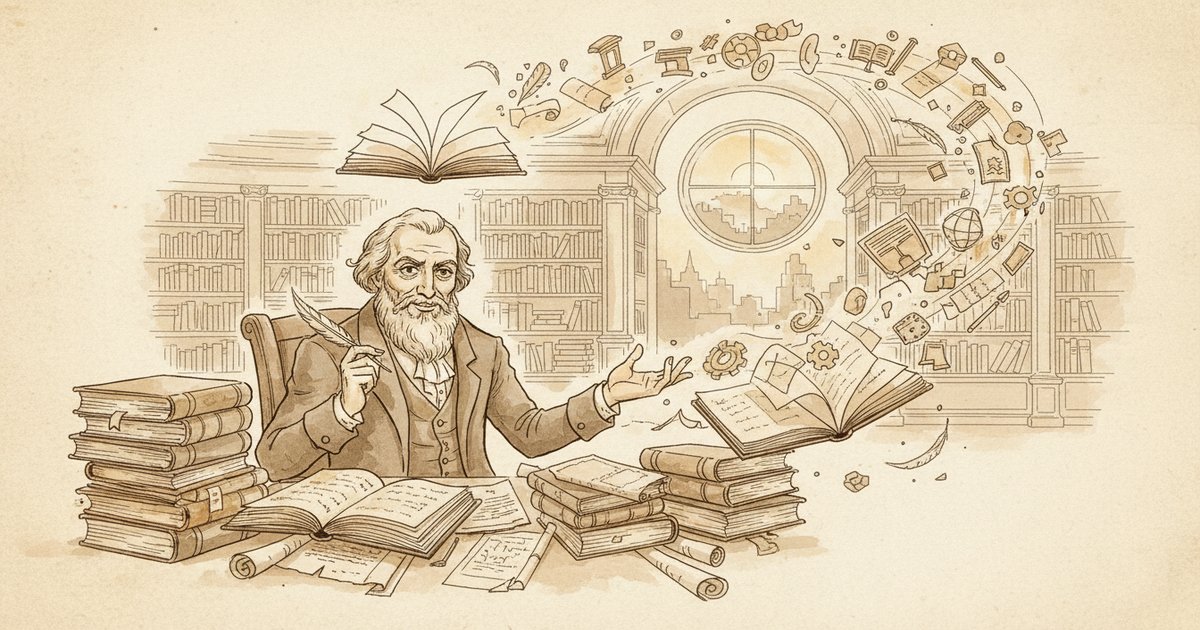
In January 1759, Voltaire smuggled a manuscript out of his estate near Geneva and onto the press. He was sixty-four, officially retired from Paris after two imprisonments and decades of exile, and France’s censors had been watching him for thirty years. The book appeared anonymously. Within weeks it had been condemned by the Paris parlement, banned in Geneva, and reprinted in a dozen pirated editions across Europe. Everyone knew who wrote it. Voltaire denied it absolutely. He called Candide “a little piece of schoolboy nonsense.”
That denial is the whole argument in miniature. Voltaire did not write to liberate France through solemn manifestos. He liberated it by making things funny — so obviously, so irreversibly funny that the authorities looked ridiculous trying to stop them. Candide alone is barely a hundred pages. It kills a man, resurrects him, kills him again, and makes you laugh every time. The thesis of this collection is not that Voltaire was wise. It is that he was dangerous, and the weapon was a grin.
The works gathered in The Voltaire Collection: Vol. 1 — Candide, Zadig, Micromégas, and the philosophical tales — show that weapon in full. These are not museum pieces. They are dispatches from a man who understood that ridicule outlasts argument, that a well-aimed joke survives a bonfire, and that laughter, properly deployed, is the one thing a censor cannot burn without looking exactly as stupid as the joke said he was.
The Man Who Made Exile His Office
François-Marie Arouet was born in Paris in 1694 and spent most of his life being punished for it. He adopted the pen name Voltaire around age twenty-four — likely to distance himself from a father who disapproved of his writing — and almost immediately earned eleven months in the Bastille for verses mocking the Regent of France. The Bastille gave him time to finish his first tragedy. He emerged with a completed play and a sharper tongue.
When he was exiled to England in 1726 after a beating arranged by the Chevalier de Rohan (who took offense at Voltaire’s wit and had better connections), Voltaire spent three years reading Locke, watching Newton’s funeral, and absorbing the idea that a society could run on reason rather than inherited rank. His Letters on the English, published in 1733, told France exactly what England had figured out. It was banned immediately. This matters because every major text in this collection is the work of a man who had learned, through repeated physical consequence, that ideas are dangerous — and who kept writing anyway, faster, sharper, and funnier each time.
He eventually settled at Ferney, just inside the Swiss border, close enough to France to influence it and close enough to Geneva to flee. He ran the estate like a small kingdom: manufacturing watches, hosting philosophers, writing six thousand letters, and producing a stream of anonymous pamphlets and tales that flooded France at a rate no censor could contain. The geography was the philosophy. He built himself a position from which he could not be easily silenced, then refused to be silent.
The scale of what Ferney represented is worth pausing on. By the 1760s, Voltaire was not merely writing from safety — he was actively campaigning. The Calas affair of 1762, in which a Protestant merchant was tortured and executed by the Catholic authorities of Toulouse on fabricated charges of murdering his son, drove Voltaire into a three-year public campaign that ultimately resulted in the verdict being overturned. He did not write a pamphlet and move on. He wrote dozens, coordinated letter campaigns across Europe, and lobbied anyone with power who would listen. It worked. The Calas family was exonerated in 1765. That is the man behind the jokes in this collection — someone who understood that wit was not a hobby but a lever, and who pulled it hard enough to actually move things.
What the Lisbon Earthquake Gave Voltaire
On the morning of November 1, 1755 — All Saints’ Day — an earthquake struck Lisbon and killed somewhere between thirty and sixty thousand people in minutes. Many of them were in church. The fires and tsunami that followed destroyed most of what the earthquake had left standing. It was the deadliest natural disaster Europe had seen in recorded memory, and it landed directly in the middle of an ongoing philosophical debate about whether God’s creation was, as Leibniz had argued, the best of all possible worlds. If this was the best possible world, people asked, what exactly would a worse one look like?
Voltaire wrote a poem about the earthquake almost immediately, and four years later he folded the disaster into Candide with characteristic precision. Candide and Pangloss arrive in Lisbon just as the earthquake hits. Pangloss explains to a sailor, as bodies are pulled from rubble around them, that this is all part of the general good. The sailor responds by getting drunk. Pangloss is shortly arrested by the Inquisition and hanged — partly, the text explains, because the Lisbon theologians had concluded that a public auto-da-fé was the best available method of preventing future earthquakes. Voltaire does not argue against this. He simply describes it. The joke and the horror occupy the same sentence, and the reader does the work of understanding what that juxtaposition means. Candide is not a response to Leibniz. It is a response to Lisbon, with Leibniz held up as exhibit A for why optimism is not just wrong but indecent in the face of what actually happens.
What the Tales Actually Do
Candide opens with its hero being expelled from a castle — a paradise built entirely on a lie — and proceeds to destroy every philosophical comfort available to an eighteenth-century optimist. The character Pangloss, who insists that everything happens for the best in this best of all possible worlds, watches his student suffer earthquake, war, inquisition, slavery, and shipwreck, and keeps explaining it away. Voltaire gives Pangloss the most logical arguments and the most obviously wrong conclusions. The cruelty is precise: the philosophy is never answered directly, only illustrated until it collapses under the weight of what actually happens to people. The final line — “we must cultivate our garden” — arrives not as consolation but as the only honest alternative to nonsense. Do the work in front of you. The world does not have a good explanation.
Zadig is quieter but no less lethal, tracking a man in ancient Babylon whose good judgment consistently ruins his life while stupidity and flattery are rewarded around him. Micromégas sends an alien of enormous size to examine human beings and finds them, after much effort, philosophically negligible but very pleased with themselves. Each tale works the same muscle: it makes the reader laugh at a system, then leaves the reader sitting with what the laughter has uncovered. A good translation matters here precisely because the timing has to land. Voltaire’s comedy is structural — the joke is in the sentence’s shape, the way a monstrous thing is described in the mildest possible register — and a flat rendering turns satire into summary. The translation we recommend keeps the blade where Voltaire left it.
The episode in Micromégas that sticks longest is near the end, when the giant alien, having traveled across galaxies to study humanity, finally communicates with a group of philosophers on a ship. He is charmed by their intelligence and curiosity. He promises them a book that will explain the meaning of everything. When the book arrives, the philosophers open it to find only blank pages. Voltaire published this in 1752. The joke is about systems of thought that promise total explanation and deliver nothing verifiable — but it is delivered so gently, so apparently without malice, that the reader laughs before registering what exactly has just been described. That is the method, repeated across every tale in this collection: the form is a gift, the content is a charge.
Why the Satire Still Has Teeth
It would be convenient to read Candide as a period piece — a document of eighteenth-century arguments about theology and optimism that no longer apply. That reading does not survive contact with the text. The targets are specific enough to be historical but general enough to be current: the bureaucrat who enforces rules he knows to be absurd, the intellectual who explains catastrophe as secretly beneficial, the institution that punishes criticism more harshly than the behavior the criticism describes. These figures are not extinct. They are recognizable in any week’s news.
What keeps the satire alive is not that the targets have survived but that the method has. Voltaire’s technique — describe the outrage in the flattest possible tone, let the reader supply the moral — turns out to be uniquely resistant to the thing it is criticizing. You cannot argue back against a deadpan description. There is nothing to refute. When Pangloss explains, in the aftermath of an auto-da-fé, that the execution of innocent people was “necessary” and that “private misfortunes make the public good,” the reader does not need Voltaire to say the words “this is wrong.” The gap between the claim and what the reader has just witnessed does all the work. That gap is still there, still functional, and still funny — which is to say, still devastating.
Why This Translation
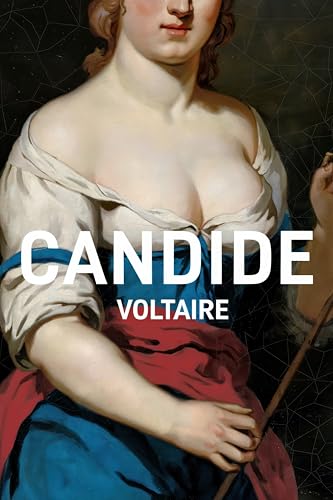
Voltaire has been translated often enough that the question is always which version trusts the reader. The best ones render him as he actually wrote: economically, with a dry precision that makes the absurdity visible without explaining it. This collection brings that register into contemporary English without updating the vocabulary into cuteness or softening the ironies into parable. For readers coming to Voltaire for the first time, it is the most direct line to what made these texts genuinely threatening. The Voltaire Collection: Vol. 1 is available in paperback here — the laughter is included, and so is the blade.
The specific challenge with translating Voltaire is that his sentences do two things at once: they move the story forward and they deliver the joke, usually in the same clause. Older translations — including the widely circulated nineteenth-century versions — tend to let the narrative momentum win, rounding off the irony in the process. The edition featured here holds both. When Pangloss explains that syphilis is a net positive because it allowed Europe to receive chocolate and cochineal from the New World, the sentence has to be delivered with exactly Pangloss’s sincerity and exactly Voltaire’s contempt, simultaneously, without editorializing. Lose either register and the scene flattens into either buffoonery or lecture. This modern English edition keeps the tension in the right place — which means it keeps the joke, and the joke is the argument.
Also worth reading
What is the best English translation of The Voltaire Collection: Vol. 1?
For readers coming to Voltaire for the first time, The Voltaire Collection: Vol. 1: New Translation stands out as one of the most accessible modern English editions available. Unlike older Victorian-era translations that preserve archaic phrasing at the expense of clarity, this version renders Voltaire’s wit, irony, and philosophical sharpness in natural contemporary prose—making it the practical first choice for general readers, book clubs, and students who want the full force of Voltaire’s voice without a dictionary of antiquated idioms at their side.
Is The Voltaire Collection: Vol. 1 worth reading in 2026?
Voltaire wrote against dogmatism, institutional corruption, and willful ignorance—targets that have not gone out of season. The Voltaire Collection: Vol. 1 gathers works that dissect power and credulity with a precision that reads less like historical literature and more like pointed contemporary commentary. In 2026, when misinformation cycles in hours and ideological rigidity shapes public discourse, Voltaire’s core argument—that reason, humility, and skepticism are civic virtues—lands with fresh urgency. This translation makes that argument available to anyone willing to spend an afternoon with it.
How does The Voltaire Collection: Vol. 1 compare to Candide: A New Translation?
A standalone Candide: A New Translation gives readers Voltaire’s most famous work in depth, often with scholarly apparatus—footnotes, critical introductions, contextual essays. The Voltaire Collection: Vol. 1 trades that vertical depth for horizontal breadth, presenting Candide alongside other works so readers can see Voltaire’s recurring preoccupations—religious hypocrisy, optimism, the social contract—develop across multiple texts. If you want Candide studied closely, a dedicated edition serves that purpose; if you want to understand Voltaire as a writer rather than a single satirical set-piece, the collection is the stronger choice.
What should I read after The Voltaire Collection: Vol. 1?
Readers who enjoy Voltaire’s blend of social critique and narrative momentum tend to move naturally toward other pillars of French and European literature. The Hunchback of Notre-Dame: A New Translation in Modern Accessible English, available at classicsretold.com, offers Victor Hugo’s panoramic vision of Paris—morally complex, richly atmospheric, and equally unsparing toward institutional cruelty. For something faster-paced, The Three Musketeers: A New Translation in Modern Accessible English, also at classicsretold.com, channels the same era’s appetite for adventure, loyalty, and political intrigue. Both are rendered in the same clear modern prose that makes the Voltaire volume so readable.
Frequently Asked Questions


Comments
One response to “Voltaire Made Fun of God and Survived”
-
[…] Candide — where the tradition begins […]
Leave a Reply